
Written by Ed Green
When a 2023 survey posed the question, “Who was Taiwan’s best president?”, the figure who came out on top was Chiang Ching-kuo (蔣經國), the president of the Republic of China (Taiwan) from 1978 to 1988. According to this survey, the public of this vibrant, pluralist East Asian democracy chose the autocratic son of the warlord Chiang Kai-shek (蔣介石) as their favourite leader. As Taiwan grows ever more vulnerable under the looming shadow of a rising China, whose government is committed to asserting its sovereignty over Taiwan by any means necessary, why did the Taiwanese public choose not only an autocrat, but a committed Chinese nationalist, wedded to a dream of reunification, as their most favoured leader?
In the current age of rising authoritarianism, the character of Chiang Ching-kuo, an autocratic democrat, stands out from the pages of twentieth century history as a complex, reforming visionary, who successfully led his country from being a totalitarian relic of the Second World War to being a thriving, open, and autonomous liberal democracy. As the eldest son of the Chinese Nationalist leader Generalissimo Chiang Kai-shek, Ching-kuo’s early life does not presage the crucial role he would come to play in Taiwan’s democratic transition. Ching-kuo was sent to the USSR to study in 1925, whereupon he received a Marxist, revolutionary education at Moscow’s Sun Yat-sen University. With classmate Deng Xiaoping (鄧小平), the future architect of modern China and instigator of the 1989 Tiananmen Square Massacre, he would join the Communist Youth League and be one of its most active members as a self-proclaimed Trotskyite.
However, back in the Republic of China, Ching-kuo’s generalissimo father would turn on the Chinese communists in a violent purge in 1927, as a consequence of which Ching-kuo was kept sequestered in a Siberian steel factory, forbidden to return to China until 1937. During his time as a hostage in the Soviet Union, Ching-kuo gained not only a wife and son, but also a teleological conviction in the inevitable collapse of communism, a belief that he would later see vindicated during his presidency in the 1980s.
Upon his return to China, Ching-kuo held various positions in the Chinese Nationalist Party (KMT) regime, where his Soviet-inspired policies often achieved considerable successes. In 1949, as the mainland fell to Communist forces, he followed his father as the KMT government fled to its permanent exile on the island of Taiwan. As Chiang Kai-shek’s regime imposed martial law, transforming the island into a fortress from which he would prepare a reconquest of the mainland, Ching-kuo presided over the fragile regime’s secret police and the subsequent ‘White Terror’ it prosecuted over the civilian population of the island, which would end up claiming thousands of lives over multiple decades.
As his father Chiang Kai-shek aged, so too withered his perennial dream of reconquering the Communist-held mainland. As the Generalissimo’s death neared, Chiang Ching-kuo assumed greater responsibility, becoming Premier in 1972 and thereupon its de facto leader. Chiang Kai-shek died in 1975, with Yen Chia-kan (嚴家淦) carrying out the remainder of his presidential term. In 1978, the “ten thousand year” legislators of the National Assembly, the mainlander representatives elected before the flight to Taiwan, unanimously chose Chiang Ching-kuo as the new president of the Republic of China. Upon his elevation, Ching-kuo refused the titles of 領袖 “leader” and the royal exclamation 萬歲 “long live” that had been used to address his warlord father and other Chinese leaders down to the imperial past. The reason was that this was, according to Ching-kuo, an age of democracy, and he was not only a common citizen, but a civilian president, a common party member. In 1978, Chiang Ching-kuo, despite being an architect of the ‘White Terror’, had the goal of democratisation and reform in mind.
In fact, the reasons for democratisation were obvious. In 1978 Taiwan was facing nothing less than an existential crisis. In a process initiated by the Nixon-Kissinger partnership in Washington, the poles of Cold War great power relationships were in flux; the United States had allowed the ROC’s seat at the UN to be stripped away in 1971, and in 1978, the USA was on the cusp of recognising the communist People’s Republic of China as the ‘One China’ over its erstwhile ally, the rump nationalist regime on Taiwan. The coup de grâce came on 1 January 1979, when the USA officially de-recognised the Republic of China, leaving the regime diplomatically isolated and vulnerable. In the short term, Chiang responded by putting the security services on high alert, implementing a curfew, and calling off the scheduled elections. However, Chiang had a long-term vision meant to safeguard Taiwan’s autonomy amid diplomatic crisis: the KMT regime would have to reform, turning Taiwan into an internationally important political and economic model in order for it to survive as an independent actor into an uncertain new age.
By Chiang’s death in 1988, he would come to view the USA’s derecognition of the ROC as a blessing in disguise. The alliance with the United States continued and was strengthened into the Reagan years, albeit conducted in an informal manner. Chiang’s new model of ‘pragmatic diplomacy’ would focus on the depth and value of the bilateral relation, rather than the superficial recognition of the ROC as the sole Chinese state. With Taiwan’s economic growth continuing at a stratospheric rate, alongside Chiang’s continuing promises for democratic reform, the USA would come to view Taiwan as a genuinely important partner in economic and political matters.
Fundamentally, the sense of crisis in 1979 gave Chiang the impetus to phase out the mainlander-dominated, Civil War era ancien régime, whose entire sense of legitimacy collapsed alongside its mantle to be the ‘One China’. To shore up the government’s legitimacy, the instruments of repression were slowly relaxed, more native Taiwanese were recruited into positions of power, and elections became increasingly competitive and open to non-KMT candidates.
As Chiang’s health began to fail in 1986, his programme of reform went into overdrive. He appointed a committee to study the possibility of lifting martial law, removing the ban on rival parties, parliamentary reform, and increasing Taiwanese representation in the government. When non-party activists illegally formed the Democratic Progressive Party (DPP) later in the year, Chiang chose not to enforce the law, allowing the party to campaign and run in the upcoming elections. In Chiang’s view, if the KMT were to remain relevant, it had to become a popular and democratic party, able to compete with opposition forces in elections. The high level of support the KMT received in the 1986 elections vindicated Chiang’s thinking. When by presidential decree the sweeping powers of the government were removed with the lifting of martial law on 15 July 1987, a corner had indisputably been turned.
Chiang’s poor health finally caught up with him in 1988; he passed away on 13 January. His chosen successor was Lee Teng-hui (李登輝), a native Taiwanese, who brought the democratic transition of Taiwan and the KMT to its fruition in the 1990s. The accomplishments of Lee, known as Taiwan’s “Mr Democracy”, are however unthinkable without the bold reforms unleashed by his predecessor.
Chiang’s decision to dismantle the one-party state bequeathed to him by his father can not only be viewed through the lens of relations with the USA, but also through the relationship with China, as well as the zeitgeist of the wave of democratisation of the late 1980s. Chiang believed that bringing democracy to Taiwan would in turn spread democracy to the mainland, eventually allowing for future reunification under a democratic regime. The liberal currents in the Chinese Communist Party prior to 1989, as well as a multitude of protests that flared up in China in 1986, whereby students demanded free elections similar to those being held in Taiwan, lend credibility to Chiang’s thinking. Democracy was triumphing in Taiwan’s neighbours in South Korea and the Philippines, whose autocratic regimes were being toppled. Democracy was even sweeping over Chiang’s previous home, the Soviet Union, which was under the reforming leadership of Mikhail Gorbachev. Thus, while we may look back on Chiang’s reforms from autocracy towards democracy as an aberration, in his eyes he was riding the crest of the wave of the collapse of authoritarianism across the world.
It is for this reason that in the current climate of resurgent authoritarianism, Chiang’s earnest commitment to lead Taiwan away from autocracy to democracy in a top-down manner seems ever more unique. Chiang’s chequered past – Soviet-educated revolutionary, the son of a totalitarian warlord, prosecutor of the ‘White Terror’ – may lead us to doubt his personal commitment to liberal democracy. Instead, Chiang’s commitment to democratic reform can be considered to be a relic of a not-too distant past where democracy was viewed as the inevitable future. However he may be assessed, his legacy is the Taiwan we see today: vibrant, autonomous, rich, democratic, and free.
Bibliography:
Hsiung, James C. “Diplomacy against Adversity: Foreign Relations under Chiang Ching-kuo.” In Asian Affairs: An American Review, Summer, 2000, Vol. 27, No. 2, 111-23. Abingdon: Taylor & Francis, Ltd, 2000.
Larin, Alexander and Alexander Lukin. Chiang Ching-kuo’s Life in the USSR and Its Possible Formation of His Worldview. Taipei: 蔣經國總統資料庫, 國史館, 2021.
Lorenzo, David J. Conceptions of Chinese Democracy: Reading Sun Yat-sen, Chiang Kai-shek, and Chiang Ching-kuo. Baltimore, MD: John Hopkins University Press, 2013.
Olivier, Jeremy. “Re-evaluating the legacy of Chiang Ching-kuo.” The News Lens, 26 April, 2017, https://international.thenewslens.com/article/66904, accessed 10/03/2024.
Rubinstein, Murray A. “Political Taiwanization and Pragmatic Diplomacy: The Eras of Chiang Ching-kuo and Lee Teng-hui, 1971-1994.” In Taiwan: A New History, edited by Murray A. Rubinstein, 535-605. Abingdon: Routledge, 2007.
Taylor, Jay. The Generalissimo’s Son: Chiang Ching-kuo and the Revolutions in China and Taiwan. Cambridge, MA: Harvard University Press, 2000.
Thomson, Jono. “Taiwanese rate authoritarian leader Chiang Ching-kuo best president.” Taiwan News, 6 June, 2023. https://www.taiwannews.com.tw/en/news/4925765, accessed 23/01/2024
Tien, Hung-Mao. The Great Transition: Political and Social Change in the Republic of China. Stanford, CA: Hoover Institution Press, Stanford University, 1988.
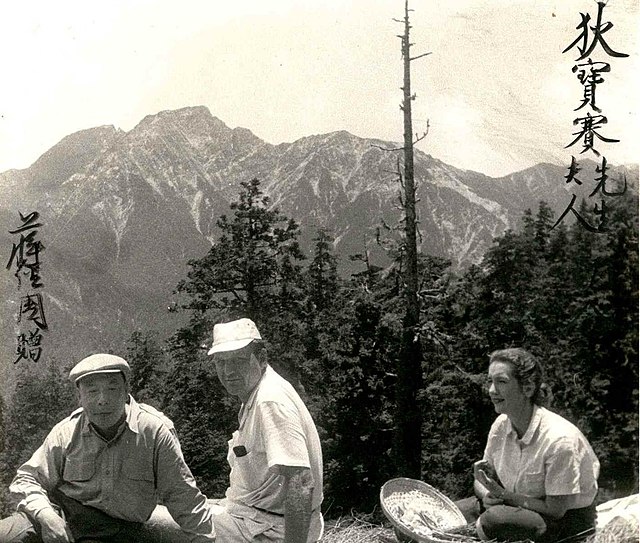
Featured Image Credit: 中文(臺灣):行政院國軍退除役官兵就業輔導委員會主任委員蔣經國與狄寶賽夫婦在踏勘中部橫貫公路途中休息。, circa 1955

