
Written by Harry Fry
‘I paint myself because I am often alone and I am the subject I know best’
Frida Kahlo.
Is it ever possible to construct a portrait of a woman that is entirely favourable to the subject? This portfolio includes female ‘image-makers’ conveying the limitations of their agency – Autoportrait by Tamara de Lempicka and X-Ray of M. O.’s Skull by Meret Oppenheim – as well as a female and male ‘image-maker’ unintentionally representing a woman poorly – Anna May Wong by Dorothy Wilding and Portrait of Adele Bloch-Bauer I by Gustav Klimt. Lempicka and Oppenheim portray themselves, purposely emphasise a woman’s constraints, whereas Wilding and Klimt accidentally do so. From their underlying difficulties in representing a powerful woman, this portfolio suggests it perhaps cannot be done. Whether these images decorate their subject’s portrait heavily, these stylistic decisions – glamorous and ordinary – all display women, and their lives, as bounded. They present manipulation, almost performance, of the female body, notably, directing women’s hands. While certain knowledge is limited to the female experience, this essay will use race as a factor in displaying how female ‘image-makers’ can be flawed. Ultimately, female ‘image-makers’ largely surpass male ones in portraying women, yet divergences exist amongst female artists’ representations of their own gender.
Klimt, Gustav. Portrait of Adele Bloch-Bauer I ‘The Woman in Gold’, 1907, Neue Gallerie, New York (Fig. 1).
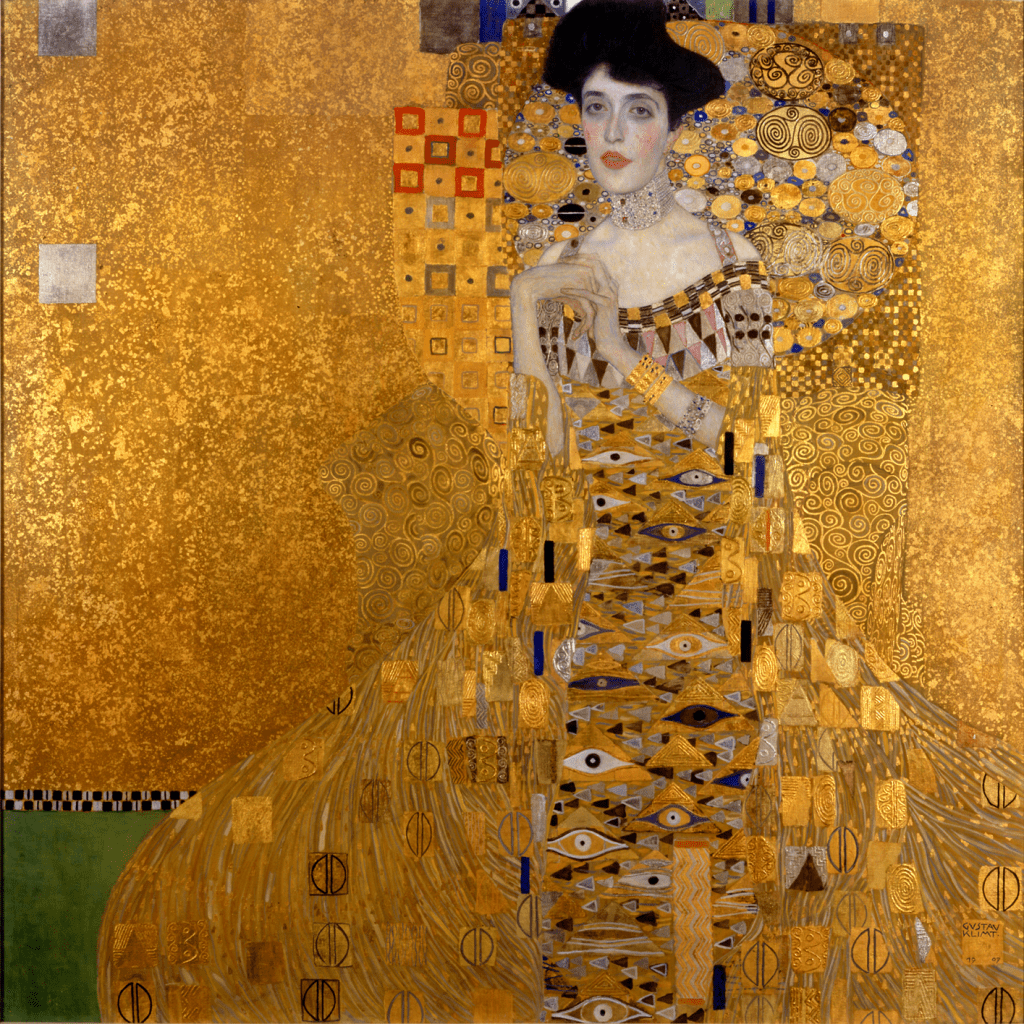
The portrait of Adele ‘The Woman in Gold’ is a male attempt to paint female agency. Klimt styles Adele in a tight dress and choker, consumed by gold symbolic of wealth (Fig. 1). The sitter represents a successful Viennese family and this gold leaf illustration of her is meant to be favourable and glamorising. However, Klimt’s attempts instead follow typical objectifying depictions of spotlighted women, which demonstrates their frequent sexualisation in visual representation. This impedes the portrait’s ability to be a progressive representation, as while this tall, gold, painting indicates a sense of autonomy, O’Connor notes that Adele appears more vulnerable than powerful. Thompson argues that “one comes across the model almost by accident”, as Adele appears to be an afterthought to his luxurious background. Indeed, Adele is represented as virtually entrapped within her family’s wealth, and her unsettled facial expression suggests she is perhaps unable to handle these surroundings; or rather, as if she merely is an ornament and not her own identity. Being an established artist in his lifetime, Lynne notes that only retrospective scholars have begun robustly critiquing Klimt’s objectification of women: in Adele’s portrait, he implicitly makes her autonomy only seem viable through sexual undertones and heavy decoration.
Lempicka, Tamara de. Autoportrait (Self-Portrait in a Green Bugatti), 1928, Private Collection, Switzerland (Fig. 2).

In Lempicka’s self-portrait, she emphasises the unattainable nature of female agency. With a Bugatti, fashionable clothing, and a confident expression, Lempicka appears successful: her hand is assertively placed on the wheel (Fig. 2). However, despite this facade, Lempicka intentionally paints herself for German Die Dame fashion magazine as living a hoax life. In reality, her own unimpressive car was stolen and the steering wheel of her fabricated Bugatti is on the wrong side. Lempicka purposely makes her representation inaccurate, subverting this magazine’s goal to showcase the New Woman. In contesting women’s struggle to reach true prosperity, Lempicka emphasises the conditions high-profile women must follow: luxury and glamour. This indicates that wealth and beauty parallel female power and, in conjunction with Klimt’s Adele, women only grasp this agency when their accessories are the focus. Further, this agency is restricted, as Lempicka shows in this portrait that many women can only pretend to own sufficient resources. Nochlin finds ‘artist’ to be a solely masculine title. She believes that unlike male attempts, novel female art will never be appreciated for the depth of knowledge it contains. Lempicka plays on this concept through outwardly displaying a flawed image of female power, yet simultaneously her work proposes that women need to be unorthodox in their artwork to receive the title of ‘artist’.
Oppenheim, Meret. X-Ray of M. O.’s Skull, 1981, The Museum of Modern Art, New York (Fig. 3).

In Oppenheim’s X-Ray of herself, she mimics the first recorded x-ray where a scientist accidentally captured his wife’s left hand and ring. Oppenheim highlights the unintentional symbolism of this event, affirming the role of jewellery in visually representing gender. With a blurred, gender-neutral body, in this piece jewellery clarifies and assigns her gender (Fig. 3). The earrings and rings captured are distinctly feminine, demonstrating embedded societal gender stereotypes. Her gender identity is formed by these accessories, asserting the gender binary in depictions of women. Men can largely be represented with a blank canvas, whereas women must be accessorised in every form of portrait; in Adele and Lempicka’s case, becoming secondary to their appendages. This X-Ray runs parallel to Mulvey’s concept of human pleasure being made through observation, especially of the unconventional. Oppenheim’s skeletal features create a sense of discomfort, yet this encourages intrigue and inspection. This begins to connect with Freud’s more radical perspective regarding the potential for the abnormal to fulfil our desires, but more importantly justifies that an unorthodox representation of a woman is frequently the standard in female portraiture. Tying into Butler on gender as performative, male ‘image-makers’ think simplicity is insufficient and female ‘image-makers’ often contain their depictions within the same box. Ultimately, the extreme formats of femininity and the necessary criteria to be a woman are presented.
Wilding, Dorothy. Anna May Wong, 1929, National Portrait Gallery, London (Fig. 4).
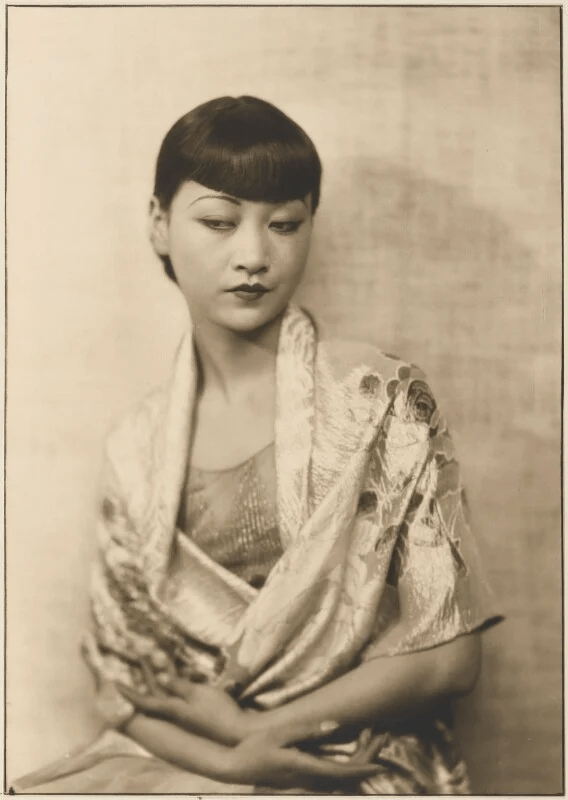
While it is common habit to argue female ‘image-makers’ will, to an extent, always design women well, artists such as Sherman have challenged these notions, asserting that all genders can accidentally present women within societal expectations. However, race is limitedly viewed as a factor in this dynamic. Wilding, a seasoned celebrity artist, photographed Anna May Wong, becoming an exemplary image of Hollywood’s first Chinese-American actress. In this black and white format Anna appears uninviting and as if she is missing something (Fig. 4). Her hand positioning connotes the idea that women cannot have their hands resting by themselves plainly but must be in some form of action. Moreover, given her unnatural arrangement facing away from the photographer and with her posture, Anna is captured with sexual undertones. These stylistic decisions from Wilding can be viewed as implicit orientalism, where spotlighted Asian women were and are represented with a sense of mystery and difference – foreignness. Anna dressed similarly to American Hollywood stars and not in more unusual silk, floral garments, leading viewers to perceive her as distinctly Asian and not the born and raised American she was. Following Crenshaw’s theory on intersectionality within gender and racial prejudice, this portrait marks a crossroad of issues in female portraiture; trusting female-image makers’ can be damaging.
In reflection, Klimt makes us question whether men are capable of producing a faultless portrait of a woman. While Lempicka and Oppenheim intentionally craft a paradox of female authority, Wilding epitomises female ‘image-makers’ struggling to present women favourably. One must question how women can be depicted powerfully, as the prevailing societal standards set out for women irrevocably falls into how they are visually formatted. Indisputably visible is the usage of women’s hand gestures in attempting to define their agency: Klimt’s and Wilding’s poor representations have their sitters holding their hands in artificial positions, amplifying the way women’s body are posed in motion when depicted. Oppenheim could also be unintentionally probing the significance of hands in her X-ray – it allows rings, often central in female representations, to be featured. Similarly, Lempicka deliberately illustrates her hand on the wheel to portray artificial confidence. However, this assumes women must use their hands to convey meaning, alike to historical female portraits where their body indicates the narrative. Being unable to relax their hands, as their male counterparts do, signifies the root cause of poor representation: complicating their ornamentation and physicality; never standing alone powerfully. As Mulvey argues, noteworthy women in art must be intriguing spectacles, deemed insufficient alone. Although women have an intrinsic understanding of female identity, these severe depictions suggest they are constrained by internalised misogyny, resulting from their patriarchal context. This implies a lack of knowledge in presenting a woman with real agency, regardless of the image-maker’s gender.
Traditionally, the criteria for women in power largely followed an established, attractive, and wealthy European image; Klimt latches onto these stereotypes and almost designs his sitter artificially, yet Wilding acts similarly. Klimt’s wealth and Wilding’s race obsession shows a woman’s importance as polarised to single, often shallow identities. Returning to Butler, gender being inherently performative means spotlighted women are presented unusually: Lempicka makes a parody of the Art Deco style, but all these examples present attempts at showcasing novel representations. This suggests that a natural urge to revise depictions only moves female portraiture to inaccuracy. Displaying themselves, Lempicka and Oppenheim can re-evaluate female agency, yet gendered constraints mean even a female ‘image-maker’ will inevitably struggle to portray women flawlessly.
Bibliography
Crenshaw, Kimberle. “Mapping the Margins: Intersectionality, Identity Politics, and Violence against Women of Color”, Stanford Law Review, 43:6, (1991), https://doi.org/10.2307/1229039.
Claire, Jean. “Marcel Duchamp et le dernier tableau”, in Marcel Duchamp: la peinture, meme, (2014), Paris: Centre Pompidou.
Freud, Sigmund. “The Interpretation of Dreams”, The Freud Reader, (1989), New York: Norton.
Lempicka-Foxhall, Kizette and Phillips, Charles. Passion by Design: The Art and Times of Tamara de Lempicka, New York: Abbeville Press.
Lynne, Olivia. Art Lust: Desire and the Work of Picasso and Klimt, Psychoanalytic Perspectives, (2010), 7:2, https://doi.org/10.1080/1551806X.2010.10473093.
Mulvey, Laura. “Visual Pleasure and Narrative Cinema”, Screen, 16:3, (1975), https://doi.org/10.1093/screen/16.3.6.
The Museum of Modern Art. Cindy Sherman, (2014). https://www.moma.org/artists/5392.
Neret, Gilles. Tamara de Lempicka – Deesse de l’ere automobile, (2016), Paris: Taschen.
Nochlin, Linda. “Why Have There Been No Great Women Artists?”, Women, Art, and Power, (1981), New York: Harper and Row.
O’Connor, Anne-Marie, The Lady in Gold: The Extraordinary Tale of Gustav Klimt’s Masterpiece, Bloch-Bauer, (2015), New York: Vintage Books.
Petro, Patrice. Joyless Streets: Women and Melodramatic Representation in Weimer Germany, (1989), Princeton: Princeton University Press.
Thompson, Jan. ‘The Role of Woman in the Iconography of Art Nouveau’, Art Journal, (1971), 31 (2), https://doi.org/10.2307/775570.
 Retrospect Journal