
Written by Ishaabhya Tripathi
Smallpox endures in the collective psyche for two main reasons: the first is the pain, suffering, and death it wrought, and the second is its status as the only infectious disease to be effectively eradicated. In the twentieth century, it is estimated that the variola virus killed over 300 million people worldwide. Whilst the natural origins of the disease are unknown, ancient evidence of its devastating effects exist around the world, with the three-millennia-old, mummified body of Pharoah Ramses V bearing traces of smallpox sores. Humanity’s efforts to control and prevent the disease can be traced back over five hundred years, with written accounts from China describing attempted methods to immunise people against smallpox without being infected. Edward Jenner’s observation of cowpox led to the development of a rudimentary vaccination in the late eighteenth century. This invention formed the foundation of a process that culminated in the eradication of smallpox in 1970, an event widely considered the greatest public health success in history.
There were two strains of the variola virus that caused smallpox. Variola major, the most common form, produced the most severe and deadly strain of smallpox with a mortality rate of 30%, whilst the milder variant variola minor had a mortality rate of 1%. Whilst the exact geographic origin of smallpox is unknown, texts from fourth-century China and seventh-century India describe a disease with smallpox symptoms, which included fever, fatigue, body pain, and a distinctive rash. Smallpox was said to be contagious until the last rashes scabbed over and fell off. This was all integral to early immunisation attempts. ‘Variolation’ was an early method to inoculate people against the disease. In China, scabs from smallpox rashes would be dried in the sun, which weakened the virus. They would then be inserted nasally, a process known as insufflation. Whilst some people would develop a milder form of the illness, it had a significantly lower mortality rate than natural smallpox infections. In the late seventeenth century, the Chinese emperor Kangxi [romanised K’ang Hsi] inoculated his children in this way, after contracting and surviving smallpox in childhood. In India, variolation involved using a needle or a lancet to inject healthy people with pus from smallpox lesions. However, the main medical breakthrough came in 1796, when British physician Edward Jenner observed the effects of cowpox in milkmaids. Cowpox was a disease, much milder than smallpox, that spread to humans through direct contact with cattle. Like smallpox, it also caused skin lesions. Edward Jenner noticed that milkmaids who contracted cowpox didn’t develop smallpox. Jenner knew about variolation and sought to use cowpox as a safer ‘base’ for inoculation. He injected a nine-year-old boy with material from a milkmaid’s cowpox sores. The child didn’t develop smallpox even after later being exposed to the variola virus, proving that Jenner’s immunisation method worked. The word ‘vaccination’ comes from this experiment, stemming from the Latin word for ‘cow’: vacca.
Jenner’s method was used to inoculate people around the world, but it wasn’t till the mid-twentieth century that global eradication became a feasible goal. The World Health Organisation launched the initiative in 1959. Eradication was defined as the total elimination of the disease, with no chance of reintroduction. Through vaccination, smallpox had already been eliminated from western Europe, Japan, and North America in the early 1950s, but the initial eradication programme wasn’t hugely successful, with smallpox still being endemic in South America, Africa, and much of Asia in 1966. An estimated 10 to 15 million people caught smallpox in 1967: the same year that the WHO launched another eradication campaign that was more intensive and thorough than the first. Heat-stable, freeze-dried smallpox vaccines developed in the 1950s were crucial to this effort, since they didn’t need to be refrigerated for long-term storage. The Soviet Union provided these vaccines for the eradication campaign. They formed the foundation of smallpox eradication in India, China, and eastern Europe. Another essential component was the detection and close monitoring of smallpox outbreaks. The last naturally occurring case of variola major was in Bangladesh in 1975; Rahima Banu was a toddler when she contracted the deadlier strain of smallpox, but survived and made a full recovery. The last ‘wild’ case of variola minor was in Somalia in 1977. Ali Maow Maalin contracted the disease because he hadn’t been vaccinated, even though he worked in a hospital. After recovering from smallpox, he became a campaigner for polio vaccination.
Smallpox was declared eradicated on May 8, 1980. Some sources today write that ‘smallpox was an awful disease’, or that ‘smallpox killed millions of people’. It is an incredible privilege to be able to refer to it in the past tense, a privilege that wouldn’t exist if it wasn’t for vaccination. It’s also one that was very recently granted, with the last naturally occurring cases being less than fifty years ago. History is not as far from us as we tend to think. In the time of pandemics and rising measles cases, it is especially important to remember that.
Bibliography
World Health Organisation, “History of Smallpox Vaccination”, https://artsandculture.google.com/story/qAURxyAnf5tcXg
World Health Organisation, “Smallpox: Overview”, https://www.who.int/health-topics/smallpox#tab=tab_2
Centers for Disease Control and Prevention, “History of Smallpox”, https://www.cdc.gov/smallpox/history/history.html
National Geographic, “Smallpox”, https://www.nationalgeographic.com/science/article/smallpox
World Health Organisation, “Smallpox”, https://www.who.int/teams/health-product-policy-and-standards/standards-and-specifications/vaccine-standardization/smallpox#:~:text=Two%20forms%20of%20the%20disease,a%20mortality%20rate%20of%2030%25.
Hollingham, R, “The chilling experiment which created the first vaccine”, 29.9.20, BBC Future, https://www.bbc.com/future/article/20200928-how-the-first-vaccine-was-born
History of Vaccines, “Smallpox: Variola”, https://historyofvaccines.org/history/smallpox/timeline
Najera, R.F., “The History of Variolation”, History of Vaccines, 5.6.21, https://historyofvaccines.org/blog/the-history-of-variolation
Kanda, N. “Kangxi: emperor of Qing Dynasty”, 16.12.23, Encyclopaedia Britannica, https://www.britannica.com/biography/Kangxi
Männikkö, N. “Etymologia: Variola and Vaccination”, 2011, National Library of Medicine, https://www.ncbi.nlm.nih.gov/pmc/articles/PMC3377431/
World Health Organisation, “Smallpox Eradication Programme – SEP (1966-1980)”, 1.5.20, https://www.who.int/news-room/feature-stories/detail/the-smallpox-eradication-programme—sep-(1966-1980)
Belongia, E.A. & Naleway, A.L., “Smallpox Vaccine: The Good, the Bad, and the Ugly”, 2003, National Library of Medicine, https://www.ncbi.nlm.nih.gov/pmc/articles/PMC1069029/#:~:text=The%20modern%20vaccine%20was%20conceived,long%2Dterm%20storage%20without%20refrigeration.
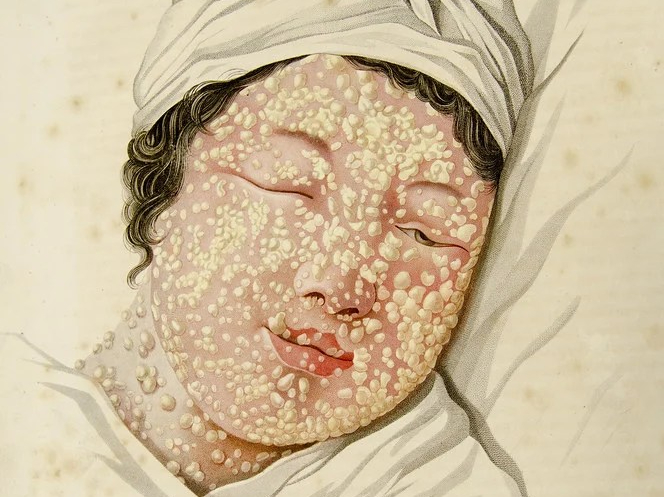
Featured image credit: “variola, or smallpox” by liverpoolhls is licensed under CC BY-SA 2.0.

