
Witten By: Meenakshi Nirmalan
By the early twentieth century, cinema as an art form began to gain traction. Technological advancements were forwarded in the production and distribution of film — enhancing the medium’s popularity. The Lumière brothers brought cinema to Moscow and St. Petersburg for the first time in May 1896, showing various screenings of new motion pictures. It was shortly after this, that the cameraman for the Lumière brothers recorded the coronation of Tsar Nicholas II at the Kremlin, marking the first recorded motion picture made in Russia.
In the October Revolution that marked an end of Tsar Nicholas II’s reign and the establishment of Bolshevik power, it was soon realised that cinema was a powerful medium to deliver propaganda. Subsequently, Bolshevik leader Vladimir Lenin nationalised film, which forced private companies to dismantle themselves. Cinema became a form of Agitprop, or political propaganda, which served to spread a particular message. In 1919, the Moscow Film School was established, where the director Lev Kuleshov taught courses on film production and editing. Due to a national shortage of film stock, educators were forced to become more creative in their approaches to teaching. As a result, students were encouraged in Kuleshov’s lessons to edit and re-edit existing foreign cinematic works, such as The Birth of a Nation, directed by D. W. Griffith in 1915. He tasked them with moving around the order of frames and shots, altering the structure, which emphasised how a film’s form enhanced its overall meaning. Taking this approach revealed that the shots were not evaluated in isolation, each shot was viewed in relation to the shots before and after it, drastically influencing their meaning.
Among his many works, Kuleshov edited a short film in which he took a shot of the silent film actor Ivan Mosjoukine. He then juxtaposed the same frame with multiple shots of Mosjoukine’s face with a neutral expression. The shot was followed by firstly, a bowl of soup, then a coffin, and finally, a shot of a woman. It was reported that people interpreted his facial expression differently, based on the following shot: when the soup followed, people saw hunger, for the coffin, grief, and for the shot of the woman, lust. Through this experiment, Kuleshov highlighted that although the shot is the same, Mosjoukine’s expression seemed to change based on what followed. Interplay between the shots was where meaning truly was derived from, pioneering Soviet Montage Theory and the Kuleshov Effect.
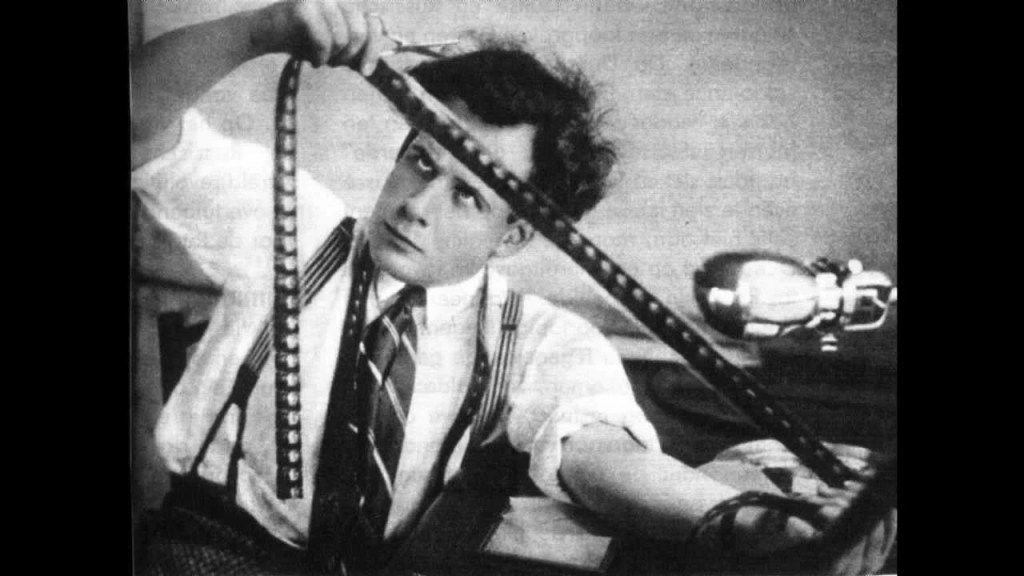
As a result of Kuleshov’s influence, a more intentional approach to editing and Soviet Montage Theory can be seen throughout Soviet era film. Sergei Eisenstein, one of Kuleshov’s students, notably used this editing style in his film Strike. The film does not take the conventional approach of having a main character, rather, it is seen through the eyes of a large group of people. In shedding light on the workers striking due to poor treatment and unfair wages, the film emphasises the importance of the role of workers – as factories are pushed into a state of disorder in their absence. Towards the end of the film, Eisenstein juxtaposes a shot of striking workers protesting with a shot of a bull being slaughtered. The pairing of these two shots within the same sequence illustrates the Marxist message of the film. The metaphor conveys the workers being taken advantage of and treated like cattle by their management, who are painted in a malevolent light due to the comparison to bull slaughterers. The interplay between shots is what creates meaning. Moreover, the influence of Kuleshov’s theories can be seen across Eisenstein’s work and Soviet Montage continues to influence contemporary cinema today.
Bibliography
Film & Media Studies, 2021. Kuleshov, Eisenstein, and Soviet Montage Theory. [Online]
Available at: https://www.youtube.com/watch?v=Mh3e-AjC51Q
[Accessed 11 Dec 2023].
Filmmaker IQ, 2014 . The History of Cutting – The Soviet Theory of Montage. [Online]
Available at: https://www.youtube.com/watch?v=JYedfenQ_Mw
[Accessed 11 Dec 2023].
No Film School, 2017. How Soviet Cinema Gave the Movie Camera its Eyes. [Online]
Available at: https://www.youtube.com/watch?v=Py4IE-yFHgo
[Accessed 11 Dec 2023].
Strike. 1925. [Film] Directed by Sergei Eisenstein. Russia: Mosfilm.

