
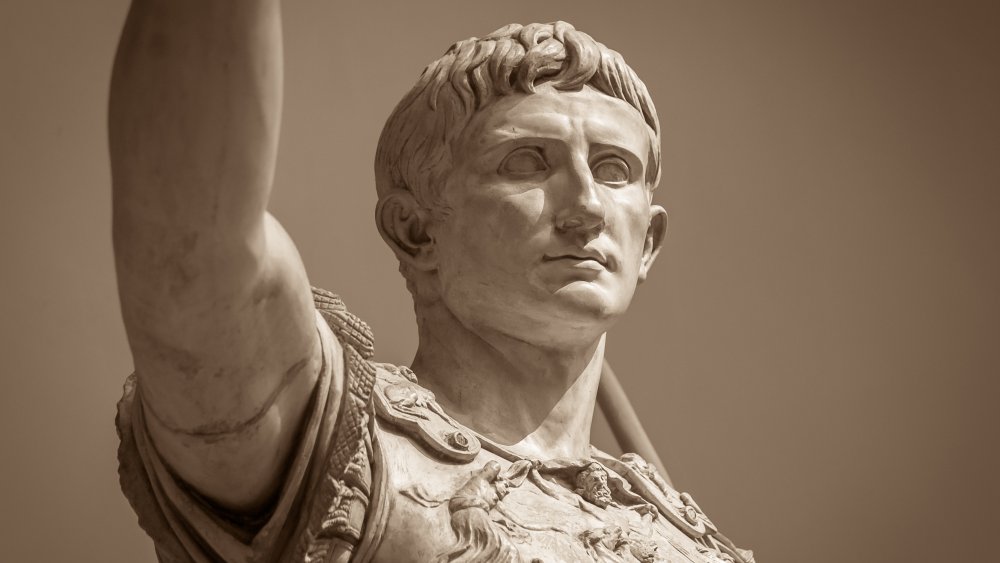
By Oscar Virdee
Dawn broke over the Palatine hill. Sunbeams cut through the luminous black night like a legion cutting through the enemy. Sunlight struck the marble of Rome; it gleamed like an Aquila.
Two men made their way up the sacred hills towards a large villa. One, a great bull of a man with skin like dried leather from months at sea; across his arms were a web of scars from a life of battle. The large man had his brown hair cut close to his scalp in a military fashion and his face was freshly shaven. The other, pacing more gracefully next to him, wore his hair longer. It shone in the sunlight, having been oiled that morning. A slave beckoned them through the atrium and into a side chamber. Within the chamber, the walls were bare, and the only furnishings were a table with maps of the known world thrown across them. Sitting and poring over the maps was a man with pale skin and blue eyes.
Wearily, he looked up from the maps with more caution than would be expected for a man of his thirty-four years. He walked over to the two men, embracing each one in turn.
“Agrippa,” he spoke softly, and nodded towards the weathered bull, ‘Maecenas’. His cerulean eyes met the eyes of the poet.
“It is good to see you, my brothers. Remember the summer day we first met?”
A smile cracked the weather-hardened leather of Agrippa’s face.
“It was at Brindisi as we waited for passage to Apollonia.”
“Gods, do you remember the stench of the ship that carried us across?” Maecenas wrinkled his nose at the bitter-sweet memory.
“It was awful!” Caesar exclaimed, “The pickled fish must have gone rancid in that heat.”
All three men laughed as they drifted into the memory. The heat had been beating down on them, and when they had finally managed to guard their stomachs against the stench and board the ship, it had nearly sunk as a wave pushed it off the shore.
“My friends,” Caesar said after the laughs had died down across the room, “It is not without purpose that I have called you here.”
Caesar let the words hang in the air as he gestured for wine to be brought to them by a slave who was then ushered out of the room.
None spoke as Caesar poured wine for them from his own hand, an act of great honour. Caesar quickly raised his cup to his lips and drank deeply, a flush spreading across his pale porcelain face. Agrippa and Maecenas copied the gesture. Finally, Caesar severed the tension that had been slowly building in the room.
“My brothers, I want to be king.”
The words had been said quietly, but their meaning was louder than a thunderclap from Jupiter himself. Agrippa put down his cup with a little too much force, spilling wine over the rim and onto the pale maps below. The wine seeped into the coarse canvas. Crimson bloomed like a flower of blood. Agrippa raised his eyes from the wine-stained maps and locked eyes with Caesar, doleful brown meeting indigo flames.
“Octavian,” Agrippa began, using Caesar’s boyhood name. “Rome does not need a king.”
“I will support you in any other form of government. I’m not saying this because I want power. Listen and listen well, Maecenas.”
Agrippa glowered at the poet. “Don’t interrupt me.”
He locked eyes with Caesar.
Octavian stiffened at the hateful memory of a bright day turning black on reading just a few hastily scribbled words.
“Remember how we all swore to you to avenge that great son of Venus? How we defeated his murderers at such a cost to our lives? And the cost to Rome? Remember the illness that nearly cost you your life at Philippi?”
Caesar nodded his head in assent, his eyes closed for a moment as he remembered how helpless he had been. “All of these deeds that we did for revenge will be remembered as if we had done them for our own personal gain.”
Agrippa paused to sip his wine before he resumed his speech.
“All men are created equal within the eyes of the gods, regardless of their faith, creed, or colour. If all men are equal in the eyes of the gods, must they not also be equal in the eyes of the law? Do they an equal right to rule? If you rule over men, you are equal too.”
Agrippa locked eyes again with Caesar, “You would be hated by many, as long as you reign.”
Agrippa pushed himself back from the table, pacing the room slowly as he continued.
“In a democracy, every man wishes the best for his neighbour, as, if one man is honoured, then the whole state is honoured. A man in a monarchy does not think of his neighbours; he thinks of himself and only what the state can do for him. Not what he can do for the state.”
Agrippa paused and massaged his temples. “A darker matter must also be discussed. How shall you punish those that are naturally opposed to the monarchy? Will you have them murdered in their beds? Will you order another wave of proscriptions as Mark Antony forced you to do?”
Agrippa let his words hang in the air for a few moments, knowing Caesar would be thinking back to a miserable day spent sheltering in a hut from the rain. Within the hut, a triumvirate had been formed and proscriptions were made ordering the deaths of two thousand men, many of which Caesar had no quarrel with.
“You must also choose your lieutenants wisely, as they would have to rule in your stead, should you fall ill or should you wish to enjoy mortal pleasures. Roman lands are vast, and one cannot rule over it, all alone.” Agrippa drained his cup again. “Give up whatever power you currently hold before you have the shame of being asked to relinquish it by the senate, and hopefully, you can avoid a tragedy. Remember the fates of Camillus, Scipio, Pompei, Marius, and finally, your own father. All these men met bitter ends when they offended the senate or gave an inkling that they desired to maintain power.”
Agrippa leaned back in his chair and crossed his arms over his chest, indicating that he was done.
Unsurprisingly, Maecenas was the first to speak. “Caesar, I strongly advise you to keep the power that you have gained. You are currently consul for the fifth year, and yet again, you are consul with a senate that is no more than a puppet. It should have already become obvious to those in the senate, that the true power of Rome lies in you.”
Maecenas paused to adjust his well-oiled hair and to drink greedily from his cup of wine.
“Choose your lieutenants carefully in secrecy and haste to preserve the lives of our legionnaires. Handpick your own officers, to avoid civil strife within your ranks.” Maecenas stopped, checking he still had the attention of both the other men in the room.
“You have already decided to be king, and just want to know how to deal with the senate. In my mind, you must expel those who we are convinced would be against our cause and do not covet the health of Rome.”
Maecenas then called for a new jug of wine and drank deeply to soothe his throat.
“Keep the power you have claimed for yourself.”
“Agrippa,” Caesar began, “will you…”
Agrippa interrupted, “I will. I followed you into salt marshes filled with death at Mutina. I followed you in Philippi when you were so weak that you had to be carried in a litter. I raised a navy for you out of nothing more than slaves and scraps of wood. I may not always agree to or understand your plans, but I will follow them. If you wish to reopen the doors of the Temple of Janus and so break the peace that we have fought for, I will stand by you.”
“Thank you, my brother.” Caesar stood up, walked over, and embraced the admiral of his navy.
Breaking the embrace, Caesar turned to Maecenas, “I trust I have your support and your skill with a quill.”
Maecenas inclined his head in answer.
“Good, then we shall do as you say. I must begin a draft of all the senators we wish to expel.”
As Caesar spoke, his blue eyes started to blaze with a blue fire against the pale porcelain of his skin.
“Follow me outside.”
The three men stood as one and walked out past the foundations of a temple that Caesar had started to construct within his grounds. They walked out to where they could see the city of Rome beneath them, a cacophony of market calls, orators, and the smells of the city were carried up to them on a stray breeze.
“This city,” Caesar began in a voice barely louder than a whisper, “shall be ours. We will raise it in glory and construct an empire so vast and strong that it will be remembered for centuries. Let no man or nation stand before us, for if they do, we shall crush them with the might of our Roman empire.”
“Is that to be your title then? Imperator?” Maecenas asked with a wry grin.
“Yes, I like the sound of it. I shall be Caesar, the emperor of Rome,” Caesar answered, and his blue eyes simmered with a godly blaze.

