
Written by Ishaabhya Tripathi
The American coastal city of Malibu has earned the titles of “wildfire capital of North America” and “the fire coast” for the devastating wildfires that it experiences every summer. This weather phenomenon has always occurred, but the development of housing estates on Malibu beach, as well as migration to California in times of greater unemployment, has increased the human impact on the wildfires and what the government could do to control them. The Great Depression caused mass unemployment, which meant that the 1930s saw lots of people moving to California in order to find jobs. In unexpected ways, this resulted in, not only more wildfires, but also a controversy over public versus private ownership of Malibu beach.
Malibu canyon came under private ownership during a time of economic prosperity in the 1880s, when Massachusetts millionaire Frederick Rindge bought it for a purported price of $10 ($324 in today’s money) an acre. A wildfire in 1903 burnt down the farm that Rindge built on this land. Anyone familiar with the area was aware of the immense wildfire risk, caused by the Santa Ana winds, which blew over Malibu a few weeks before the first autumn rainfall and fuelled fire by providing oxygen to the brush fires that spread especially easily due to the flora of the region. Despite the land being functionally inhabitable, Rindge’s wife refused to sell it after his death in 1903; she became known as the “Queen of Malibu” for the ferocity and passion with which she guarded it. May Rindge barricaded the beach with barbed wire and hired armed guards to watch over the territory, giving them a ‘shoot to kill’ order in case any government official tried to seize it. A team conducting a road survey approached Rindge at one point, but they were driven away by these guards, who later had a dispute with California’s deputy sheriffs. May Rindge went to court against the state of California to stop the expansion of California’s road network but was unsuccessful. The construction of the Pacific Coast Highway went ahead, linking the city of Los Angeles to Malibu beach. The industrialisation wasn’t limited to the motorway, because May Rindge had to sell parts of the land as a result of spending so much of her money on the legal fees for her court case. One of the buyers was Jack L. Warner, who turned the lot into Warner Brothers’ Burbank studio. Was this linked to the expansion of Hollywood and the celebrity-studded neighbourhoods of luxury houses surrounding it? It’s certainly possible; even modern sources describe the city of Los Angeles as a “decentred metropolis”, with the beach and its significance in public life detracting from anything in the city’s centre, even though the beach itself is in the outer suburbs. Introducing cars to the region provided a potential fuse for the fires to start, as well as potentially accelerating the commercial and residential development of Malibu beach.
America’s top landscape architecture company, Olmsted Brothers, wanted to set aside the area of Malibu beach as a national park, similar to Yosemite, as open green spaces were supposedly a rarity in Los Angeles County. This plan would have avoided spreading the sparse population of L.A.’s metropolitan area even more thin and reduced the impact of wildfires on human settlements because no one would have been able to build houses on the land. Ultimately, it never came into being for political and commercial reasons. Was the firm’s observation of Los Angeles too damning for the city’s officials to approve it? Olmsted Brothers would control a considerable amount of southern California’s coastline if Malibu were to become a national park—it is theorised that city administrators didn’t want to surrender their influence over it. Additionally, the beautiful coastal landscape and sandy beaches were becoming emblematic of Los Angeles, embedding themselves more and more in the city’s subculture as locals flocked to the seafront. A certain Jack L. Warner buying a plot of land from May Rindge contributed to the urbanisation of southern California—the construction of Warner Brothers studio in Burbank foreshadowed the takeover of the region by film studios. Cinema professionals, who achieved celebrity status as a result of the films produced at these studios, also took up residence in the area. With its Mediterranean climate and ocean views, Malibu became a high-end, sought-after place to live.
This Mediterranean climate attracted not just celebrities but also economic migrants; the latter group rapidly grew as a result of the 1929 Wall Street Crash. Despite 1928 seeing the start of an intense drought (which would only end five years later), fire departments across the state, especially those in more rural regions, had to make employees redundant because they couldn’t afford to pay them. This would prove to be incredibly detrimental later on, as unemployed men would start fires across California in order to get a job controlling the blaze. The fire departments tried to stop this by making it a rule that volunteer firefighters would not be given work, but incidences of intentionally set fires didn’t decrease. In the end, opening up jobs in the forestry sector resulted in fewer people setting fires in order to find employment, but the damage was done. Over one hundred and two thousand acres of California’s forests burned in 1931.
That alarming number was a premonition of the Matilija wildfire. Starting in the autumn of 1932, the wildfire burned almost two hundred and twenty thousand acres of forest in just a few days. The smoke and fog blocking the coastal plain made it harder for the fire to be spotted from land—at the Reyes Peak Lookout, the fire was barely visible even though it was only eight kilometres away. The size and severity of the fire warranted the use of aeroplanes; aerial photography revealed the best places to deploy firefighters. Radio technology was also incredibly important, as this enabled constant communication between personnel fighting the fire. It only came under control when the Santa Ana winds from the north—that fuelled the fire—abated and ocean winds took over.
Overall, the 1930s didn’t see a relatively severe fire season. The drought, which began in 1928, ended in 1934. A year later, California recorded normal rainfall levels for the first time in many years; a welcome change from the devastation of the Matilija Fire. Despite the flammable nature of Malibu beach, the coast has cemented itself as an essential socio-cultural aspect of the city of Los Angeles. The wildfires still remain just out of the reach of human control, with the 2020 wildfire season setting the record for the largest recorded wildfire season in modern California history, with over four million acres of land burning.
Bibliography
R.W. Cermak, “Fire in the Forest: A History of Forest Fire Control on the National Forests in California, 1898-1956”, 2005, pgs 175-182, available from https://books.google.co.uk/books?id=clceAQAAIAAJ&printsec=frontcover#v=onepage&q&f=false
S.J. Pyne, “Fire in America: A Cultural History of Wildland and Rural Fire”, 2017, pgs 420-422, available from https://books.google.co.uk/books?id=N3QkDwAAQBAJ&printsec=frontcover#v=onepage&q&f=false
M. Davis, “The Case for Letting Malibu Burn”, 1995, Environmental History Review, 19(2), pgs 1-8, available from https://www.jstor.org/stable/3984830
E.R. Blakely, “Historical Overview of Los Padres National Forest”, 1985, pgs 70-73, available from https://lpfw.org/wp-content/uploads/2013/06/19850700_Blakley_HistoricalOverviewLPNF.pdf
United States Geological Survey, “California Droughts Compared: A Tale of Three Droughts”, available from https://ca.water.usgs.gov/california-drought/california-drought-comparisons.html
Consumer Price Index inflation calculator, available from https://www.officialdata.org/us/inflation/1887?amount=10
C. Littleton, “Warner Bros. at 100: How a Band of Brothers Built a Cornerstone of Hollywood”, 6.4.23, available from https://variety.com/2023/biz/news/warner-bros-100-sam-harry-jack-albert-brothers-1235575598/
C. Hawthorne, “Reading L.A.: The Olmsted Brothers plan and what might have been”, 11.11.11, available from https://www.latimes.com/archives/blogs/culture-monster-blog/story/2011-11-11/reading-l-a-the-olmsted-brothers-plan-and-what-might-have-been
J.E. Keeley and C.J. Fotheringham, 2001, Conservation Biology, 15(6), pg 1543, available from https://www.jstor.org/stable/3061253
M. Stiles, R. Menezes and J, Schleuss, “Malibu’s wildfire history”, 12.12.18, available from https://www.latimes.com/projects/la-me-malibu-wildfire-history/
R.A. Davidson and J.N. Entrikin, “The Los Angeles Coast as a Public Place”, 2005, Geographical Review, 95(4), pgs 584-592, available from https://www.jstor.org/stable/30034261
California Government, “2020 Incident Archive”, available from https://www.fire.ca.gov/incidents/2020
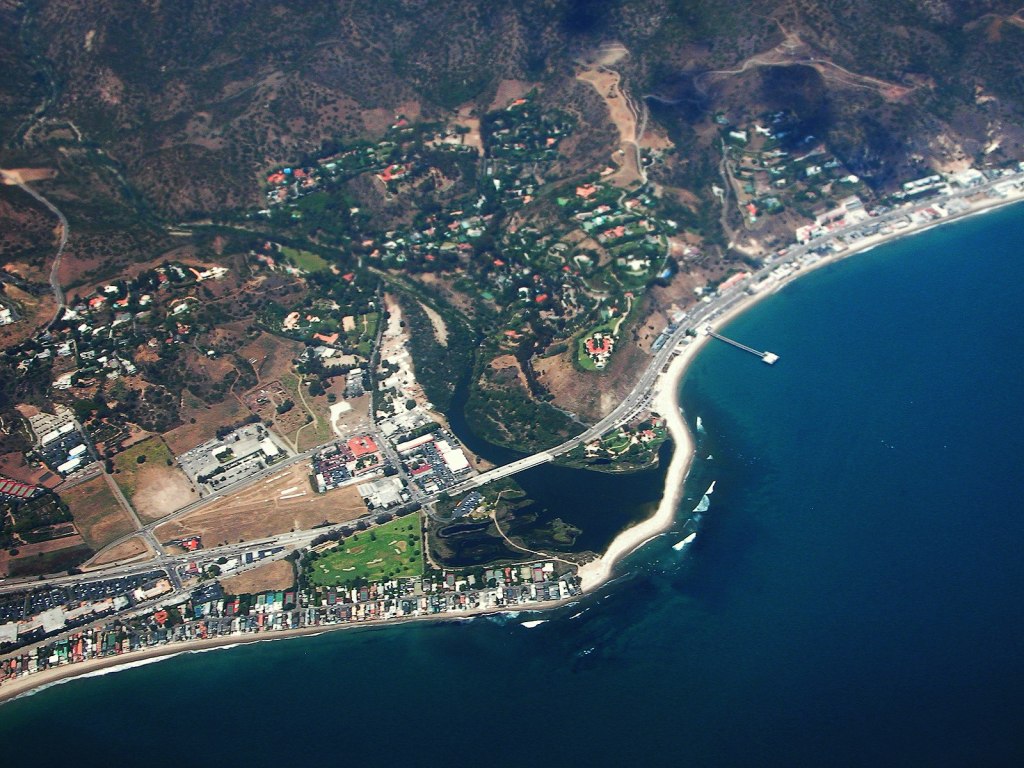
Featured Image Credit: The original uploader was Tillman at English Wikipedia, English: Downtown Malibu. The Colony Is on the Left. Central Is Malibu Lagoon, the Estuary of Malibu Creek., August 3, 2008, August 3, 2008, Transferred from en.wikipedia to Commons by Off2riorob using CommonsHelper., https://commons.wikimedia.org/wiki/File:MalibuAir.jpg.


