
Written by Darcy Gresham
26/11/2023
The Meiji Restoration of 1868 was a turning point in Japanese history; it marked the move towards modernisation and imperialism. In this respect it is usually heralded as a success due to the later victories in the Russo-Japanese and Second Sino-Japanese wars and alliances with the West. It was caused by social, economic and political tensions stemming from a range of factors including Shogunate power and the US black shops demanding trade. Initially, it seems that the Meiji Restoration was a restoration, not a revolution, due to the return of the emperor to power.
The Meiji Restoration is named after the emperor, who assumed power following the coup d’état in January 1868. The emperor Meiji became the ruler of the nation, around whom a personality cult was formed, stemming from the belief that he was a descendent of the Sun Goddess. Politically, the Emperor issued the ‘Charter Oath’ in 1868. In name, the direct correlation with the restoration of the emperor is clear, with the event taking his regnal name of Meiji, and the Chosu and Satsuma clans declaring their action in this name. The reversion to monarchy also has a historical parallel to the restoration of Charles II in 1660, following political conflict. In 1868, the emperor was restored to ultimate power. However, he had ‘Genro’ advisors, which led to him becoming a modern constitutional monarch. His status was also intensified by the international recognition, with British royalty embracing him as a peer, displaying the steps towards becoming an imperial power and how the political system improved global relations. The importance of these relationships and the high regard of the West is reflected by the compulsory wearing of western-styled dress at the royal court by 1872. However, the modernity of a constitutional monarch after the Tokugawa shogunate’s dictatorship is a juxtaposition – the return to sovereignty is an ancient idea but is modernised by the reforms that followed. Therefore, some historians see the events of 1868 as a restoration due to the changes in political power and the reversal of shogunate power back to emperor rule. This is a widely adopted perspective, reflecting the name of the restoration and the most obvious structural changes within the government. The reestablishment of ancient capitals as cultural cores also links to this. However, the ideas of modernity intertwined with the rule of the emperor demonstrated that the restoration did not completely return to the old regime of power.
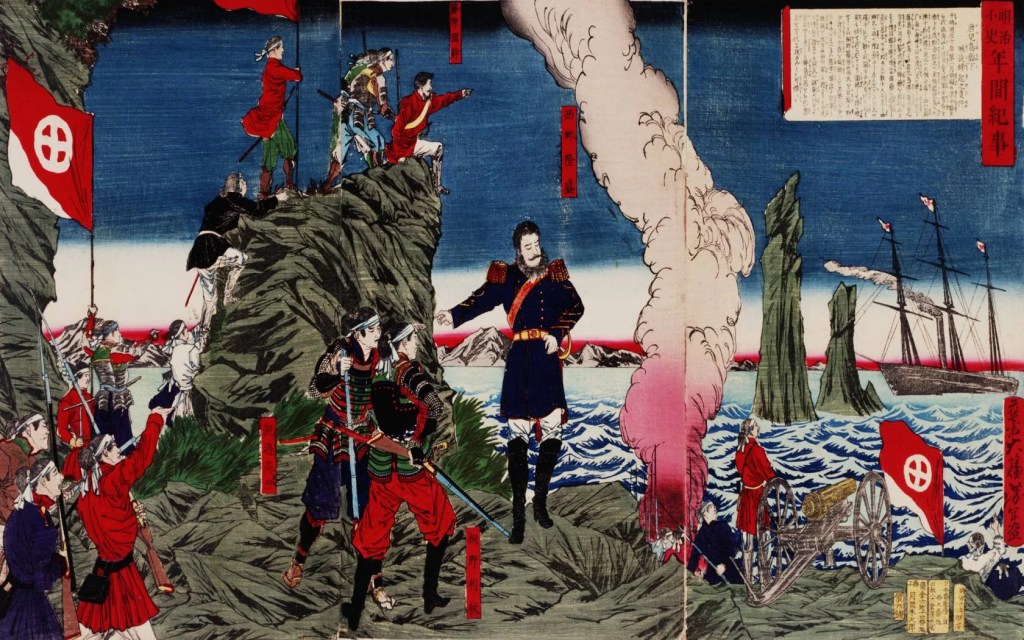
Another claim for the events of 1868 being a restoration focuses on the Boshin War, which broke out in late January 1868, between the forces who had initiated the Restoration and those who supported the Tokugawa shogunate. Military changes supported the power shift, with loyalty sworn to the emperor instead of to the daimyo class. The Imperial Rescript to soldiers and sailors of 1882 also highlighted the breakdown of the feudal system, as they pledged to serve their country. More recent interpretations claim that the Boshin war has been romanticised, diluting the brutality and violence. Thus, this division between the restoration and war through name demonstrates that the conflict related to the overthrow of the political structure has, in this case, been separated by historians. Overall, the Boshin War as a civil war demonstrates that the Meiji Restoration was a restoration, as the fighting that broke out escalated separately from the structural changes.
The lack of violence is one of the main differences between the ideas of restoration and revolution, and some historians have called the Meiji Restoration a bloodless revolution, indicating the importance of conflict in this classification. One of the markers that can be used to understand this perspective is the comparison to other revolutions in history. For example, during the Russian Revolution, the Tsar was not killed in the February or October Revolutions but was imprisoned until July 1918 when he was murdered as a result of counter-revolutionary fear. Yonekura claims, ‘The Glorious Revolution of England in 1688 is often held up as an example of a bloodless revolution, but even less blood was shed during the Meiji Restoration’. In these ways, the Restoration is less violent and brutal than other notable revolutions through history therefore supporting its title. The experience of the displaced leaders plays a role, with their ultimate fates being a key continuity with revolutions, such as the French and Russian.
On the other hand, the violent context of the 1860s and the global arms trade illustrate the revolutionary aspects of the Meiji Restoration. The militaristic and violent atmosphere is an important feature in many cases revolutions are a culmination of discontentment and therefore the background of conflict could demonstrate the underlying feelings, the climax of which resulted in the Meiji Restoration. Pre-Meiji Japan was not on a par with the West in terms of militaristic or economic strength, which is illustrated by them being unable to stop the humiliation of Commodore Matthew Perry’s black ships arriving in Edo in 1853 to demand open trade. Whilst there were not international disputes, there were internal military conflicts and armed conflicts that rose in the 1860s. This demonstrates some military tendencies in the pre-Meiji era, and furthermore, the military attitudes ingrained in the social hierarchy, with the role of the samurai as the warrior class. From analysing a range of sources, there seems to be no single phrase that is used by historians for the actions on the 3rd of January 1868, which suggests differing perspectives of the occurrences. ‘Coup d’état’ is a popular description, referring to a violent means of overthrow, but holds back on the declaration of a revolution. The impact of the global weaponization suggests it was a preventive coup d’état in January 1868, out of fear of the important of foreign arms. On the whole, the background of violence and military conflict provides a breeding ground for further brutal actions of a revolution.
The volume of change that ensued in the Meiji Period is used as another perspective of the Restoration actually being a revolution. In the 1990s, Western historians began to focus on socioeconomic trends and used structuralist perspectives, giving ‘voices to ordinary people and women’. Uncertain economic times often lead to conflicts and leadership changes, the most extreme example of which can be seen in the rise to power of Hitler following the failure of recovery after the Great Depression. However, after the Restoration, the economy became a priority as it was seen as a key factor in imperial strength. The government looked West and changed its budgeting and taxation systems, investing in infrastructure and business. Socially, the tensions of the 1860s were caused by hierarchical conflicts, mainly the Daimyo and Samurai classes, who lost their positions when the ‘shi-no-ko-shu’ distinctions were abolished. Ultimately, the socioeconomic characteristics of the Meiji Restoration created great change and, therefore, displayed that the Restoration was actually a revolution. However, the tensions were common for the era, having been underlying in Japan for at least the decade, indicating that they did not cause exceedingly turbulent changes.
Finally, language barriers have coloured interpretations globally, which, in the case of the Meiji Restoration, is due to the differing definitions of ‘revolution’. The name ‘Meiji Restoration’ was used by the new government in 1868, to describe their actions, but this definition does not directly correlate with Western understanding. Western understanding of ‘revolution’ has a close connection with a historical tradition of people’s self-emancipation’, whereas in Japan, there are no such traditions of ‘revolution’. Furthermore, the contemporary name of the Restoration was ‘Meiji Restoration (Ishin)’, where the Japanese words ‘Ishin (restoration)’ and ‘kakumei (revolution)’ originate from Chinese. However, ‘Ishin means “all things are changes and renewed”’, and the ‘original meaning of kakumei was “the change of Chinese dynasty by fate’’. The change in the definition of ‘kaukmei’ only came about after the Meiji Period, when it gained the same meaning as its Western equivalent. It was the Meiji government themselves that described their own actions as a ‘revival of ancient kingly rule’ (ōsei fukko), but also as a revolution (ishin). This is a direct juxtaposition, with ‘fukko’ meaning in reference to the ancient past, whilst ‘ishin’ declares, on the contrary that ‘all is being made new’. In general, the lexicon surrounding the Meiji Restoration is a newer way of examining the events and is revealing of the inconsistencies across borders – it is a convincing reason for the mistaken name ‘Restoration’.
Overall, we should accept the Meiji Restoration as a restoration, adopting the original views of the events 1868. Although these primary opinions would be biased towards the new government, this is the closest description to the time. This is also contributed to the Meiji events as a restoration becoming ‘historical fact’, to use Carr’s phrase, as it has been so widely accepted for so long. The name of the restoration directly and solely, refers to the emperor himself, and whilst other factors, such as social tensions and economic uncertainty were crucial, the adopted title for events is ‘Meiji’ and therefore ‘restoration’ does describe the return to rule by emperor. However, there are revolutionary elements to the actions and it is clear that the Meiji restoration brought Japan into the industrialised and westernised world through modernisations in all aspects of society, economy and politics. In the Meiji Restoration, the feudal class systems completely transformed, as did the military in areas such as conscription. However, politically the constitution was not in place until 1889. Furthermore, the Emperor could still issue imperial edicts and veto legislation, demonstrating the elements of dictatorships and, therefore, lack of complete change. Thus, the Meiji Restoration of 1868 was indeed a restoration, although it featured revolutionary aspects.
Bibliography
Yonekura, S., 2015. The Samurai Company: Double creative response in Meiji Japan the case of Onoda Cement. Hitotsubashi Journal of Commerce and Management, 49(1), pp.1-23.
Kawashima, S., 2018. Moving On From The Meiji Restoration | The Japan Times
E. Forster, 2019 ‘Do all revolutions End Badly? History Today
Neitzel, L., n.d. What Is Revolution?. [online] Columbia.edu. Available at:
Daniels, G., 1968. The British Role in the Meiji Restoration: A Re-Interpretive Note. Modern Asian Studies, 2(4), pp.291-313.
Neary, I., 1993. War Revolution & Japan. 1st ed. Folkestone [England]: Japan Library.
Hellyer, R. and Leheny, D., 2018. What Japan Can Teach Us About The Future Of Nationalism’. The Washington Post.
Fuess, H. and Hellyer, R., 2020. The Meiji Restoration: Japan As A Global Nation. Cambridge: Cambridge University Press.

