
Written by Moritz Raum
This article is an adaptation of a presentation given at the International Migration & Intercultural Communication – A Cross-Disciplinary Student Congress | University of Edinburgh 11–12 May 2026
In Chapter 54 of Robert de Clari’s ‘Conquest of Constantinople’, the Crusader tells of an encounter of some Frankish barons in 1203 with a Nubian ‘king’ whom emperor Alexios IV Angelos received with great honours. Ignorant of his identity, the barons were surprised that this royal was, in fact, a Christian on a pilgrimage around the Mediterranean and to the Holy Land. Alexios’ treatment of the ‘king’ is not only a stark contrast to contemporary Western European attitudes, but also suggests that in Byzantium, or at least at the imperial court, encounters with people from faraway lands were not uncommon. Despite no other Byzantine or Western sources mentioning this particular episode or any similar encounters, Clari’s account features several details that corroborate it as a source. However, since the discussion has so far largely been limited to (medieval) Western European perspectives, this paper’s aim is to look further and give an introduction to intercultural communication between People of Colour – often addressed as ‘Ethiopians’ – and the Byzantine empire in both written and visual culture.
To prove that Clari did not simply make up this encounter with the Nubian ‘king’, some of his wording must be put into context:
And while the barons were there at the palace, a king came there whose skin was all black, and he had a cross in the middle of his forehead that had been made with a hot iron. This king was living in a very rich abbey in the city, in which the former emperor Alexios [the usurper Alexios III] had commanded that he should be lodged and of which he was to be lord and owner as long as he wanted to stay there. When the emperor [Alexios IV] saw him coming, he rose to meet him and did great honour to him. And the emperor asked the barons: “Do you know,” said he, “who this man is?” “Not at all, sire,” said the barons. “I’faith,” said the emperor, “this is the king of Nubia, who is come on pilgrimage to this city.” […]
First, this royal is introduced as the ‘king of Nubia’, a region on the river Nile south of Egypt inhabited by the Nubians, who founded there three kingdoms that succeeded the earlier Kingdom of Kush (also called Meroë).In the Byzantine sphere, the term ‘Nubia’ is most often applied to Makuria, the most powerful of these three kingdoms, or to Dotawo after having merged into a single realm. It and its Kushite predecessor are often conflated with another common term, namely ‘Ethiopia’, having little to do with the modern country of the same name. The latter was traditionally known as either Axum or, beginning in the twelfth century, as Abyssiniaand was a separate political entity south of Nubia. Starting with the Homeric epics, ‘Ethiopia’ became known as a general descriptor for Northern Africa. The historic use of the term ‘Ethiopian’ (from Greek αἰθίοψ, aithíops, ‘burnt face’) for people is descriptive in nature rather than tied to a specific culture or ethnicity and can, in some part, be compared to the modern term ‘Person of Colour’ (PoC). Although ‘Nubia’ as a place name could have been known to the Crusaders, since it featured in Old French songs from the twelfth century onward, Clari’s account makes it clear that the barons were wholly ignorant of the ‘king’s’ identity. By not choosing the somewhat vague term ‘Ethiopian’, it is more likely that Clari was directly quoting Alexios IV.
Secondly, and much more convincingly, is the mention of the cross, which had been branded with a hot iron onto the ‘king’s’ forehead. This custom is historically well attested, for example, in depictions of royalty and clergy in Nubian wall paintings (Fig. 1), or by reports of Nubian pilgrims in the Holy Land, and so it lends much credence to Clari’s account. References to the cross markings are so numerous that they become a topos in medieval literature; however, Clari’s text predates those.
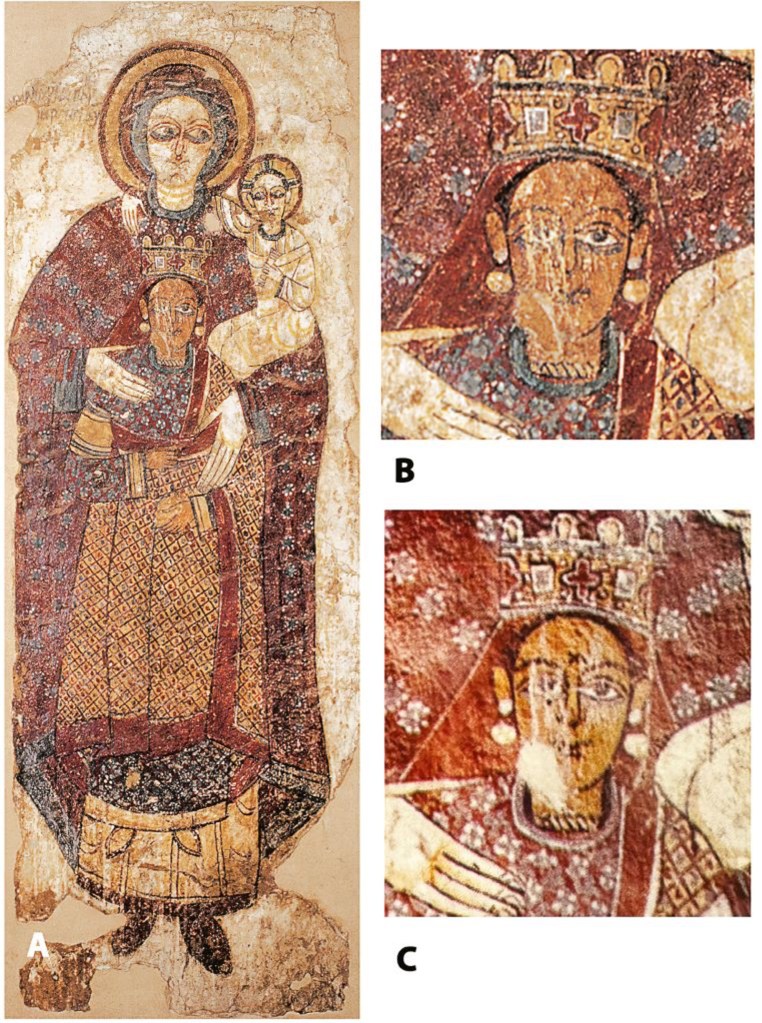
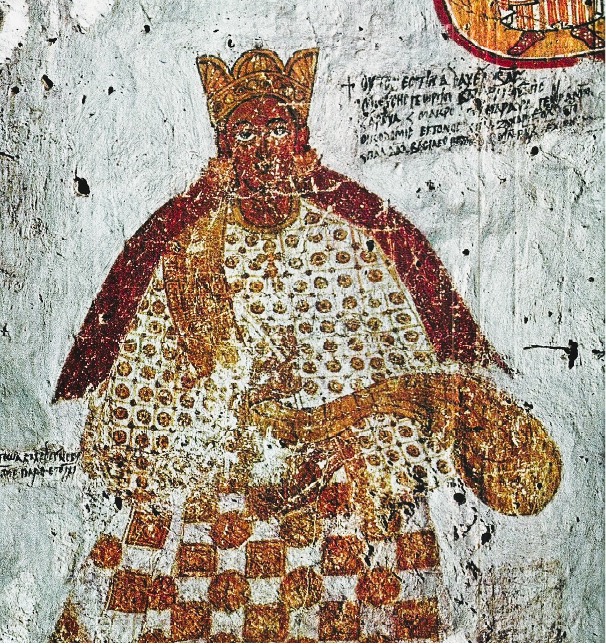
Notwithstanding the small chance of all records of the encounter except Clari’s having been lost, the scarcity of sources suggests that this could have been a one-time event. This, however, seems equally unlikely. Nubian sources seldom mention diplomatic envoys or their own kings visiting other countries – with historiography in general seemingly being of minor importance compared to other literary genres – yet they still allow for a possible identification of Clari’s Nubian ‘king’ with Moses Georgios, (by the time this episode takes place) the former ruler of Makuria (Fig. 2). As evidenced from his continued correspondence with the patriarch of Alexandria, kings like Moses Georgios were also well connected to the wider Mediterranean world. Given that the three kingdoms were Christianised in the sixth century through several missions originating in Byzantine Egypt, Greek was also the dominant liturgical language of the Nubian church.
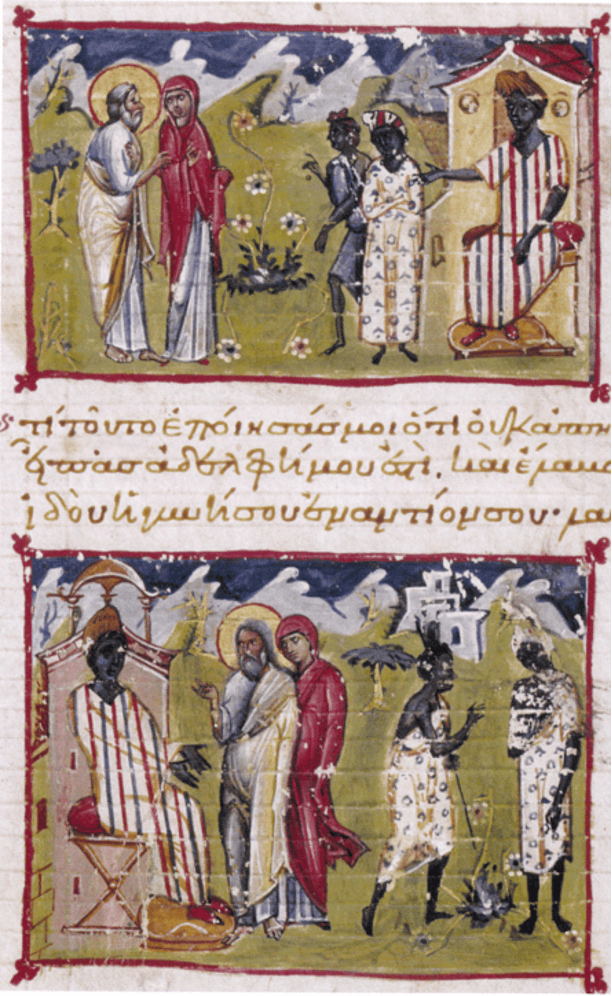
Nevertheless, Byzantine silence concerning important political events is not uncommon in historical writing: not only do they make no mention of the Nubian ‘king’, but they are also silent on other embassies as well as major diplomatic matters; for example, the Byzantines’ temporary alliance with the Ayyubid sultan Saladin. Ultimately, diplomatic (or in this case pilgrimage-related) visits seemed to be fairly frequent occurrences at the Byzantine court, and additionally, during the reign of Manuel I Komnenos (r. 1143-1180), ‘Ethiopians’ (amongst many other foreigners) were seen frequently at the imperial palace. Dark skin, however, does not automatically connote foreignness: even though by the 1200s Byzantium did not have direct control over a lot of its former territories, their inhabitants were, for a long time, still seen as part of the Roman/Byzantine world. Even as such, Egyptians were occasionally described and depicted as dark-skinned as well (Fig. 3).
Besides literal examples of intercultural communication, the relationship can also be conveyed through more indirect means: the empire had a lasting influence on visual culture, making it the strongest (and due to the occasional absence of written sources, often the only) indicator that regions, especially those this article is concerned with, were part of this greater network based on trade, aesthetics and religion. Nubian wall paintings (Figs. 1 and 2) make this abundantly clear.
One prominent example of this cultural alignment with the Christian African kingdoms can be found on Folio 107 of the so-called Menologion of Basil II. It features an illustration of an ‘Ethiopian’ eunuch (Fig. 4), a treasurer of Candace – Kandake being the title of the Kushite/Meroitic queen mother – who had an encounter with Philip the Evangelist and was the first non-Jew to be baptised (Acts 8). Despite their difference in skin colour and Philipp having a halo, the eunuch is given an aura of familiarity by the choice of clothing, depicting him with garments one would expect from high-ranking officials of the Byzantine court. It was clothing fit to reflect his respective position at the Kushite court. Similarly, even though to Clari and the Frankish barons, the Nubian ‘king’ stood out due to his skin tone and cross on his forehead, Alexios treated him as an equal and he was seen as just another Christian doing a very Christian activity – pilgrimage. More than in Western Europe, in Byzantium skin tone was not a person’s sole identifying feature and even perceived foreignness could be overwritten by cultural alignment.
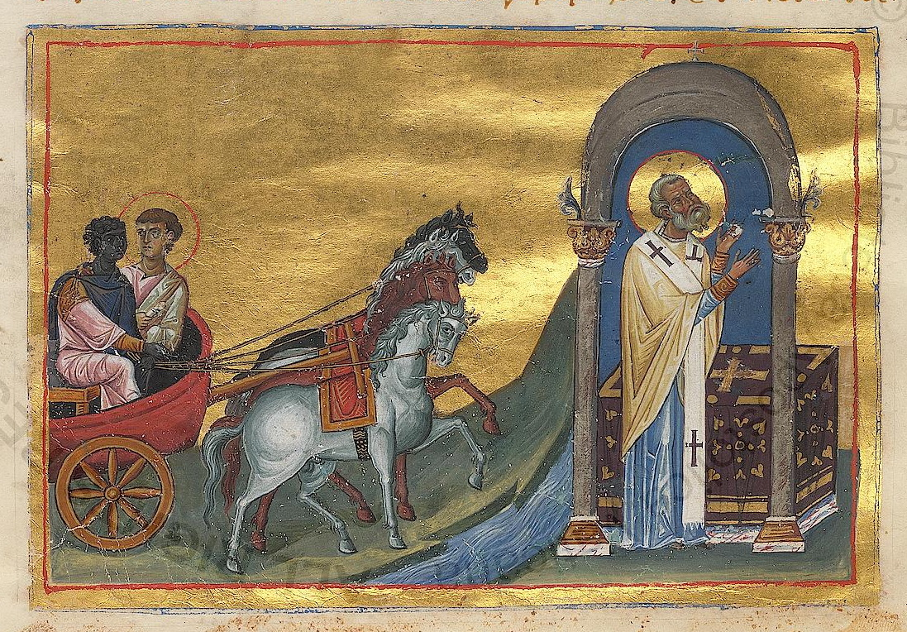
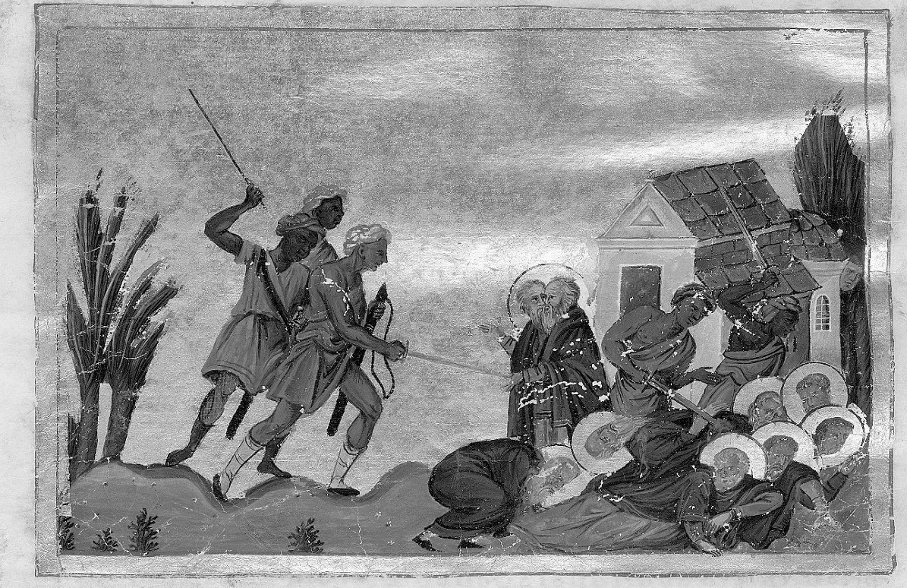
This general trend, however, can be contrasted with examples of discrimination based on skin colour in Egyptian monastic circles or outright racist comments by some Byzantine authors. Amongst the many ways in which Ethiopians were perceived as the Other and one which lends itself as a complete inversion of the Christian Nubian ‘king’ on pilgrimage would be that of the ‘dark-skinned barbarian’ who needs to be missionised – an image prevalent in depictions of Pentecost and of martyrdoms. While the depiction of the eunuch in the Menologion is wholly positive (Fig. 4), the same work features many examples of dark-skinned barbarians brutally murdering holy men and women (Fig. 5), although the images involving light-skinned attackers are in no way less brutal.
In conclusion, intercultural communication between the Byzantine empire and People of Colour, or ‘Ethiopians’ in contemporary sources was rather complex and occurred through both written and visual culture. By continued alignment with a shared network across the Mediterranean, Ethiopians were participating in the overarching institutions of Christianity and Roman-Byzantine culture. In this regard they were seen as other Christians, exemplified by an account of a former Nubian king visiting the Byzantine court in 1203 while on pilgrimage. Not seldom they seem to be even preferred over other groups like the Western European Christians. However, without or sometimes despite this alignment, Ethiopians could also be treated very differently through the process of Othering but by using the same epidermal, cultural and vestimentary markers.
Bibliography
Betancourt, R. (2020) Byzantine Intersectionality: Sexuality, Gender, and Race in the Middle Ages. Princeton.
Clari, R. (1216) La Conquête de Constantinople, trans. E.H. McNeal, The Conquest of Constantinople Translated From the Old French of Robert of Clari (New York, 1969).
Courtès, J.M. (2010) “The Theme of ‘Ethiopia’ and ‘Ethiopians’ in Patristic Literature” (trans. W. Granger Ryan), in D. Bindman and H.L. Gates, Jr. (eds), The Image of the Black in Western Art: From the Early Christian Era to the “Age of Discovery”. From the Demonic Threat to the Incarnation of Sainthood. 2nd ed. (London), 199-214.
Devisse, J. (2010) “The Black and his Color. From Symbols to Realities” (trans. W. Granger Ryan), in D. Bindman and H.L. Gates, Jr. (eds), The Image of the Black in Western Art: From the Early Christian Era to the “Age of Discovery”. From the Demonic Threat to the Incarnation of Sainthood. 2nd ed. (London), 73-137.
Fiaccadori, G. (2005) “Un re di Nubia a Constantinopoli nel 1203,” Scrinium 1 (1): 43-49.
Guilbault, K.A., Stark, R.J., and Obłuski, A. (2025) “Embedded Beliefs: Early Tattooing and Embodied Faith in the Middle Nile Valley,” Journal of African Archaeology 23 (2): 127-144.
Hendrickx, B. (1985) “Un roi Africain à Constantinople en 1203,” Byzantina 13 (2): 893-898.
Łajtar, A. and Ochała, G. (2021) “A Christian King in Africa: The Image of Christian Nubian Rulers in Internal and External Sources,” in P.M. Forness, A. Hasse-Ungeheuer, and H. Leppin (eds), The Good Christian Ruler in the First Millennium: Views from the Wider Mediterranean World in Conversation (Berlin/Munich/Boston), 361-379.
Milanović, L. (2002) “Representations of Others in Early Christian and Byzantine Art,” Athanor 20: 21-31.
Rostkowska, B. (1982) “The Visit of a Nubian King to Constantinople in AD. 1203,” in P. van Moorsel (ed.), New Discoveries in Nubia: Proceedings of the Colloquium on Nubian Studies, The Hague, 1979 (Leiden), 113-116.
Simmons, A. (2022) “The Nubian ‘King’ in Constantinople (1203): Interactions between Nubia and the Mediterranean,” Medieval Encounters 28: 242-264.

