
Written by Yang Guo
This article is an adaptation of a presentation given at the International Migration & Intercultural Communication – A Cross-Disciplinary Student Congress | University of Edinburgh 11–12 May 2026
Chinese indentured labour in the nineteenth century occupied an uneasy, deeply contested borderland between chattel slavery and so-called “free” wage labour. On paper, the labour contract presented indenture as a voluntary, legally codified relation of employment. In daily plantation practice, however, Chinese labourers were bound to a single master for a fixed term of years, subject to corporal punishment for desertion or refusal to work, and placed under pervasive systems of surveillance and discipline that severely restricted their mobility and physical autonomy. Yet focusing exclusively on this machinery of domination risks telling an incomplete story, reducing historical actors to silent, powerless victims. Labourers’ agency never vanished under the pressures of indenture; instead, it was constrained, uneven, and exercised through narrow yet vital channels. Chinese labourers navigated their condition on two complementary fronts: acting within the formal framework by using petitions and testimonies to demand contractual compliance, and operating beyond it by leaning on huiguan (Clan Hall) for mutual aid, mediation, and communal solidarity. When colonial archives are read against the grain, they reveal not passive resignation, but a persistent, everyday struggle to negotiate, survive, and resist.
Why, then, should indenture be understood specifically as a “structurally coercive” contract system? The fundamental problem was never the mere existence of a written agreement. In legal theory, contracts can clarify mutual obligations, establish wage rates, and provide safeguards against purely arbitrary demands far more effectively than informal, verbal promises. Rather, the coercive nature of indenture was rooted in the deeply unequal terms of the colonial encounter itself. Chinese migrants were recruited under conditions of pervasive deception, carried across oceanic distances into mounting debt, and placed into legal and administrative regimes where planters, magistrates, and colonial officials held almost all interpretive and enforcement authority. The contract never functioned as an agreement negotiated between equals. Instead, it served as an institutional instrument of discipline, closing off a worker’s freedom to seek another employer, exposing them to criminal penalties for civil infractions, and stripping away their bargaining power from the moment of arrival.
Yet the written contract also functioned as a double-edged sword. Because it explicitly stipulated wages, provisions, housing, hours of work, and terms of service, it handed labourers a concrete, legally recognised benchmark against which to measure everyday abuses. Agency, in this plantation setting, rarely meant total liberation from domination; it emerged as the practical capacity to interpret, contest, and renegotiate that domination from within. Alongside covert flight, feigned illness, or open defiance, labourers frequently appealed to magistrates, inspectors, and colonial commissions. They registered formal grievances over unpaid wages, broken recruitment promises, inadequate rations, and excessive corporal punishment. By invoking the contract, labourers held employers to their own legal words, turning the rhetoric of colonial legality back onto the very masters who routinely breached its terms.
These legal appeals were far from humble pleas for benevolence or pity. Fully aware that colonial legal institutions favored their employers, petitioners adopted a deliberate rhetorical strategy. They carefully framed themselves not as unruly rebels outside the law, but as compliant, hardworking labourers who had fulfilled their duties and were being denied what they were legally owed. This calculated posture allowed workers to transform private, physical suffering into formal, public grievances that colonial authorities could not easily dismiss.
This strategic use of testimony becomes especially vivid in the Cuban context. The statements preserved in the 1876 Cuba Commission Report expose the stark gap between formal contractual promises and the lived reality of plantation labor. Some testimonies detailed kidnapping and fraudulent recruitment in Chinese ports; others laid bare brutal punishments, food deprivation, and forced contract re-indenture that directly violated agreed terms. While individual depositions vary in detail, they collectively preserve an undeniable record of labourers actively analysing their condition and formulating coherent claims of justice. Their words in the archive appear not as passive laments of misery, but as deliberate acts of legal claim-making.
If formal petitions illustrate how agency was exercised within colonial institutions, how did workers protect themselves outside the master’s surveillance? They did so primarily through huiguan, the clan, district, and native-place associations organised around shared ancestral origin, dialect, and cultural ties. In overseas diaspora settings, these organisations provided crucial practical and symbolic resources. They offered newly arrived migrants temporary shelter, organised food supplies, managed postal communication with families in China, mediated internal disputes, and arranged proper traditional burials. In doing so, huiguan restored the human connections and mutual obligations that plantation life sought to sever.
This sphere of communal organization carried profound social and political significance. Indenture, despite its physical demands, did not exhaust the entire social existence of labourers. Employers could attempt to monopolise labour time and restrict movement, but they could not entirely dismantle the networks through which migrants made sense of their hardship and maintained collective identities. Huiguan shielded labourers from acute isolation, linking them to wider merchant networks and forms of mutual assistance that were completely autonomous from the planter class. By creating spaces where labourers were recognized not as mere units of labour, but as full members of a shared community, huiguan reduced vulnerability and provided the social resources necessary to endure and resist coercive labour regimes.
Mutual aid and communal care must therefore be recognised as vital forms of historical resistance. Under oppressive labour systems, the everyday work of sustaining human dignity, preserving cultural memory, and maintaining mutual protection is itself a meaningful political act. Agency in the indentured diaspora was not always loud, organised, or spectacular; it was woven into the quiet, patient labour of keeping a community alive in a hostile environment.
Recovering these diverse practices, however, requires reading colonial archives against their own grain. Imperial records rarely preserved a labourer’s perspective on its own terms. Colonial officials, magistrates, and plantation managers routinely classified legitimate worker grievances as “disorder,” collective strikes as “mutiny,” and flight as “criminal default,” reducing complex social claims to simple matters of police discipline. Colonial archives were never neutral records of objective facts. They were bureaucratic tools designed to govern, discipline, and extract labour from displaced populations, systematically erasing the subjective motives of those they controlled.
A critical archival reading must look past these administrative categories to interrogate how and why records were produced. When petitions appear in administrative files, they are frequently framed as evidence of disruption rather than legitimate outcries against injustice. When workers ran away, slowed down their labour, or gathered to organize, official reports treated these actions as breaches of public order rather than rational responses to coercion. Reading against the grain allows historians to see what bureaucratic language was designed to hide: that behind labels of “crime” and “vagrancy” lay continuous struggles over fair treatment, mobility, bodily integrity, and survival.
In extreme circumstances, when every legal and communal avenue of relief was blocked, some labourers resorted to acts of self-destruction and suicide. These desperate acts can be understood as radical refusals of continued enslavement, yet they should not overshadow the more widespread, everyday strategies of survival that remain historically recoverable. The historical experience of Chinese indentured labour cannot be captured by a single, dramatic model of armed rebellion. It is far more accurately reconstructed through the multiple, constrained ways in which workers defended their rights, held employers to their promises, and rebuilt social worlds under intense structural pressure.
Ultimately, nineteenth-century Chinese indentured labourers were neither completely unfree chattel slaves nor autonomous participants in a free labour market. They lived inside a structurally coercive contract regime that restricted their movement, disciplined their bodies, and narrowed their possibilities for collective action. Yet within those rigid confines, they exercised meaningful, calculated agency. By deploying petitions and testimonies within the legal apparatus to expose broken contractual promises, and by organising huiguan to secure mutual aid and solidarity outside the master’s reach, Chinese labourers proved that they were never passive victims. A critical reading of the colonial archive brings these resilient practices to light, demonstrating that the history of indenture is an enduring record of labouring people negotiating, organising, and fighting for their dignity under unequal conditions.
Bibliography
Bates, Crispin. “Some Thoughts on the Representation and Misrepresentation of the Colonial South Asian Labour Diaspora.” South Asian Studies (Society for South Asian Studies) 33, no. 1 (2017): 7–22.
Barcia Paz, Manuel. The Yellow Demon of Fever: Fighting Disease in the Nineteenth-Century Transatlantic Slave Trade. New Haven: Yale University Press, 2020.
Chen, Yong. Chinese San Francisco, 1850–1943: A Trans-Pacific Community. Stanford, CA: Stanford University Press, 2000.
Dorsey, Joseph C. “Identity, Rebellion, and Social Justice among Chinese Contract Workers in Nineteenth-Century Cuba.” Latin American Perspectives 31, no. 3 (2004): 18–47.
Hu-DeHart, Evelyn. “From Slavery to Freedom: Chinese Coolies on the Sugar Plantations of Nineteenth Century Cuba.” Labour History (Canberra), no. 113 (2017): 31–51.
Imperial Maritime Customs Press. The Cuba Commission Report: A Hidden History of the Chinese in Cuba: The Original English-Language Text of 1876. Introduction by Denise Helly. Baltimore: Johns Hopkins University Press, 1993.
Kale, Madhavi. Fragments of Empire Capital, Slavery, and Indian Indentured Labor Migration in the British Caribbean. Philadelphia: University of Pennsylvania Press, Inc., 2009.
Richards, Thomas. The Imperial Archive : Knowledge and the Fantasy of Empire. London: Verso, 1993.
Stanley, Amy Dru. From Bondage to Contract : Wage Labor, Marriage, and the Market in the Age of Slave Emancipation. Cambridge: Cambridge University Press, 1998.
Stoler, Ann Laura. “Colonial Archives and the Arts of Governance.” Archival Science 2, no. 1–2 (2002): 87–109.
Stoler, Ann Laura. Along the Archival Grain : Epistemic Anxieties and Colonial Common Sense. Course Book. Princeton, NJ: Princeton University Press, 2010.
Yun, Lisa. The Coolie Speaks : Chinese Indentured Laborers and African Slaves in Cuba. Philadelphia: Temple University Press, 2008.
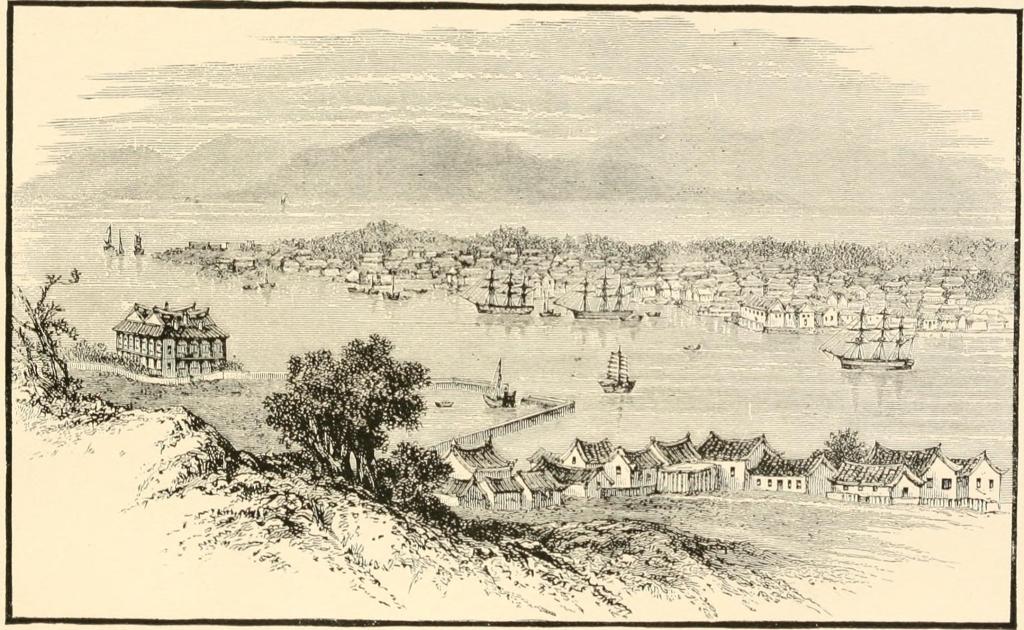
Image credits: https://commons.wikimedia.org/wiki/File:Amoy,_from_Kulangseu.jpg


