
Written by Sam Mackenzie
29/03/26
In 1864, the Civil War in the United States looked as though it could drag on for years. Hundreds of thousands of Americans were already dead, and almost every family had been touched by the wrath of the war.
As the 1864 election approached, President Abraham Lincoln appeared on course to lose to General George B. Maclellan. Maclellan promised an end to the war through negotiations with the South. At this stage, the conflict seemed to be bringing the Union no closer to victory, while continuing to drive up an ever-higher body count.
Lincoln, if re-elected, promised more struggle. He would not allow the Confederate States to gain legitimacy through negotiations as though they were anything more than a rabble. But this was not popular with the American public in the North. The Union had not won a major victory since Chattanooga in November 1863, and the North was growing tired of the conflict. Increasingly, it seemed, it was also growing tired of Mr. Lincoln. Lincoln sent out a memo to the cabinet, stating: “[t]his morning, as for some days past, it seems exceedingly probable that this Administration will not be re-elected.”
The situation was bleak when General William Tecumseh Sherman – ‘Uncle Billy’ to his men – began a series of campaigns that would transform the course of the war and American history. General Ulysses S. Grant, newly promoted Major General of the Armies, left General Sherman, a close personal friend of his, in charge of the armies in the western theatre after the battle of Chattanooga in November 1863.
Grant ordered Sherman to advance through the Deep South and capture Atlanta, capital of Georgia, as it was the major rail and industrial heart of the Confederacy. Grant would support the campaign by advancing south in Virginia. This would prevent Robert E. Lee – the Confederates star general – from marching south to relieve Atlanta.
Sherman’s Army of the Tennessee, Army of the Ohio, and Army of the Cumberland numbered 112,000 men by the time the campaign was truly underway in June 1864. Against them was the force of General Joseph E. Johnston who had only 65,000 men with which to defend Georgia.
Sherman pushed steadily southwards, winning a series of excellent manoeuver-based victories. These forced Johnston out of strong defensive positions without costly frontal assaults, until he had retreated almost to Atlanta. Johnston was then relieved of command by President of the Confederacy, Jefferson Davis, and was replaced with the hothead John B. Hood.
Hood launched a series of vicious frontal charges. Sherman’s numerical superiority, however, tore his army apart, and Atlanta was soon placed under siege.
Sherman, instead of negotiating or waiting for the city to starve, ordered an immediate heavy bombardment of the city with all his army’s heavy batteries. For 37 days, Union artillery bombarded the city until Atlanta surrendered on 2 September, and the Confederate Army escaped, setting the city ablaze as they went.
Many historians argue that the capture of Atlanta was a turning point for Lincoln’s re-election campaign. It demonstrated that his hardline strategy was working and that the Confederacy could be defeated on its own ground. The capture of Atlanta also crippled the Confederates’ war effort in a way that cannot be overstated. The South could not hope to challenge the Union again industrially.
A mere two months after the fall of Atlanta, Sherman was on the move again. He had devised a plan which had never really been done before with an army the size of his. Leaving behind a garrison in Atlanta enough to hold against any Confederate attack, Sherman took 62,000 men and decided he would march for Savannah on the Georgia coast.
But the way he would feed his army was novel. Instead of relying on a long supply train stretching across Georgia – which would have been impossible to protect – Sherman turned to the 1860 census. He planned his route through the most agriculturally productive regions, targeting farms and cotton mills. Sherman said to Grant, convincing his commander to allow him to embark on the venture, “I can make the march and make Georgia howl.”
And howl she did. From 15 November to 21 December, the Union army burned and looted its way through the deepest belt of the South. Sherman issued special field orders No. 120, with the following being some excerpts:
“The army will forage liberally on the country during the march. To this end, each brigade commander will organize a good and sufficient foraging party.”
“To army corps commanders alone is intrusted the power to destroy mills, houses, cotton-gins, &c., and for them this general principle is laid down: In districts and neighbourhoods where the army is unmolested no destruction of such property should be permitted.”
“As for horses, mules, wagons, &c., belonging to the inhabitants, the cavalry and artillery may appropriate freely and without limit, discriminating, however, between the rich, who are usually hostile, and the poor or industrious, usually neutral or friendly.”
Notably, Sherman’s men were on their best behaviour, for the most part. The penalty for wanton looting was death for the men in Sherman’s army, and less than 50 cases of this penalty being issued are recorded.
Nevertheless, Sherman’s army reached Savannah, sieged it, and captured it on 21 December 1864. Sherman telegrammed Lincoln and joked, “I beg to present to you as a Christmas gift the City of Savannah”.
In the one month and six days Sherman marched for, the damage wrought on Georgia was immense. Over the course of the march, an estimated $100 million of damage was inflicted ($2.07 billion today). Around three hundred miles of railroad were destroyed, along with bridges and telegraph lines. The army also seized vast quantities of resources: five thousand horses, four thousand mules, thirteen thousand head of cattle and millions of pounds of corn (4,750 tons) and fodder (5,250 tons). It destroyed countless cotton gins and mills.
As historian Archer Jones stated, “Sherman’s raid succeeded in ‘knocking the Confederate war effort to pieces’.” Agriculture in Georgia and the wider South would not fully recover from the effects of Sherman’s march until 1920.
After the capture of Atlanta, Sherman gave his men one month to rest through Christmas and the new year. Then he began the end of his swinging motion to squeeze the heart of the Confederacy, Virginia, between his and Grant’s armies. Grant wanted Sherman’s 60,000 veteran troops to be redeployed by ship to Virginia, but Sherman instead argued that he should march north and do the same to North and South Carolina as he had done to Georgia. Grant agreed, and planning began.
The bulk of the army moved out in mid-January. Sherman feinted towards Augusta and Charleston, but his true objective was Columbia, South Carolina – the capital of the first state to secede from the Union.
As his men marched out, Sherman stated, “[t]he whole army is burning with an insatiable desire to wreak vengeance upon South Carolina. I almost tremble at her fate but feel that she deserves all that seems in store for her.”
Over the course of 50 days, Sherman’s army marched 425 miles. Much like in Georgia, they burned cotton gins and mills, looted food and horses, and tore up railroads and telegraph lines as they marched. Sherman always regarded the Carolinas campaign as the more impressive as it faced greater logistical challenges due to the weather.
Sherman’s army built miles of ‘corduroy roads’ – rough tracks made by laying logs side by side to create passable routes. One Confederate officer remarked, “[i]f Sherman’s army had gone to hell and wanted to march over and there was no other way, they would corduroy it and march on.”
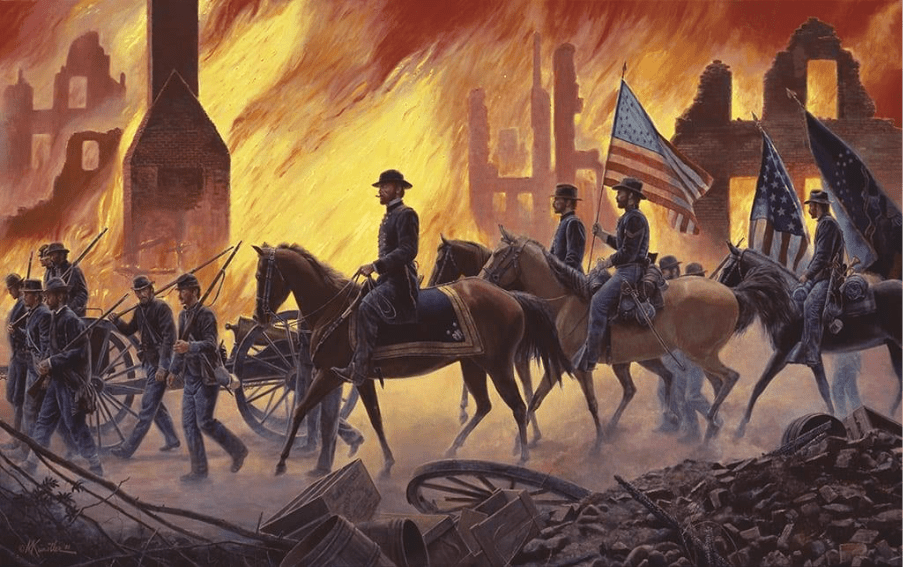
When his army arrived in Columbia, South Carolina, they burned it to the ground. The city whose legislators had started the rebellion was finally brought to heel and made to feel the wrath of the Union.
Sherman received the surrender of the final major Confederate army in North Carolina on 18 April, a full nine days after Lee’s surrender to Grant at Appomattox, and just three days after the assassination of Abraham Lincoln.
Sherman’s march was a masterclass in strategic manoeuvring, as well as logistics management and psychological warfare. By marching across the South, and raiding the plantation class’s homes with impunity, Sherman brought the war home for the Confederate gentry and lower classes. The Yankees could reach them. They could take their food, burn their mills, and free their slaves. It became increasingly difficult for civilians to believe newspapers claiming the war was turning in their favour, when a Yankee brigade had just set their barn on fire.
Ultimately the South’s morale cracked and then broke once Atlanta fell and Sherman tore the Deep South up unopposed. The North had achieved absolute military dominance, and the war was effectively over before the first verse of ‘Marching through Georgia’ was even penned.
“War is the remedy that our enemies have chosen, and I say let us give them
all they want.” – William T. Sherman 1864-65
Bibliography
Mackowski, Chris. 2022. “‘It Seems Exceedingly Probable That This Administration Will Not Be Re-Elected’ – Emerging Civil War.” Emerging Civil War. September 4, 2022. https://emergingcivilwar.com/2022/09/04/it-seems-exceedingly-probable-that-this-administration-will-not-be-re-elected/
Sherman, William T. 1864. “Telegram of William T. Sherman to Ulysses S. Grant, October 9, 1864.” October 9, 1864. https://cwnc.omeka.chass.ncsu.edu/items/show/143
“The Carolinas Campaign – Essential Civil War Curriculum.” 2015. Essentialcivilwarcurriculum.com. 2015. https://www.essentialcivilwarcurriculum.com/the-carolinas-campaign.html
://mangowebdesign.com, Website design and web development by Mango Web Design http. n.d. “Carolinas Campaign (January 1865-April 1865).” North Carolina History Project. https://northcarolinahistory.org/encyclopedia/carolinas-campaign-january-1865-april-1865/
Saelee, Mike. n.d. “Research Guides: Sherman’s March to the Sea: Topics in Chronicling America: Introduction.” Guides.loc.gov. https://guides.loc.gov/chronicling-america-shermans-march
Bailey, Anne. 2002. “Sherman’s March to the Sea.” New Georgia Encyclopedia. September 5, 2002. https://www.georgiaencyclopedia.org/articles/history-archaeology/shermans-march-to-the-sea/
Marszalek, John. 2014. “Sherman’s March to the Sea.” American Battlefield Trust. American Battlefield Trust. September 17, 2014. https://www.battlefields.org/learn/articles/shermans-march-sea
History.com Editors. 2010. “Sherman’s March to the Sea – Route, General, Facts | HISTORY.” HISTORY. February 22, 2010. https://www.history.com/articles/shermans-march
James Lee McDonough. 2016. William Tecumseh Sherman: In the Service of My Country: A Life. W. W. Norton & Company.
Kearns, D. (2013). Team of rivals : the political genius of Abraham Lincoln. London: Penguin.
White, Ronald C. 2016. American Ulysses : A Life of Ulysses S. Grant. New York: Random House.
Featured Image Credit: Clark, Joseph R. 2018. “The Strategic Significance of Sherman’s March to the Sea.” War & Warfare. May 18, 2018. https://wp.towson.edu/jrclark/2018/05/18/the-strategic-significance-of-shermans-march-to-the-sea/
 Retrospect Journal