
Written by Peiqi An
The ancient Babylonian Epic of Gilgamesh (c. 2100–1200 B.C.E.) is a fictionalised account depicting the life of King Gilgamesh during his reign over Uruk around the year 3 B.C.E. The Epic draws on mythologisation to portray Gilgamesh as a semi-divine figure and pairs him with the wild animalistic Enkidu, weaving a story of their encounter, adventures, growth, and fate. The narrative of the epic is roughly divided into three stages, each connected by an experience of loss. The first stage features the creation and humanisation of Enkidu, in which his loss of primitive innocence serves as the driving force. The second stage centres around the heroic adventures of Gilgamesh and Enkidu, culminating in Gilgamesh’s devastating loss of his companion and the awakening of his self-awareness. The final stage of the story tracks Gilgamesh on his quest for immortality, which he ultimately abandons after losing all hope.
As will be discussed in the subsequent sections, an exploration of the psychological weight of these losses and their impacts on the characters can illuminate two universal questions considered by the Sumerians and their successors: the boundaries between humans and nature, and between humans and the gods. In addressing these questions, the epic offers its own interpretation of humankind’s place in the world and how one ought to live.
Enkidu is the protagonist in the first stage of the epic. Created by the gods from clay, he was sent on a mission to counterbalance the overwhelming power of King Gilgamesh. During this time, Gilgamesh had been exerting tyranny over his subjects in Uruk, provoking widespread discontent. Enkidu did not confront Gilgamesh immediately after his birth. He instead lingered on the steppe, ignorant of human affairs, wild and robust. The epic describes Enkidu in this phase as a beast-like man “befriended with the animals, expelled hunters, fed on grass, and heart delighted in water.” Such descriptions suggest that, in his early life, Enkidu lived according to primitive instincts, identifying himself with the animals of the steppe. It was only through his encounter with a harlot from Uruk that Enkidu would cultivate the human side of his being. The harlot seduced him, and Enkidu eagerly yielded to the experience, abandoning his animal kinship and awakening fully to human desire.
The harlot then initiated Enkidu into the customs of human society: he dined with shepherds, drank beer, clothed himself, and tended to his hair. Through this contact with humanity, Enkidu lost his former bond with the animals. Enkidu initially became frustrated to find that the wild beasts no longer approached him, and that he had forfeited the swiftness once comparable to that of a deer. Yet this bitter realisation soon gave way to a new longing for human companionship. Upon hearing of Gilgamesh’s tyranny, Enkidu resolved to correct the king’s excesses and set out for Uruk. His arrival in the city marked the completion of his transition from nature to civilization; his ties to the human world were then fully formed. His extraordinary strength and vitality soon won him the friendship of King Gilgamesh (a dynamic some interpret as homoerotic). Enkidu lived in Uruk among its citizens as a fulfilled human, “wise and godlike”. But the price of this transformation was Enkidu’s irrevocable loss of his original innocence.
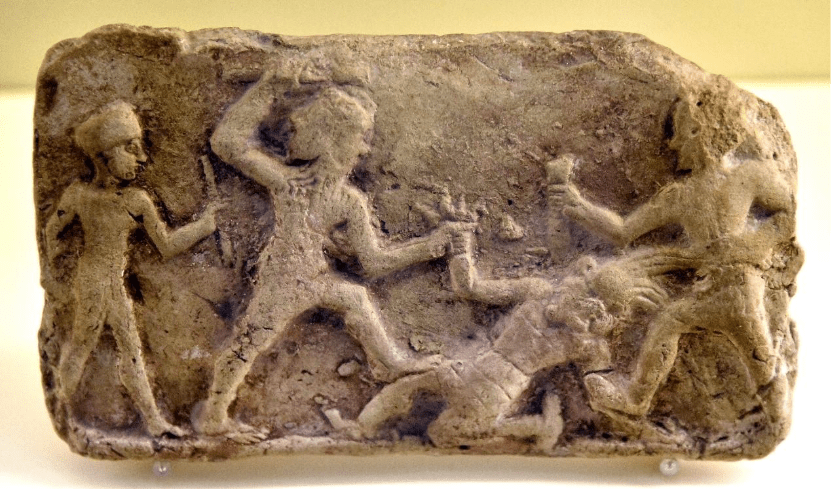
The story then proceeds to its second stage, where Gilgamesh and Enkidu go on a series of adventures. The heroes once travelled to a cedar forest to claim its timber, where they encountered and slew the forest’s monstrous guardian, Huwawa. This triumph drew the attention of Ishtar, the Mesopotamian goddess of love and war. She proposed marriage to Gilgamesh but received merely a scornful rejection. Offended by the King’s arrogance, Ishtar sought revenge by sending the Bull of Heaven to ravage Uruk. The heroes defeated the beast, but the act further provoked the gods, who judged that the pair had gone too far in transgressing the divine order. As punishment, they decreed that Enkidu must die. Following the gods’ decision, Enkidu was struck with a fatal illness and died in a miserable, effortless struggle.
The sudden death of Enkidu constituted the second crucial loss in the epic. It plunged Gilgamesh into profound grief and, more disappointingly, revealed to him a terrifying truth: even the most glorious individuals could not overcome their destined mortality through sheer force of will. Prior to this point, Gilgamesh had acted with pride and privilege, eager to distinguish himself from lesser beings. His “two-thirds divine, one-third human” nature had endowed him with superior charisma to achieve whatever he desired in the secular world. It was not until the inescapable loss of his closest companion that the ambitious king began to reflect upon the limitations of his existence: being godlike imposed greater expectations; yet being human ultimately constrained his fulfilment. Too powerful to find companionship among mortals; yet not omnipotent enough to join the gods, Gilgamesh’s realisation posited himself in an uneasy state of isolation and loneliness. He came to believe that the problem of mortality was the most fundamental of all, and that by overcoming it, he might be able to close the gap between humans and gods.
Driven by an all-consuming desire to transcend his fate, Gilgamesh embarked on a long journey in search of immortality, leading the story into its third stage. He eventually found Utnapishtim, the only human to escape death, from whom he sought advice. In their dialogue, Utnapishtim revealed the secret of his eternity: he had survived the Great Flood sent by the gods to annihilate humankind, and he was granted infinite life as an exchange for keeping the cause of the Flood sealed. After reviewing Gilgamesh’s mixed lineage, Utnapishtim drew a fatalistic conclusion that Gilgamesh, human at his core, could not alter the fate of death that had been determined by the gods. Yet, moved by the king’s courageous quest, Utnapishtim presented him with a herb of rejuvenation that could restore youth to the old and thus delay the approach of death. With this mystical plant in his possession, Gilgamesh prepared to return to Uruk, hopeful of fulfilling his magnificent ambition.
Regrettably, the herb of rejuvenation was stolen by a serpent on Gilgamesh’s way home. This final loss in the epic declared the complete failure of the King’s quest. Humiliated yet fatigued, Gilgamesh eventually accepted the limitations imposed by his mortal nature. He returned to the city of Uruk and continued to rule as its king. The later course of his life is described in the very opening of the epic as follows:
“He who saw everything to the ends of the land,
Who all things experienced, considered all!
[ … content lost … ] of wisdom, who all things[ … ].
The hidden he saw, laid bare the undisclosed.
He brought report of before the Flood,
Achieved a long journey, weary and worn.
All his toil he engraved on a stone stela.
Of ramparted Uruk the wall he built,
Which no future king, no man, can equal.
Go up and walk on the walls of Uruk,
Inspect the base terrace, examine the brickwork:
Is not its brickwork of burnt brick?
Did not the Seven Sages lay its foundations?”
These narratives suggest that the loss of the plant, along with the hope of attaining eternal life, marked the beginning of Gilgamesh’s spiritual advancement. Upon his arrival in Uruk, Gilgamesh had evolved from an arrogant king untouched by self-reflection into a human being of wisdom and maturity. The king did not succumb to despair but turned to fortifying the great city of Uruk. By securing the remembrance of his deeds and virtues for future generations, Giligamesh found an alternative form of immortality. Perhaps, in the eyes of the epic narrator, being able to confront death and embrace life constitutes the true essence of a hero’s extraordinary stature.
Through its tripartite structure, The Epic of Gilgamesh presents loss as a driving force of individual development. At each stage of transformation, the protagonists left their former states behind and acquired new insights of humanity, which enabled them to move from innocence to awareness, from ignorance to wisdom. Meanwhile, through these moments of loss and gain, the epic encourages its readers to reflect upon the place of human beings within the contiguous realms of animals and gods by recognising both their limitations and their capacity for inner fulfilment—even in the absence of divine power. Besides its universal themes of humanity and nature, mortality and eternity, the epic also engages with secular concerns such as love, friendship, and combat. The social and philosophical reach of the epic, rooted in the ancient Mesopotamian worldview, continue to invite careful reading and interpretation today.
Bibliography
Black, Jeremy; Anthony Green, and Tessa Rickards. Gods, Demons and Symbols of Ancient Mesopotamia: An Illustrated Dictionary. Austin: University of Texas Press, 1992.
Nash Wolff, Hope. “Gilgamesh, Enkidu, and the Heroic Life.” Journal of the American Oriental Society 89, no. 2 (1969): 392-398. https://doi.org/10.2307/596520.
Pritchard, James B., ed. Ancient Near Eastern Texts. Princeton, NJ: Princeton University Press, 1950.
Van Nortwick, Thomas. Somewhere I Have Never Travelled: The Hero’s Journey. Oxford: Oxford University Press, 1996.
Featured image credit: “Gilgamesh and Enkidu Slaying Humbaba at the Cedar Forest”. 19th-17th century B.C.E. Vorderasiatisches Museum, Berlin, Germany. Wikimedia Commons.
 Retrospect Journal