
Written by Hannah Connolly
29/03/26
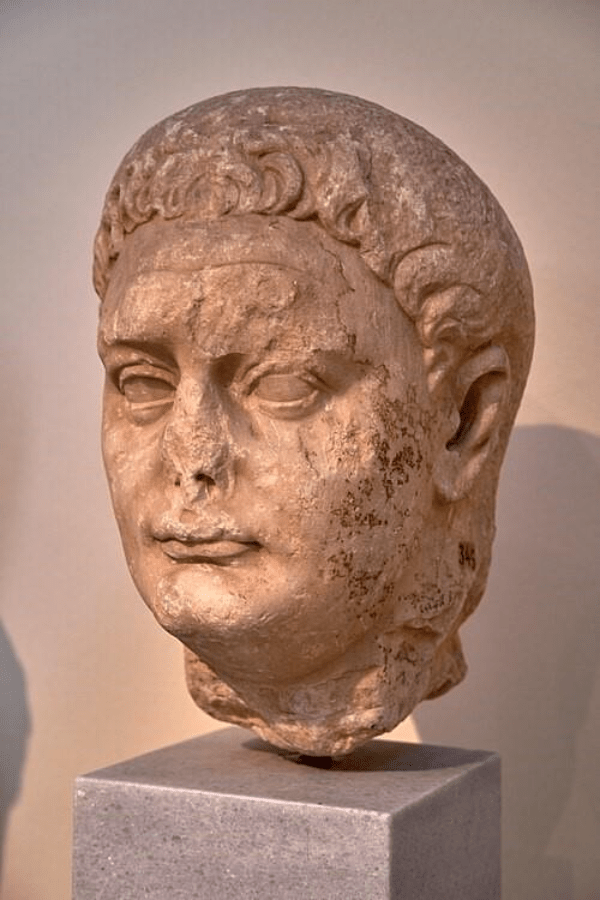
Of all the emperors of Rome, few have earned a reputation as hostile or condemnatory as that of the last Flavian princeps, Domitian. Post-Flavian historians such as Suetonius and Tacitus characterised Domitian’s reign (81–96 CE) as a time of tyranny and corruption, with Domitian himself cast as the ultimate despot: tyrannical, suspicious, and autocratic. This hostile portrayal, born of senatorial discontent and literary manipulation, has only recently been challenged in scholarship. Increasingly, historians have begun to present Domitian not as an arbitrary tyrant but as a capable and even paradigmatic emperor. Although Domitian was no more or less autocratic than his predecessors had been (or than his successors would be), he lacked the political restraint of the Julio-Claudian dynasty, whose careful preservation of republican conventions had secured the cooperation of the senatorial elite. Domitian’s more overt manifestation of his imperium, particularly in his self-presentation, unsettled the established pretence of Republican virtue, displacing the elites. As a result, members of the senatorial class increasingly depicted him as a threat to their historic authority and to the restrained style of emperorship that had characterised earlier reigns.
As the younger son of Vespasian, Domitian was not expected to ascend to the principate. During the reigns of his father and his elder brother, Titus, he received honours appropriate to an imperial prince but possessed little practical administrative authority. It is easy to see how this position could be manipulated by anti-Domitianic historians as the motivation for his bitterness and tyranny. By contrast, Titus’ popularity and his sudden death in 81 CE ensured that his reputation remained largely untarnished. Domitian therefore inherited a principate overshadowed by the memory of his predecessor, and his policies were frequently judged against an idealised image of Titus’ brief reign. In the post-Flavian literary tradition, this contrast between the two brothers became a powerful rhetorical device. Authors regularly portrayed Titus as the virtuous antithesis to Domitian’s despotism across biographies of both brothers (Suet. Tit. 9). Suetonius even suggests that Domitian may have been implicated in his brother’s death, claiming that he prematurely declared Titus dead in order to secure his own accession (Suet. Dom. 3.3). The construction of this narrative, however effective, reveals less about the circumstances of Titus’ death than about the willingness of later writers to construct narratives that reinforced Domitian’s reputation as a tyrant.
By the time Domitian ascended the principate in 81 CE, the office of emperor had existed for over a century. During this time, Romans developed strict expectations for how an emperor was supposed to act, both personally and politically. The extent to which any emperor met this standard, or failed to do so, had a significant impact on how their reign was perceived. Many writers also depended upon senatorial patronage, meaning that their works often reflected the political attitudes of the aristocratic class. One aspect of imperial behaviour that attracted particular scrutiny was the emperor’s public self-presentation. Anti-Domitianic authors repeatedly emphasised a claim that Domitian demanded to be addressed as Dominus et Deus (“Lord and God”), presenting this alleged insistence as proof of his arrogance and detachment from Roman political tradition (Suet. Dom. 13.1). Modern historians have found no reliable evidence that Domitian formally adopted this title. Nevertheless, the rumour proved useful to hostile writers, who exploited the religious implications of the phrase to portray Domitian as an impious and tyrannical ruler. For Roman elites, the idea that a living emperor might openly claim divine status represented an affront both to traditional Roman notions of deification — which were generally reserved for deceased emperors — and to the carefully cultivated modesty that senators expected from their rulers.
In reality, however, associations with the divine were neither unprecedented nor unique to Domitian. Imperial links with divinity had been an established feature of Roman political culture since the reign of Augustus. For the Flavian dynasty, such associations carried particular importance. Unlike the earlier Julio-Claudian rulers, the Flavians lacked a direct hereditary claim to the throne and accentuated associations with the divine to make their reign seem predestined, and therefore incontestable. Both Vespasian and Titus were formally deified by the senate upon their deaths. As in other aspects of his reign, Domitian continued and expanded this tradition by cultivating more visible connections with the divine during his lifetime, presenting himself as an earthly counterpart to Jupiter and drawing upon broader Hellenistic traditions of sacred kingship. Although the concept of a divinely favoured ruler was not new, Domitian’s willingness to emphasise such associations more openly than his predecessors provoked criticism among later authors. Even relatively conventional expressions of imperial honour were interpreted negatively. For example, Domitian’s decision to rename the month of his birth “Domitianus” was portrayed as an act of vanity, despite the precedent set when Augustus renamed the month Sextilis in his own honour. This demonstrates how post-Flavian writers reinterpreted otherwise typical imperial practices to reinforce the image of Domitian as a tyrant. In this respect, Domitian’s supposed despotism often reflects the rhetorical strategies of hostile authors rather than the realities of his rule.
There are some elements of Domitian’s principate that writers found harder to criticise, particularly in his engagement with the Roman people through entertainment and public benefaction. His spectacles extended beyond physical contests to include competitions in poetry, literature, and oratory. Even hostile writers acknowledged his consistent commitment to staging tournaments and games in Rome (Suet. Dom. 4.1–5), though they often sought to undermine this praise by comparing his spectacles to those of the archetypal literary tyrant for post-Julio-Claudian writers, Nero. In the Panegyricus delivered to Trajan, Pliny the Younger invoked memories of Nero’s Neronia to present Domitian’s games as instruments of domination that emphasised the people’s subordination to imperial authority (Plin. Pan. 33.3–4). Yet this interpretation wasn’t universal. In the Statius’ Silvae (1.6), Domitian’s spectacles appear instead as expressions of imperial generosity, celebrating the emperor’s role as benefactor and guardian of the Roman world. These contrasting portrayals illustrate the extent to which literary perspective shaped the historical image of Domitian.
A similar dynamic can be observed in the treatment of Domitian’s ambitious building programme. Over fifty structures in Rome were built, restored, or completed during his reign—an achievement rivalled by few other emperors. Although large-scale urban development had long been a hallmark of imperial rule, and many of Domitian’s works were inherited from Titus, writers such as Suetonius portrayed the scale of Domitian’s construction projects as evidence of extravagance and fiscal irresponsibility, claiming that the strain placed upon the imperial treasury encouraged increasingly oppressive forms of governance (Suet. Dom. 12). In promoting this narrative, Suetonius effectively “retroactively darkens” both Domitian’s building programme and his character, presenting tyranny as the inevitable consequence of excessive ambition. He further alleged that Domitian replaced the names of original builders with his own (Suet. Dom. 5.1), reinforcing the stereotype of a ruler who appropriated public generosity for personal glory. Modern scholarship, however, has questioned these accusations. Some historians, such as Geoff W. Adams, have argued that inscriptions likely read “restored by Domitian” rather than claiming original construction, a distinction that undermines the ancient charge of self-aggrandisement. Increasingly, scholars recognise that Domitian’s energetic building activity reflects a conscious engagement with the traditional expectations of imperial benefaction. Indeed, Carole E. Newlands suggests that, after Augustus, Domitian was Rome’s most significant builder, shaping its identity not only as a political centre but as a cultural capital. Such policies sit uneasily with the traditional portrayal of Domitian as a cold and isolated tyrant and instead support more favourable reassessments of his reign.
Ultimately, Domitian’s historical reputation owes far more to the political rhetoric of later authors than to the realities of his rule. In the violent transfer of dynasties following Domitian’s assassination in 96 CE, the new regime established under Nerva and later developed by the Nerva-Antonine dynasty had strong incentives to distance itself from the Flavian past. In this context, emphasising Domitian’s alleged tyranny served both to legitimise the new dynasty and to flatter the senatorial elites whose support was essential to the stability of the regime. Domitian himself largely followed the same imperial model established by earlier emperors, but he did so with less concern for preserving the delicate fiction that the Senate remained politically dominant. By openly exercising powers that had long been inherent in the principate, he forced Roman elites to confront an uncomfortable reality: that ultimate authority within the Roman state rested firmly in the hands of the emperor. There was no aspect of Domitian’s reign that was more tyrannical than his predecessors had been. The hostility of many ancient sources reflects not an unprecedented tyranny but a reaction against the increasingly explicit nature of imperial power. Modern scholarship, by reassessing the literary biases of these sources and placing Domitian’s policies within their broader historical context, offers a more balanced interpretation of his reign and challenges the long-standing caricature of the emperor as merely “an object of terror and hatred to all.” (Suet. Dom. 15.1)
Bibliography
Adams, G.W (2005), ‘Suetonius and his treatment of the emperor Domitian’s favourable accomplishments’, Studia Humaniora Tertuensia 6.A.3, 1 – 15.
Augoustakis, A & Buckley, E. (2021), ‘Man and God: Literature’ in Raimondi Cominesi, A et al (eds.), God on Earth: Emperor Domitian. The Reinvention of Rome at the end of the 1st century AD, Leiden, 159 – 167.
Boyle, A.J. (2003), ‘Introduction: Reading Flavian Rome’ in A.J Boyle and W. Dominik (eds.) Flavian Rome: Culture, Image, Text. Leiden, 1 – 67.
Coleman, K. (2019) ‘The Emperor Domitian and literature,’ Aufstieg und Niedergang der römischen Welt II 32.5, 3087 – 3115.
Escamez de Vera, D.M. (2019), ‘The Sodales Flauiales Titiales, the Flamen Dialis, and the Propaganda of Domitian’ in A. Augoustakis et al. (eds.), Un-damning Domitian. Reassessing the last Flavian princeps, Illinois Classical Studies 44.2, 326 – 343.
Jones, B.W. (1992), The Emperor Domitian, London.
Newlands, C. (2003) ‘The Emperor’s Saturnalia: Statius, Silvae 1.6’ in A.J Boyle and W. Dominik (eds.) Flavian Rome: Culture, Image, Text. Leiden, 499 – 522.
Raimondi Cominesi, A. et al (2021), ‘Introduction: Domitian, the Neglected Emperor Who Wished to Be God’, in A. Raimondi Cominesi et al (eds.), God on Earth: Emperor Domitian. The Reinvention of Rome at the end of the 1st century AD, Leiden, 13 – 17.
Schulz, V. (2019) Deconstructing Imperial Representation: Tacitus, Cassius Dio and Suetonius on Nero and Domitian, Leiden.
Southern, P. (1997) Domitian. Tragic Tyrant. London.
Spinelli, S & Gregory, G. (2019), ‘(Un)-damning Subplots: The Principate of Domitian Between Literary Sources and Fresh Material Evidence’ in A. Augoustakis et al. (eds.), Un-damning Domitian. Reassessing the last Flavian princeps, Illinois Classical Studies 44.2, 242 – 268.
Tang, H. (2019), ‘Domitian, Literary Restriction, and the Poetics of Catasterism and Divinity in Statius’ Silvae 1.1 and 1.2’ in A. Augoustakis, et al. (eds.), Un-damning Domitian. Reassessing the last Flavian princeps, Illinois Classical Studies 44.2, 344 – 359.
Wallace – Hadrill, A. (1982), ‘Civilis Princeps: between citizen and king’, JRS 72, 32 – 48.
Featured Image Credit: George E. Koronaios, CC BY-SA 4.0 <https://creativecommons.org/licenses/by-sa/4.0>, via Wikimedia Commons
 Retrospect Journal