
Written by Kate Taylor
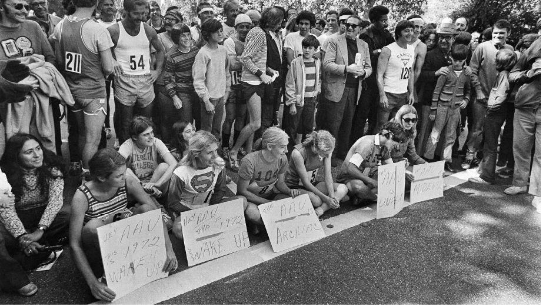
The 1972 New York Marathon had 272 runners. Only six of these were women. For the first time, women were allowed to stand on the start line with men in Central Park. But there was a catch: they had to start the race ten minutes before the men. So when the gun went off, Lynn Blackstone, Jane Muhrcke, Liz Franceschini, Pat Barrett, Nina Kuscsik, and Cathy Miller sat, in protest. For ten minutes.
Prior to 1972, the Amateur Athletics Union (AAU) had banned women from participating in marathon events, citing contested scientific research that suggested that long distance running could have disproportionate negative effects on women’s health. Indeed, following earlier opposition, they doubled down on the ban, claiming that women would receive an unfair pacing advantage if they ran with men in the marathon. This echoed the Civil Rights concept of ‘Separate but Equal’, used since the 1896 Plessy v Ferguson Supreme Court case to determine segregation as lawful. Women who travelled to AAU meets had to be accompanied by a chaperone, regardless of age. Running, it seemed, lagged behind social change.
Attempts had been made before to increase female representation in athletics. The 1928 Olympics saw the first female half mile event, but the collapse of several competitors on the finish line saw the event’s removal for over thirty more years.
But 1972 was different. Just months before the New York marathon, Title IX of the Education Amendments was passed, preventing federally funded education institutions from discrimination in sports based on sex. Many universities had yet to introduce female athletics and ball-sports teams. In response to this, the AAU had agreed that ‘certain women’ would be allowed to take part in marathon events but had failed to stipulate the criteria that would judge this categorisation. The 1972 Boston Marathon was the first event that women were officially allowed to take part in. Several female entrants arrived at the start line with hope of a new era of women’s sport, only to find that they were forced to start the race from a separate start line.
In New York, men and women were allowed to start from the same line, but not at the same time. The six start line protesters were not all serious marathoners. Indeed, only two of them actually finished the race once they had concluded their protest. Several of them had been roped in purely for the opportunity to send a message of the AAU. Nina Kuscsik won the race with a time of 3:08:41, smashing her previous personal best. Or so she thought. Because the AAU added ten minutes to her time.
The now-famous start line photograph, taken by New York Times photographer Patrick Burns, was plastered across the front pages of major US newspapers for days. It seemed that the tides were finally turning. At the 1973 AAU Convention, Nina Kuscsik turned up and threatened a lawsuit, which had been funded and prepared by experts at the American Civil Liberties Union, who were well versed in civil rights related cases during this period. In response, the AAU agreed to drop the separate start policy, allowing women equal access to marathon events for the first time. But there was still a long way to go. Nike was yet to even release a running shoe for women.
It took until 1980 for the American College of Sports Science to conclude that there was little real evidence to suggest that long distance running was specifically harmful to women. With this backing, the AAU and Kuscsik began lobbying the Olympic Committee to increase the maximum Olympic distances for women. They agreed in 1981, with the first women’s marathon event to be held at the 1984 Los Angeles Olympics.
Fifty four years later, over half of the New York marathon field are female. A large part of this progress can be attributed to the ‘Six Who Sat’ and the running revolution that their protest catalysed.
Bibliography
Butler, Charles. ‘Sole Sisters of ’72’. Runner’s World, 2018. https://www.runnersworld.com/runners-stories/a20966306/sole-sisters-of-72/.
Hartzell, Hannah. ‘The NYC Marathon’s Original Badass’. Women’s Running, 16 October 2018. https://www.womensrunning.com/culture/the-nyc-marathons-original-badass/.
Lee, Dana. ‘Fifty Years Ago, Six Women Protested at the Start Line of the NYC Marathon and Changed History’. ESPN, 2022. https://www.espn.com/espnw/story/_/id/34948681/fifty-years-ago-six-women-protested-start-line-nyc-marathon-changed-history
New York Road Runners. ‘Title IX, Women’s Running, and the Road Ahead’. New York Road Runners, 2017. https://www.nyrr.org/run/photos-and-stories/2020/title-ix-womens-running-and-the-road-ahead.
Waxman, Olivia B. ‘The Story Behind the Photo of a Turning-Point Protest at the New York Marathon 50 Years Ago’. TIME, 2022. https://time.com/6226132/six-who-sat-history-new-york-city-marathon/
Featured Image Credit:
‘Sole Sisters of ’72’. Runner’s World, 2018. https://www.runnersworld.com/runners-stories/a20966306/sole-sisters-of-72/.
 Retrospect Journal