
Written by Bethan Williamson
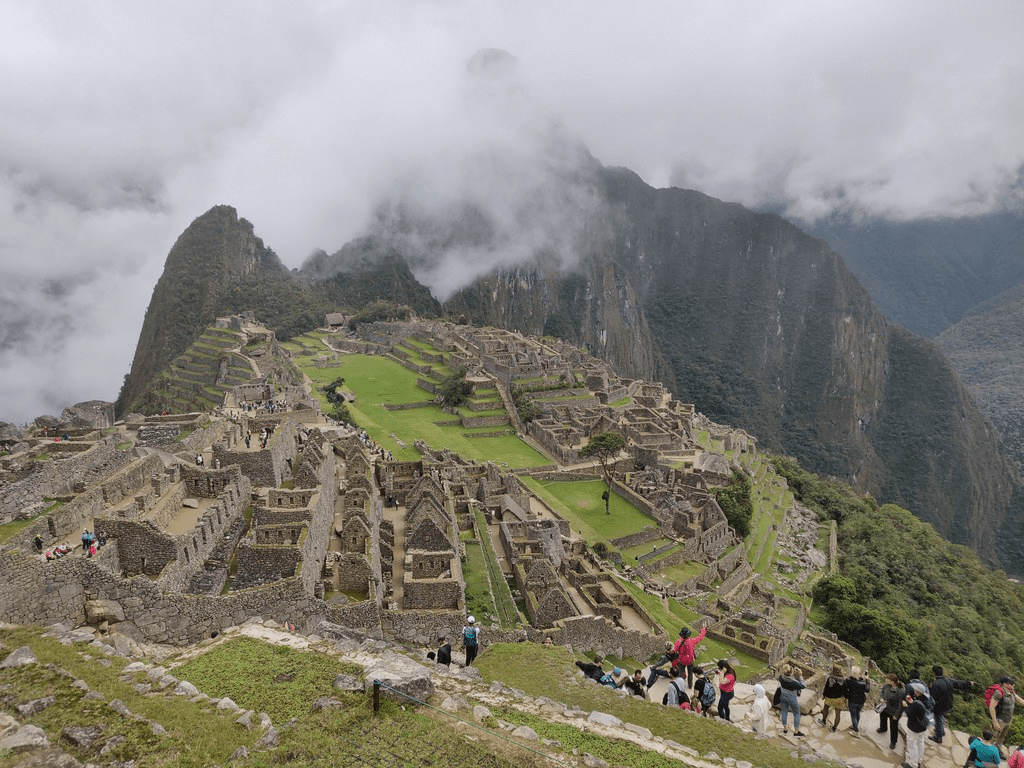
Not only is the site of Machu Picchu in the Andean Amazon basin one of the most biodiverse places on earth, but the approximately 200 structures that stretch across the steep slopes are held as some of the greatest artistic and architectural achievements to this day. This article means to challenge the Western understanding of Machu Picchu and the hierarchies of discovery stemming from Hiram Bingham’s publicization of the historic site. This debate remains very relevant for both indigenous communities in Peru, and for our present need to continue decolonising history. Neither Machu Picchu as a site nor historical narratives surrounding it should be construed as static. Machu Picchu is an important part of a living Andean landscape, far from a colonial treasure frozen in time. As for archaeology and history as disciplines, it is essential to renew and challenge our shared language to avoid the narratives of colonial conquest and Eurocentric superiority that are apparent in the mythmaking of Machu Picchu.
Decolonising histories
The mystique of Machu Picchu today does not exist in isolation of the conditions that it was created in. It can instead be understood in terms of cultural currency, stretched or adapted to affirm national identities. This is where unpacking the idea of ‘discovery’ becomes pertinent to decolonising our histories and challenging hierarchies of intellectual authority. Although post-colonial histories have been developing as a discipline from even as early as the 1960s, it was not until the 2010s that our understanding of the imperial subtext behind many instances of early archaeological narratives really began to grow. In decolonising a history of Machu Picchu, we owe a lot to the efforts of historians working on different examples of colonial storytelling, such as those studying the popular imagining of Mesopotamia or even histories of the use of atlases. It is essential to understand how even the development of a field of research can make up one part of a multi-faceted cultural structure of empire that outlasts the physical dissolution. One of the most important criticisms that these historians make is that world archaeology, as it has been defined by the West, perpetuates a teleological worldview—specifically the widely circulated notion that all civilisations are singular steps in a slow evolution resulting in the present Western economic and political model. These narratives often describe ancient civilisations as advanced whilst simultaneously framing their local ancestors as underdeveloped. Colonial narratives can therefore claim ownership of the past by arguing that geographical ancestors such as Peruvians have degenerated from this history. However, this historiographical challenge to intellectual tradition has laid the foundations for attempting a history of the Inca civilisation that reflects the development of the present indigenous population and Quechua culture, rather than serving the interests of the colonial cultures that historians previously wrote from.
The 1911 expedition
American professor Hiram Bingham first led an expedition in an attempt to uncover the history of the Incas in February 1909, although it took another expedition in 1911 to actually find Machu Picchu, and many more to properly study it. Bingham had an academic background in South American history as a Yale professor, however neither he nor any other member of his expedition team had any formal training in archaeology. The success of the trip could not have been possible without the efforts of Peruvians in guiding and advising the team of Americans, particularly a local peasant farmer named Melchor Arteaga who physically led them to Machu Picchu. It is true that there was a lack of organised academic research into the historical sites of the Incas such as Machu Picchu, however, to perpetuate the belief that Machu Picchu was ‘lost’, and that the only local interest that existed was ‘huaqueros’—referring to poor farmers that dig up graves in search of ancient valuables to sell—fails to appreciate the essential Quechua expertise in traversing the terrain. In addition, there even were families who lived within the site and had cultivated it for crops. They had even hosted Bingham during his expedition, which seems a strikingly different story from one of uncovering a mysterious lost city. Bingham reported his findings to Yale and in 1913, National Geographic published an entire edition dedicated to his ‘discovery’, with no mention of the help he had received. This lack of Peruvian attention sheds light on why some historians today argue that Bingham was nothing more than a grave robber himself, only more strategic in his methods.
Peruvian interpretations of the Machu Picchu mystique
Even as Peru rejects the colonial myth of discovery, the image and the daily reality of Machu Picchu remains entangled in global tourism and heritage capitalism. One aspect of cultural history that we must consider is the growth of national identities in the wake of decolonisation, and specifically how this historical material culture has been useful to pan-Latin American nationalism. Some historians describe that the cultural significance of the historical site has been a key resource in nation-building and disentangling Latin American identity from its colonised past. It is equally important to recognise the importance of tourism and Machu Picchu’s role in stimulating the economy, as around 1.5 million tourists visit the site every year. Others, however, have raised concerns about the overemphasis on tourism and how these initiatives often neglect the needs of the rural or farming communities that live locally, and their traditions, livelihoods, and environments. This has led some to argue that the current use of the image of Machu Picchu represents just another form of commodification and appropriation of Inca history to capitalise off of its cultural currency.
In summary, it is clear that much more work needs to be done not only to conduct a genuine effort of understanding the Inca civilisation and the traces that they left behind, but also to challenge the way that we conduct and retell history itself. Discovery narratives such as Bingham’s position the West as a supreme scientific authority and reduce living history to collectable objects. This is not to say that the history of this iconic site belongs to the Peruvian government only—as it is clear that the use of archaeological sites as profitable national assets can have negative effects on local communities—but instead that our understanding of Machu Picchu would benefit from a collaborative and continually evolving process.
Bibliography
Hall, Amy Cox. “Collecting a ‘Lost City’ For Science: Huaquero Vision and the Yale Peruvian Expeditions to Machu Picchu, 1911, 1912, and 1914–15.” Ethnohistory 59, no. 2 (2012)
Herrera, A. Heritage Tourism, Identity and Development in Peru. Int J Histor Archaeol 17, 275–295 (2013).
Malley, Shawn ‘From Archaeology to Spectacle in Victorian Britain: The Case of Assyria, 1845-1854’ (Farnham, Surrey, Ashgate, 2012)
Scarre, Chris. 1990. ‘The Western World View in Archaeological Atlases,’ in Peter Gathercole and David Lowenthal, eds., ‘The Politics of the Past’ (Routledge, London, 1995) pp. 11-18.
Shullenberger, Geoffrey. 2008. “That Obscure Object of Desire: Machu Picchu as Myth and Commodity.” Journal of Latin American Cultural Studies 17 (3): 317–33.
Featured image credit: “Peru – Machu Picchu” by Alf Igel is licensed under CC BY-NC 2.0.
 Retrospect Journal