
Written by Bethany Hicks-Gravener
15/03/2026
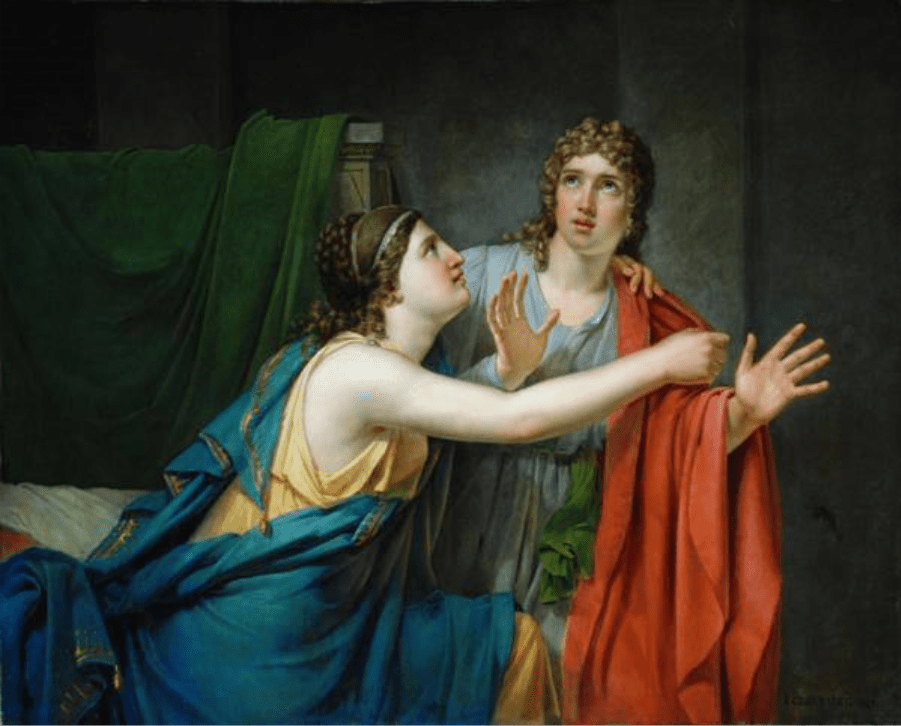
The character of Phaedra has caused much debate amongst scholars throughout history. She was a daughter of King Minos of Crete and his wife Pasiphaë, sister to Ariadne, and stepsister to the Minotaur, but she is most famously known within mythology for falling for her stepson, Hippolytus, and falsely accusing him of raping her. This article is not going to act as an excuse or a justification for her character’s actions but is instead an examination of the way she is characterised within Euripides’ play Hippolytus.
After Theseus’ slaughter of the Minotaur, he and the other Athenian captives escape Crete with Ariadne, the eldest daughter of King Minos, via a ship that is waiting for them. Ariadne agrees to go with Theseus, therefore betraying both her family and her kingdom, because she has fallen in love with him on account of Aphrodite. Theseus then proceeds to abandon Ariadne on the island of Naxos on his journey to Athens. He also chooses to ‘forget’ to change the colour of the sail of his ship, so as he sails into the harbour at Athens, his father, the king, believes that he has been unsuccessful in his mission and has died. Believing that his son is dead, his father throws himself from the palace, killing himself and making Theseus the new king of Athens. Some years later, Theseus decides that he needs a wife to provide him with legitimate heirs to his throne, and he selects Phaedra, the younger sister of Ariadne. What is unknown to Phaedra at the time is that Theseus already has a son, Hippolytus, with an Amazon (some sources say Hippolyta is his mother, others say Antiope). Some years into his marriage with Phaedra, Theseus’ son comes to visit, and it is here that Euripides’ play Hippolytus commences.
When we meet Euripides’ Hippolytus, he has sworn himself loyal to the virgin hunting goddess, Artemis. He has pledged to never take a wife and to remain chaste in honour of her for the rest of his life. Aphrodite hears of this pledge made by Hippolytus and is enraged. She seeks out a way for her to punish Hippolytus for the slight that she believes he has made against her by utilising Phaedra as a vehicle for her revenge. The passion for Hippolytus that is stirred up within Phaedra is completely controlled by Aphrodite; effectively, Phaedra is being punished for the actions of a man, much like her mother Pasiphaë’s situation when she was used by Poseidon to punish her husband Minos with the conception of the Minotaur.
Euripides explores, within his Hippolytus, the idea of a young Phaedra. Although we don’t actually know any of the characters’ ages in the play, Phaedra comes across as quite young and a bit naïve. This can be seen through the way in which the nurse, someone who is in quite regular and close contact with her, speaks to Phaedra, “but even from this desperate plight, my child, // you can escape” (705-706). Painting a picture of a more youthful Phaedra, one who is potentially in her late teens or early twenties, makes her more vulnerable to being used by Aphrodite. We can imagine that Phaedra is most likely not in love with her husband, Theseus, and so such feelings of desire and love that are instilled in her by the goddess are new to her, so she easily becomes their victim. Phaedra’s character is also quite badly afflicted with the emotions she feels throughout the duration of the play, therefore making it more believable, but also potentially more palatable that she is a younger woman. This plays into Richard Lattimore’s theory that “Euripides is content to make us see her as young,” and that from her youth we are able to sympathise more with her character.
It is also important to note that Euripides’ Phaedra is unaware that her feelings towards Hippolytus have manifested out of Aphrodite seeking to punish her stepson. Within the play she refers to the fact that Aphrodite has given her these feelings for Hippolytus, “I shall delight the goddess who destroys me,” (725), but she is unaware of the underlying reason, believing instead that it is innocently done. She never suspects herself as a vessel of divine revenge. Phaedra acts as puppet unknowingly controlled by Aphrodite, and she is so affected by the weight of her feelings and the shame that she feels regarding them that she isolates herself from her nurse and the chorus. The way in which Phaedra conducts herself, for example her choosing to try and keep her love to herself out of fear of both rejection, humiliation and the loss of her respectability amongst her people, speaks both of her human character but also again as a potential reflection of her age. Her feelings scare her because they threaten the safety that she has created for herself through providing her husband with male heirs; she strives to be a good wife even though it is clear that she feels no romantic nor erotic love towards her husband.
When all is revealed, and Hippolytus ultimately rejects her advances, Phaedra is left in a vulnerable position. Her husband is away, but those around her have borne witness to her humiliation. Ultimately, she is terrified because she knows that word will soon reach Theseus of what she has done, hence why she jumps straight to the worst possible manoeuvre she can make, just as has been planned by Aphrodite. Phaedra accuses Hippolytus of rape, therefore fulfilling her divine ‘mission’ set by the goddess and damning him to the wrath of his father. In doing this, Phaedra’s character aligns with ancient Grecian male fears at the time towards female sexuality: Phaedra’s actions would have been perceived as evidence that she is unable to control her sexual feelings and desires towards Hippolytus, and a man suffers as a result. But in reality, that is not a fair characterisation of Phaedra, she is a scared young woman who is reacting to a situation that she doesn’t know how to deal with, and so she is doing so with high drama, both because she is young and inexperienced, but also because this result was ordained by the fates and Aphrodite. There is also an argument to be made that she fears her husband’s treatment of her sons after her death, had he believed her to be a seductress; through her maternity towards her children, she seeks to protect them even in death. Due to the emotional pain and humiliation she feels with her feelings being revealed, Phaedra sees no feasible way for her to live; she knows that when Theseus finds out about the situation, her life will never be the same, and she will no longer be respected as his queen, and she fears that. Therefore, she decides to die by her own hand — providing her with one final moment of agency.
Ultimately, Phaedra is the perfect vessel for Aphrodite to enact her revenge on Hippolytus because of her mouldability caused by her lack of experience in love and by her age. She is consumed by the emotion she feels, but she never tries to fight it, allowing it to control her completely. She hates the fact that she feels such a way about Hippolytus because it threatens her entire livelihood, and she knows that nothing positive will ever come from it; at the same time, with a young Phaedra in mind, it does beg the question as to whether she also, in her own way, welcomes the feelings. They are new to her: she has never had an opportunity to fall in love, and so, although she is pained because of them, she wants to try and soak up as much emotion and romance as she can possibly get out of it. Potentially for the first time, she has a crush, which in turn proves that although she may respect her husband, she does not feel any sort of romantic love for him. In her naivety regarding love, she also probably felt confident that she would be able to control her emotions; maybe she would have been able to if Aphrodite had not been set on punishing Hippolytus. Phaedra, therefore, falls into the category of women within myth who suffer the curses of their male counterparts and, therefore, end up with tragedy befalling them too. At the close of Euripides’ play, Hippolytus also dies due to a curse cast onto him by his grieving father through Poseidon: so, Aphrodite is appeased.
Bibliography
Euripides. Hippolytus, edited by David Grene.
Lattimore, Richmond. ‘Phaedra and Hippolytus’. Arion: A Journal of Humanities and the Classics 1, no.3 (1962):5-18.
Reckford, Kenneth J. ‘Phaedra and Pasiphae: The Pull Backward’. Transactions of the American Philological Association (1974-2014) 104 (1974):307-328.
Walcott, P. ‘Greek Attitudes Towards Women: The Mythological Evidence’. Greece & Rome, 31, no.1 (1984):37-47.
Featured Image Credit: https://www.vads.ac.uk/digital/collection/NIRP/id/28669/
 Retrospect Journal