
Written By Abby Hughes
15/03/2025
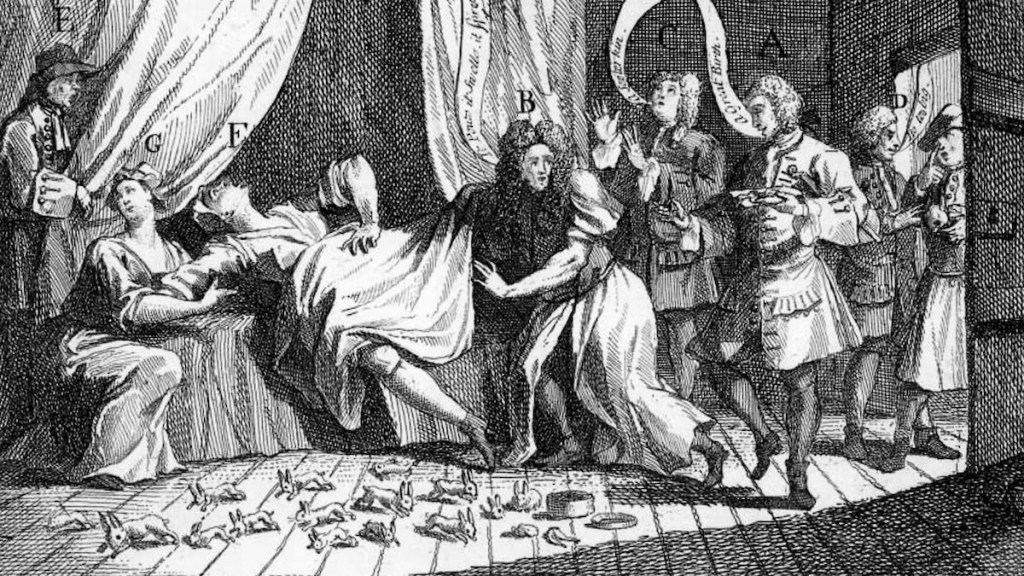
William Hogarth’s Cunicularii forms a fantastical etching, welcoming its viewer into a scene of chaos, curiosity, and spectacle. Draped curtains frame its central character in an alluring darkness as the reclined woman laments in pain. Beneath her prostrate form and lifted skirts, a litany of rabbits dance about on the floor. Flanked by doctors lost in vivid discussion, this figure represents Mary Toft. On Monday 10 October 1726, the British Gazeteer published the first mention of Toft, noting that “a poor Woman who lives at Godalmin, near that Town, who has an husband and two Children now living with her; was, about a Month past, delivered by Mr. John Howard, an eminent Surgeon and Man-Midwife living at Guildford, of a Creature resembling a Rabbit”. This confounding mystery animated the minds of many, being reported widely thereafter in newspapers, pamphlets, poems, and even featuring in caricatures. Hogarth’s 1726 engraving follows this same spectacle. Karen Harvey has argued that the composition of this piece deliberately serves as a parody of Mary’s delivery of Christ, playing on the notion of a miraculous birth, which is presented here as ridiculous rather than holy. Indeed, Hogarth uses his etching to mock the elite, wig-wearing doctors for their credulity, setting the scene of what appears an evident sham.
Two months after the initial scandal, Mary Toft would confess that the alleged rabbit-birth had been a hoax. She revealed that various animal parts had been artificially placed within and then subsequently expelled from her body. This experience itself would have been undoubtedly difficult and risked extreme illness and even death on Toft’s part. The incentive for such a performance must therefore have been incredibly alluring. However, the reason behind this deception is ultimately unclear. Lisa Cody has argued that Toft had nothing to gain from this claim, and that the manipulation of those around her has likely been underexplored. Others, such as Dennis Todd, have expressed the likely motivation of monetary gain, concluding that Toft must have been “devoted” to the cause of earning money through the attention of this scandalous story. The inability of historians to conclusively recover Toft’s own intention obscure our understanding of this strange event.
However, the fact that her testimony was originally believed reveals that this era was one where ‘monstrous’ births still played an active role in society. Harvey points to the historical idea that women’s thoughts, and in particular their “thwarted desires”, could affect their unborn children “in physical ways”. This idea manifests in Toft’s own explanation, suggested through the account of one doctor involved in the case, Nathaniel St Andre. St Andre’s report narrates Toft’s story, beginning on the 23 April 1726 when she was pregnant, and weeding in a field. Upon chasing a rabbit, Toft was unable to catch it and subsequently dreamt of rabbits for a significant time. Seventeen weeks afterwards, Toft miscarried, and then took ill weeks later, then “giving birth” to what she described as “parts of a pig”. Following this, Toft describes giving birth to a number of rabbits, and states in her confession that she “had seen some rabbits who I longed for”. Attended by several doctors afterwards, including some from the Royal College of Physicians, Toft continued to give birth to rabbits throughout the autumn of 1726, the sham only being uncovered when Toft herself confessed in December.
This nonsensical description risks enticing historians to attempt the fruitless task of uncovering an actual chain of events here. However, it is more revealing when taken as a rare account of a woman’s experience of miscarriage, longing, and a struggle to understand the processes of her own body. To uncover Mary Toft’s personal experience from the pieces of description, a historian might turn to the account of her confession.
Yet how far can Toft’s confessions be used to reconstruct her personal experience of the hoax? For one, these admissions were obtained under threat of “a very painful Experiment”, as noted by Richard Manningham in his Exact Diary, and in the company of five men. Harvey places this interrogation among weeks of “frequent physical examination and round-the-clock observation”. Concluding that the confessions are “heavily mediated” documents, Harvey highlights the uncertainty that Toft’s voice can be heard in sincerity through its words. Nonetheless, the inclusion of instances where Toft is interrupted by interrogators indicates a variety of voices and opinions present at the scene, offering a glimpse of her account amongst the busy setting.
Further to this, Toft’s experience is evident through her continued mention of miscarriage. Harvey explores the idea that Toft’s tall tale acts as an elaborate metaphor for her miscarriage, noting that “the chronology Mary Toft gives of her miscarriage… and the early stages of the rabbit births match very closely”. Recognising the “repetition of detail on the miscarriage” as unnecessary throughout her confession, Harvey has suggested that this story is the most prevalent aspect of her confession and therefore is likely the aspect that Toft herself deemed most central.
Although an alluring and bizarre scandal for a historian to enquire after, the value of the accounts of Mary Toft’s hoax lies in their ability to reveal the physical manifestations of emotion on the body of this eighteenth-century woman. In this case, the female body functioned as a literal scene of public debate. Investigated as the potential setting of a monstrous birth and later revealed as a potential tool for the exploitation of the masses, Mary Toft’s womb reflected wider societal scepticism around the under-explored inner workings of the female body. Furthermore, as Harvey emphasises, by using this phenomenon to enquire after Toft’s emotional state, her bodily experience functions as more than a spectacle, mystery, or hoax. Rather, her body itself and the physical suffering she experienced unveil a rare window into an individual case of historical emotional distress.
Bibliography
Dennis Todd. ‘Imagining Monsters: Miscreations of the Self in Eighteenth-Century England.’ Chicago: University of Chicago Press. 1995.
Karen Harvey, What Mary Toft Felt: Women’s Voices, Pain, Power and the Body, History Workshop Journal, Volume 80, Issue 1, Autumn 2015, p. 33–51
Joanna Bourke. “WHAT IS PAIN? A HISTORY ‘THE PROTHERO LECTURE.’” Transactions of the Royal Historical Society, vol. 23, 2013, pp. 155–73.
Featured Image Credit: William Hogarth, Cunicularii, or the Wise Men of Godliman in Consultation, Etching, 22 December 1726. Wellcome Library, London
 Retrospect Journal