
Written by Sam Mackenzie
National anthems around the world are the subject of much debate, both inside and outside of their own countries. Usually the debate centres around which anthem is the catchiest, most inspiring, or interesting to listen to. England’s ‘God Save the King’ is almost universally labelled as dull, the French ‘La Marseillaise’ is thought to be rousing, even if few know what the lyrics mean, and the Welsh ‘Hen Wlad Fy Nhadau’ is considered to be moving, again even if few know what they’re singing along too.
Personally, I’m biased to ‘Flower of Scotland’ as it is the best one. But another area of debate which isn’t covered nearly enough when discussing National Anthems is the origin of the anthems. Here, one story rises above the rest, ‘The Star Spangled Banner’ of the United States of America.
Almost all American children know the story of the penning of ‘The Star Spangled Banner’; Francis Scott Key is on a ship while a fort is attacked, and he wakes the next day to find the fort is still standing when he thought it had fallen. Nothing overly impressive there.
But the story of the penning of the American national anthem is in fact so much deeper.
In the war of 1812, the fledgling United States of America was pitted against the might of the British Empire for the second time in its history. The Americans wished to secure their own autonomy by ending the impressment of American sailors into the royal navy, lift trade barriers implemented by Britain, and secure their plans for westward expansion by stopping British support of powerful Native American tribes. Many hawks also desired massive territorial expansion into Canada.
Britain, by contrast, treated the whole war as a bit of a side-show to the situation in Napoleonic Europe, as well as the ‘Great Game’ for India. The upstart Yanks over in North America were really just not that big a problem.
By the third year of the war, 1814, the United States was in dire straits. In August, the British army had marched into the capitol, Washington DC, and burnt it to the ground. They hadn’t scored a major victory for months, and now it looked as though an invasion of the Eastern Seaboard by the British Navy was almost certain.
The survival of the United States was very much in question. If Britain could smash the U.S. coastal defences, the game might be up. The project that had begun in New England in 1776 might come crashing down amid the thunder of naval guns and a light backing-track of ‘The British Grenadiers’.
The British Navy was planning to assault Baltimore, Maryland, in September of 1814. Just weeks after they had burned down the White House and forced the American government to flee. Now they planned to burn Baltimore to the ground, revenge on the city which built all the ships of the Privateers in America which were raiding British shipping.
The only thing blocking them was Fort McHenry. A rather robust fort sitting at the mouth of Baltimore Harbour, Fort McHenry boasted a garrison of 1,000 men, and 23 heavy guns which had been taken from a French warship. The only problems with the Fort were that the entire garrison other than its commander, Major George Armistead, were green militia who had never fought anyone. As well as the fact that the ammunition stores were made only of brick, and thus a direct hit to them would blow the entire fort to smithereens.
After land skirmishes, it was decided by the British that before an assault on Baltimore could begin, Fort McHenry’s guns would need to be silenced. The fleet moved within bombardment distance, though staying out of the range of the Fort’s own guns, and prepared for the coming bombardment.
On board one of the British vessels was a writer called Francis Scott Key, who had just negotiated the release of an American prisoner, but it was decided that both men would be kept on the ship until the assault was over.
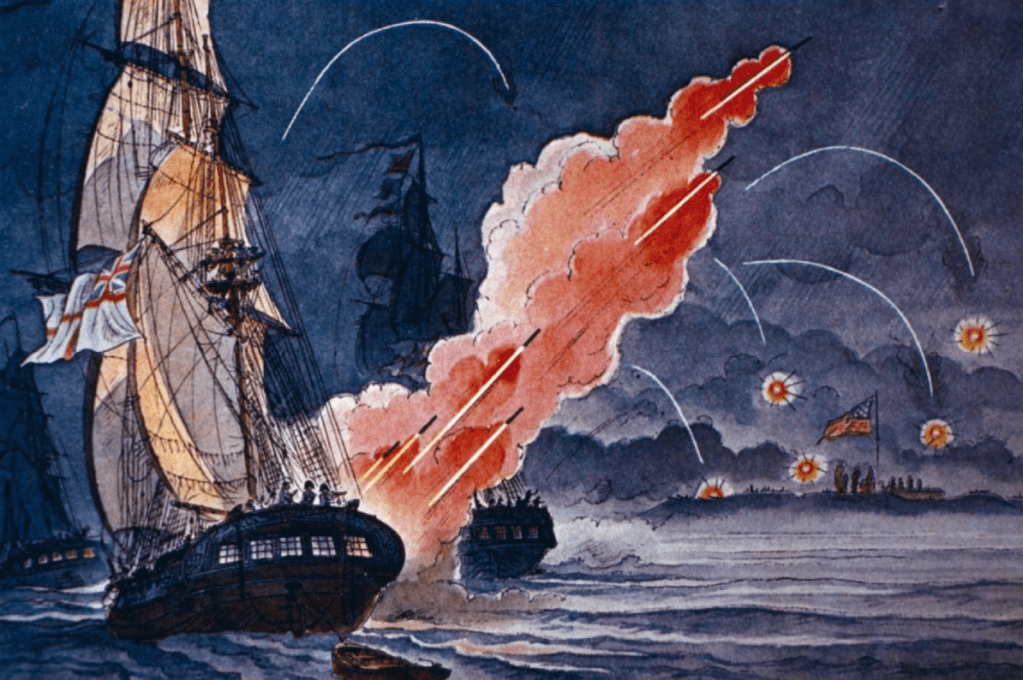
The bombardment began at roughly 6:00am on the 13th of September 1814. The British fleet fired mortar shells and newly developed rocket munitions at the Fort in a never ending barrage, pounding the fort’s outer defences relentlessly.
The barrage continued all through the day and into the evening. No respite for those inside. The roar of the guns and the booming of the explosions on the shore embedding themselves into the minds of all who heard the savage affair. Francis Scott Key heard the bombardment continue all through the night, without pause. Not for even an hour did the thunder of the British guns cease to roar at the Fort.
Key was almost certain that the Fort was lost, and with it Baltimore. One must imagine him below deck as a prisoner on a foreign warship. All he hears for the entire night is the cacophony of enemy fire being sent at his countrymen on the shore. Never ending, the bombs showered the Fort in fire and shrapnel as Francis lay helpless off the shore.
After 25 hours of constant barrage, the British guns fell silent at around 7am on the 14th. Francis Scott Key came above deck and saw, what to his eyes would have been the most surprising and beautiful thing on earth. The American Flag flapping in the morning breeze. Battered, torn, scorched, but still flying high.
Fort McHenry still stood.
It turns out that being out of range of the American guns had also left the British fleet too far away to really cause any major harm to the Fort. Even after 1,500 mortar shells and rockets, the Fort was mostly intact. No doubt the psychological effect on the mostly green recruits would have been harrowing, being under constant shelling for over a day, but the Fort itself was only superficially damaged.
It was decided by the British that without McHenry’s surrender, an assault on Baltimore was impossible, and so the fleet and the army withdrew, never to threaten the city again.
The war began to stabilize for the United States after McHenry. With the war finally ending in what was essentially a draw after the battle of New Orleans, and the peace treaty signed in 1815.
But it is impossible to overstate the impact that the defence of Fort McHenry has had in the American psyche. In the popular imagination, all the might of the British Empire threw itself at one fort, and the fort, by sheer American grit, stood against it all. This is obviously not strictly true, but the idea has held in the public imagination for over two centuries.
Key’s ‘Defense of Fort M’Henry’ was penned after he witnessed the defence of Fort McHenry, and was eventually set to music, and its name was changed to ‘The Star Spangeld Banner’. The song was officially adopted as the U.S. national anthem in 1931.
The war of 1812 turned into a war of survival for the new nation of the United States, and the song ‘Star Spangled Banner’ is quite an appropriate one to reflect the ideals of nationhood which carried America through that conflict, and through so many more of the conflicts to come in its history.
“O! thus be it ever when freemen shall stand
Between their lov’d home, and the war’s desolation,
Blest with vict’ry and peace, may the heav’n-rescued land
Praise the power that hath made and preserv’d us a nation!
Then conquer we must, when our cause it is just,
And this be our motto — “In God is our trust!”
And the star-spangled banner in triumph shall wave
O’er the land of the free, and the home of the brave.”
‘Defence of Fort M’Henry’ Francis Scott Key, 1814.
Bibliography
“The Rockets’ Red Glare: The Story of Fort McHenry.” n.d. Warfare History Network. https://warfarehistorynetwork.com/article/the-rockets-red-glare-the-story-of-fort-mchenry/
American Battlefield Trust. 2019. “Battle of Fort McHenry Facts & Summary.” American Battlefield Trust. September 10, 2019. https://www.battlefields.org/learn/war-1812/battles/fort-mchenry
Baltimore, Mailing Address: 2400 East Fort Avenue, and MD 21230 Phone:962-4290 x250 Contact Us. n.d. “Bombardment of Fort McHenry Part 1 – Fort McHenry National Monument and Historic Shrine (U.S. National Park Service).” Www.nps.gov. https://www.nps.gov/fomc/learn/historyculture/bombardment-of-fort-mchenry-pt-1.htm
McCollum, Sean. 2019. “The Star-Spangled Banner.” Www.kennedy-Center.org. September 17, 2019. https://www.kennedy-center.org/education/resources-for-educators/classroom-resources/media-and-interactives/media/music/story-behind-the-song/the-story-behind-the-song/the-star-spangled-banner/
Francis Scott Key. 2020. “Defence of Fort M’Henry by Francis Scott Key | Poetry Foundation.” Poetry Foundation. 2020. https://www.poetryfoundation.org/poems/47349/defence-of-fort-mhenry
Featured Image Credit: “The Rockets’ Red Glare: The Story of Fort McHenry.” n.d. Warfare History Network. https://warfarehistorynetwork.com/article/the-rockets-red-glare-the-story-of-fort-mchenry/
 Retrospect Journal