
Written By Manahil Masood
In the flickering candlelight of Edwardian England’s spiritual underworld, one name burns brighter, stranger, and far more stubbornly than the rest: Aleister Crowley. Oft-called a genius, a madman, a poet, a fraud, and, most famously, “the wickedest man in the world”, the multifaceted Crowley cultivated scandal almost effortlessly. He juggled identities as a mountaineer, a magician, a libertine, and a self-declared prophet of a new religious age. But strip away the sensation and what remains is a more interesting question: not whether Aleister Crowley fit the moral binary of good Christian or evil heretic, but why, even now, he continues to command our morbid curiosity.
Born in 1875 to a wealthy and intensely religious family in Royal Leamington Spa, Edward Alexander Crowley grew up under the shadow of the Plymouth Brethren, a rigid evangelical sect that preached strict moral discipline and the imminent apocalypse. By his teens, he had rejected their piety, theatrically renaming himself Aleister and embarking on a lifelong campaign to free the self from what he saw as the chains of repressive morality.
His early life followed a trajectory familiar to many turn-of-the-century aristocrats: Cambridge, European travel, and a dabble in mountaineering. But Crowley’s interior world was uncommonly vast compared to his peers. He read deeply in the occult, studied yoga and Tantric practices, and, in 1898, he joined the secretive magical society known as the Hermetic Order of the Golden Dawn. Among its members were poets, playwrights, and eccentrics, but none would surpass Crowley in infamy or, arguably, long-term influence.
After a falling-out with the Order, Crowley went his own way, founding a syncretic spiritual philosophy he called Thelema. Its central axioms, “Love is the Law” and “Do what thou wilt shall be the whole of the Law”, were not simply an invitation to hedonism (though Crowley rarely shied away from that), but a radical call to discover and enact one’s true will, free from inherited dogma. Indeed, as writer and close Crowley friend, Louis Wilkinson put it “it means find out what your real, true will is and then act accordingly to it…which is quite difficult to do”.
The Book of the Law, said to have been dictated to Crowley in Cairo in 1904 by a spirit-being named Aiwass, became the sacred text of Thelema. Whether one sees this as divine revelation or an elaborate act of artistic performance, the resulting work is undeniably compelling, feverishly blending Egyptian imagery, poetry, and esoteric mysticism. Crowley styled himself as the prophet of a new Aeon, “the Aeon of Horus”, marking a shift from organised religious obedience to personal sovereignty above all.
Newspapers, particularly in Britain, fed on the scandal, painting him as a depraved satanist and failed charlatan. At times, he seemed to relish the image: staging occult rituals in mountain retreats, openly taking lovers of every gender, and signing off his letters with the number 666. However, beneath the headlines lay a literary output that was undeniably immense, including poetry, plays, translations, and dense essays on mysticism, yoga, Qabalah, drug use, and ritual magic. His Magick in Theory and Practice remains a cornerstone of modern occult thought, blending psychological insight with meticulous records of ritual experimentation. Interestingly, he predicted the psychological significance of symbols, archetypes, and altered states long before they became mainstream. His psychedelic experiments with LSD and mescaline, meditations in Himalayan caves, and his early engagement with Eastern philosophy now read like a prelude to the Western countercultures of the mid-twentieth century.
Indeed, arguably, it is in his afterlife that Crowley has proved most powerful. His face peers out from the crowded collage of Sgt. Pepper’s Lonely Hearts Club Band; Jimmy Page bought his former house on Loch Ness; artists from David Bowie to Ozzy Osbourne have invoked his image. Again and again, creatives return to Crowley not necessarily because they believe in him or his occult teachings, but because he represents the intoxicating artistic permission to self-create.
Evidently, long before the age of personal branding and curated identities, he seemed to understand that the self could be theatrically staged and that scandal could function as promotional strategy. In this sense, Crowley feels less like a relic of Edwardian occultism and more like a prototype of the modern provocateur, drawing on the aesthetics of rebellion and the glamour of taboo that now feel deeply contemporary.
And yet, to read him closely is to encounter something far less romantic. His writings contain flashes of racism, misogyny, and authoritarian posturing that sit uneasily beside his rhetoric of liberation. Perhaps that tension is precisely why he endures. Immortality, in Crowley’s case, does not rest on his sainthood. Rather, it rests on the tensions and frictions between his dual states as sage and fraud, as enlightened prophet and unmistakably Edwardian bigot. He remains an ambiguous figure, and perhaps that ambiguity is the true source of his strange durability in countercultural imaginations today.
Bibliography
BBC Radio 4. Aleister Crowley, Master of the Dark Arts. 25 October 2025. Available on BBC Sounds: https://www.bbc.co.uk/sounds/play/m002lfs2
Crowley, Aleister. Magick in Theory and Practice (1929). Albatross Publishers, 2018.
Kaczynski, Richard. Perdurabo: The Life of Aleister Crowley. North Atlantic Books, 2010.
Owen, Alex. The Place of Enchantment: British Occultism and the Culture of the Modern. University of Chicago Press, 2004.
Sutin, Lawrence. Do What Thou Wilt: A Life of Aleister Crowley. St. Martin’s Press, 2000.
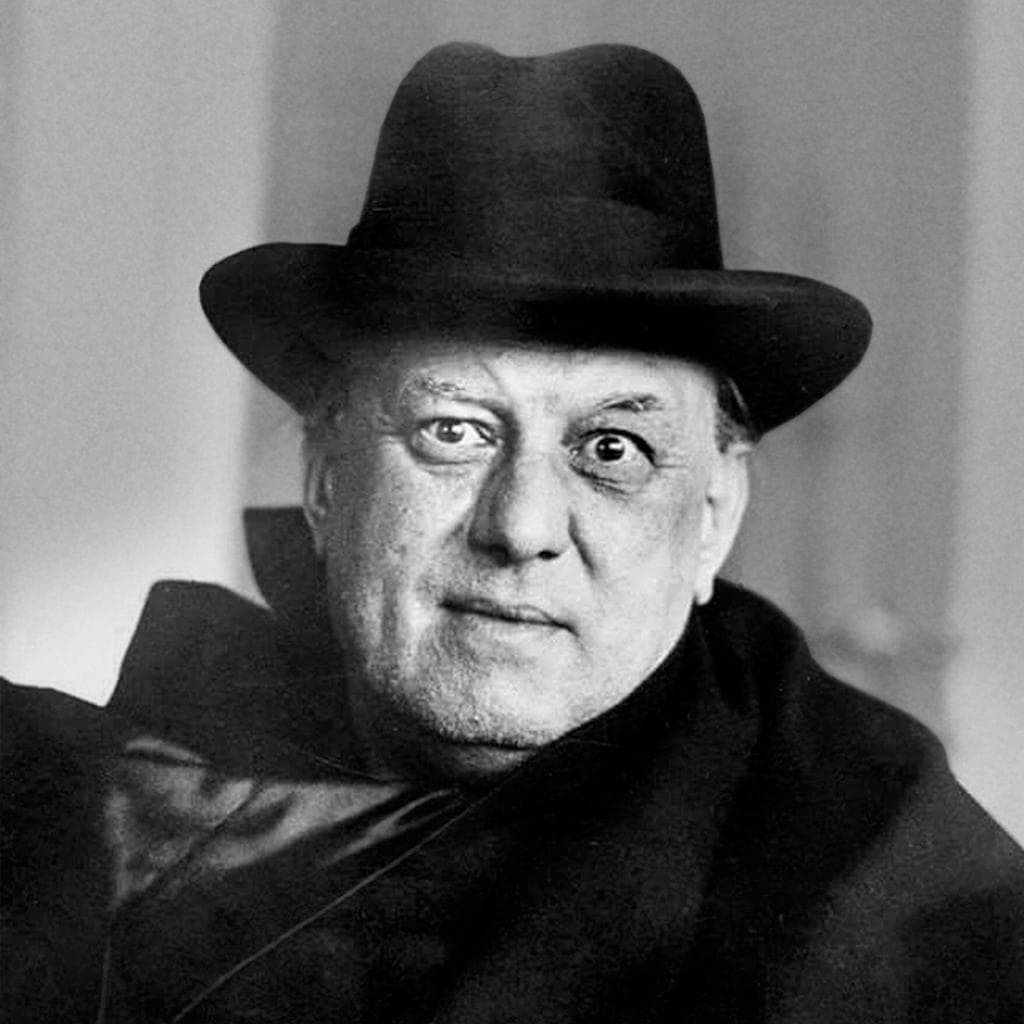
Featured Image Credit: Aleister Crowley – author photo, from the “Crowley Aleister” author page on Wordsworth Editions website. Source: Wordsworth Editions.
 Retrospect Journal