
Written by Edie Christian
22/02/2026
The 1991–2001 Yugoslav Wars are inextricably linked to the ethnic tensions of the region, particularly the rise of exclusionary Serbian nationalism during the 1980s. The death of Yugoslav Prime Minister Josip Broz Tito in 1980 removed the central, unifying figure of the federation. The resulting economic and social fragmentation was harnessed by Serbian politician Slobodan Milošević, who channelled such nationalism into ethnic hatred by emphasising Serbian victimisation. His weaponisation of political memory and folklore, namely the Kosovo myth, certainly contributed to several separate ethnic conflicts and the eventual breakup of Yugoslavia.
Despite this rapid increase in nationalism and its disastrous consequences for the region, the Kosovo myth, which focuses on the events of the 1389 Battle of Kosovo, had been central to Serbian culture for centuries. Although the events of the battle are heavily contested, the basis of the legend is that, medieval Serbian fighter Prince Lazar, whilst fighting the Ottoman Sultan Murad I, chose Christian martyrdom instead of earthly victory. The battle itself is of cultural significance to all the populations of the territory, but it is of particular significance to the minority Serbian population, to which it has become a foundational subject in folklore and literary tradition. Despite the myth’s several different forms, all versions position Serbs as a chosen people and as a blockade of Christendom against the Ottoman Empire. This is archetypal of nationalist myths in that they conjure up an image of persecution to be drawn upon in order to unify a group, whether to promote national cohesion or sow ethnic hatred.
The Kosovo myth began to develop beyond mere folklore in the nineteenth century, 500 years after the battle itself. The rise of the European nation-state led many to search through national histories in order to promote a unifying symbol and therefore promote national state-building. The Kosovo myth was ideal in its celebration of Serbian heroism as a spiritual and sacrificial act, in which the Serbian population are cast as a “chosen people”. Due to its ambiguity, the myth is almost universal in that it has acted as the central point to several, seemingly competing, narratives. For instance, before it was used to bolster exclusionary Serbian nationalism in the years preceding the Yugoslav wars, the Kosovo myth was employed to justify the creation of the Kingdom of Yugoslavia in 1918 and for Yugoslavian unity more generally throughout the twentieth century.
Despite these promotions of Yugoslav cultural unity, there were frequent hostilities between the ethnic nationalists of the different republics. The Nazi occupation of Yugoslavia during WWII developed a specifically anti-Muslim form of Serbian nationalism, epitomised by the targeting of Bosnian Muslims by the Yugoslav Chetnik forces, which resulted in thousands being killed. In the post-war period, Tito’s promotion of a common Yugoslav identity, for fear of the dangers of ethnic nationalism, appeared to be popular under his substantial cult of personality. However, it became clear after his death that repressed Serbian hostilities were threatening to boil over – namely, those of the Serbian minority population within the Serbian province of Kosovo.
It was these tensions which Milošević used to propel his rise to power. He was a high-ranking official of the League of Communists of Serbia, who became the figurehead of Serbian nationalism in 1987. On a supposedly innocuous visit to the region, during which he was instructed to calm ethnic tensions, Milošević declared support for the Serbs who claimed to be being persecuted by the ethnic Albanians, who made up 90% of the population. He was subsequently criticised by politicians from all Yugoslav identities for veering too close to the ethnic nationalism which Tito had tried to dispel in favour of Yugoslav unity. The taboo nature of ethnic nationalism was epitomised by the state’s official ideology “brotherhood and unity”, which advocated a strict prohibition on ethnic nationalism. As a result, Serbian nationalists felt Milošević was the only public figure representative of their views, which only further bolstered his popularity. Through a series of political manoeuvres, Milošević orchestrated the removals of party member Dragiša Pavlović, who publicly criticised Milošević’s stance on Kosovo, and Ivan Stambolić, the Serbian President. Stambolić was fired for allegedly misusing his power as President to block Pavlović’s expulsion; several scholars have contended that this was only possible due to Milošević’s gradual replacing of officials in government with his supporters. Stambolić subsequently resigned, opening the door for Milošević to take his place as Serbian president in February 1988.
Milošević’s promotion to president only cemented the issue of Kosovo as a perceived threat to Serbian nationalism, to which the Kosovo myth would take on a central role. On 28 June 1989, Milošević gave a speech at the Kosovo field to commemorate the 600th anniversary of the Battle of Kosovo. An estimated one million people gathered to listen to Milošević, who spoke extensively about Serbian “victimisation” and drew consistent parallels between 1389 and 1989, emphasising the continuing “betrayal” against the Serbian population. Although arguing for the necessity of “harmony and unity”, Milošević weaponised the widespread political memory of the Kosovo myth to valorise nationalism, evident in his warning that Serbia would be “facing battles” in its near future. The speech therefore marked a symbolic moment in the prelude to the Yugoslav wars. Milošević drew on existing nationalist, ethnic, and religious tensions, finishing his speech with a stark reminder of the Kosovo myth for the population to rally around – “let the memory of Kosovo heroism live forever!”
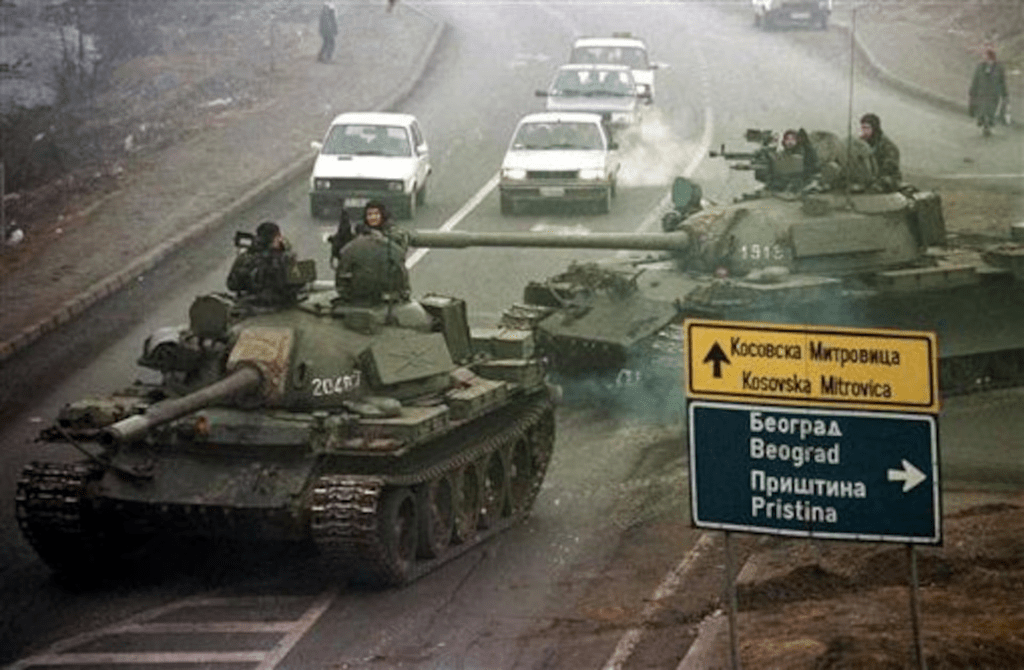
The fervour of Serbian nationalism was to proliferate and materialise in the 1991–2001 Yugoslav Wars. Declarations of Croatian, Slovenian, and Bosnian independence led to harsh retaliation by the Serb-dominated Yugoslav army in several ethnic conflicts. The wars themselves are characterised as being some of the most brutal since World War Two; the International Criminal Tribunal for the Former Yugoslavia (ICTY) was established by the UN in 1993 to prosecute its numerous war crimes, including crimes against humanity, ethnic cleansing, mass wartime rape, and genocide. An estimated 140,000 people were killed during the conflicts, with millions more being displaced as refugees. Milošević’s fervent espousal of Serbian nationalism was held as responsible for the escalating violence, particularly that of the genocide in Bosnia-Herzegovina between 1992–95. As a result, Milošević became the first sitting head of state to be charged with war crimes. His linking of the 1389 Kosovo myth to violent nationalism demonstrates the potentially disastrous impact of collective political memory upon social relations and understandings of national identity.
Bibliography
BBC News. “Balkans War: A Brief Guide.” BBC News, March 18, 2016. https://www.bbc.co.uk/news/world-europe-17632399.
Čolović, Ivan. “The Kosovo Myth in Modern Serbia: Its Functions, Problems, and Critiques | Heinrich Böll Stiftung | Belgrade – Serbia, Montenegro, Kosovo.” Heinrich Böll Stiftung | Belgrade – Serbia, Montenegro, Kosovo, 2024. https://rs.boell.org/en/2024/04/26/kosovo-myth-modern-serbia-its-functions-problems-and-critiques.
Kenny, Sean. “The Charges against Milosevic.” The Guardian, March 11, 2006, sec. Law. https://www.theguardian.com/world/2006/mar/11/warcrimes.milosevictrial.
Silber, Laura, and Allan Little. The Death of Yugoslavia. Penguin UK, 1995.
 Retrospect Journal