
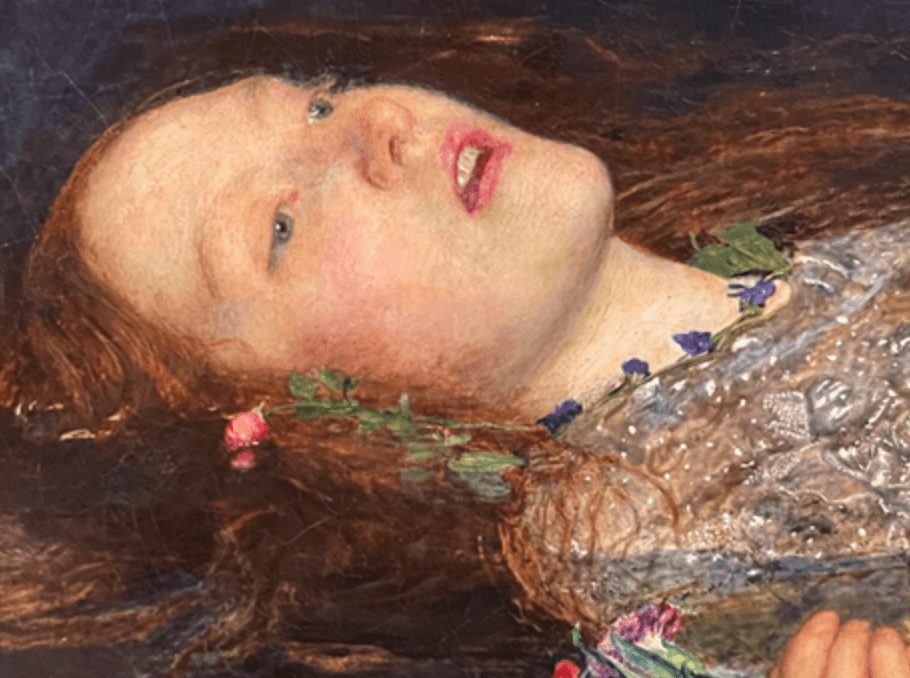
Written by Elizabeth Hill
Elizabeth Siddal has been the stuff of Pre-Raphaelite legend from the moment she first modeled for the Brotherhood. Plucked from relative obscurity in 1850, the model and artist has been remembered largely for abstract anecdotes of her life or mythical reimaginings after her death; for instance, the story of her posing for John Everett Millais’ Ophelia or the sight of her ever-growing red hair upon her body’s exhumation in 1869. Aside from the mythology surrounding her, Siddal has largely been remembered in relation to Dante Gabriel Rossetti, whom she married after a somewhat turbulent relationship and “engagement” in 1860 – but what of her own achievements? Siddal was an artist and poet in her own right, and though she may not have been as prolific or as respected as the Pre-Raphaelite Brotherhood in her time, Jan Marsh describes her work as “original, serious-minded and modestly successful.” She was certainly more than Millais’ infamous model or Rossetti’s doomed muse.
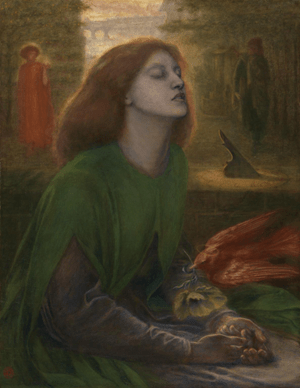
Fig. 1 – Dante Gabriel Rossetti, Beata Beatrix, c. 1864-70. Oil Paint on Canvas, 1214 x 1018 x 87mm. Tate Gallery. Painted after her death, the painting is a portrait of Elizabeth as Beatrice, Dante Aligheri’s muse.
Almost all of what we know of Siddal comes from posthumous accounts, and only in relation to the men around her. She was little known during her own lifetime, and it was only upon Rossetti’s death in 1882 that she really came into public consciousness. Even her last name – spelled with one l, instead of the original two – was chosen by Rossetti. Elizabeth was “discovered” in a milliner’s shop by a fellow artist, Walter Deverell, in 1849. In the early 1850s, she modelled for a number of well-known Pre-Raphaelite paintings besides Millais’ Ophelia; Deverell’s Twelfth Night (1850), William Holman Hunt’s A Converted British Family Sheltering a Christian Missionary from the Persecution of the Druids (1851) as well as several of Rossetti’s works (Fig. 1). The critic John Ruskin, impressed with her work and sensing what she could do with her talent, offered her financial patronage of £150 a year. Up until her death in 1862, she suffered from ill health – the nature of her illness is somewhat unclear and debated, but it supplied her with the laudanum that she became addicted to. To relieve her illness, she travelled to Hastings in 1854 with Rossetti, Ford and Emma Madox Brown, where she was frequently drawn resting or reading by Rossetti (Fig. 2). Elizabeth and Rossetti may have had an informal engagement from as early as 1853, but Rossetti was not particularly faithful and, by 1856, his all-consuming, passionate love for her had been lost to another woman. During their time apart, Siddal moved to her father’s native Sheffield and studied at the School of Art, before briefly reuniting with Rossetti in Matlock where they both had artistic projects. Eventually, Siddal and Rossetti married in 1860, despite her humble background and troubles with his finances, after another bout of illness where Rossetti heroically rushed to her side. Nine months after having a stillborn child, Elizabeth died of a laudanum overdose on 11 February 1862. She had suffered with post-partum depression, though posthumous accounts suggest she had been neurotic and emotionally dependent on Rossetti for some time; Elaine Shefer has speculated that Siddal may have also been anorexic.
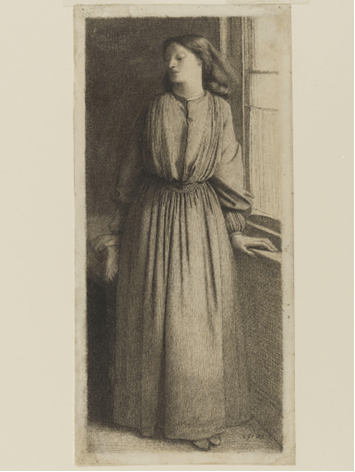
Fig. 2 – Dante Gabriel Rossetti, Elizabeth Siddal, 1854. Pen and ink on paper; 22.2 x 9.8cm. London, Victoria and Albert Museum.
Siddall was famously buried with a collection of Rossetti’s poems, which he exhumed her body to retrieve seven years later so that they could be published. This event has perpetuated the view of Elizabeth as Rossetti’s doomed victim, the cast-aside muse once her usefulness has been fulfilled – but Rossetti’s exhumation was said to be reluctant. After her death, she became a “fantasy sex object” for the Decadents and Pre-Raphaelites of the 1880s and 1890s; this stemmed from the first full account of her life by Hall Caine, Recollections of Rossetti, published in 1882. Caine described her body as mystically perfect upon exhumation, and this tale eventually evolved into the image of her bright red hair completely filling the coffin, still growing despite her death. Strands of her hair were later collected as relics, cementing the image of her as a mystical muse, a martyr-saint. She may have been so revered by the Decadents and other artists as an escape from the suppression of homosexuality, symbolising unattainable and forbidden love. This image of Elizabeth as delicate and mythological is no surprise, given the Victorian ideals around the natural separation of gender spheres, where women were entirely dependent on the dominant male. William Rossetti later wrote that Siddal was known by the Brotherhood and their friends as ‘Lizzie’, perpetuating the image of her as youthful, dependent and humble. Siddal in many ways came to symbolise the Pre-Raphaelite movement itself after her death, despite never having her own work truly recognised.
But was Siddal more than just Rosseti’s fateful victim? Were the drawings of her by Rossetti, previously taken as evidence of her physical decline, actually showing a woman struggling to become an artist in a world that fought back against her? As Jan Marsh has noted, Siddal’s work “deserves to be accorded a small but significant place in the history of Pre-Raphaelite art.” One of Rossetti’s drawings (Fig. 3) shows Elizabeth keenly bent over her drawing board, an image far from those where she appears forlorn and ill. Rossetti’s own portrayal of her in this manner challenges the perception that she was never considered a real artist by him, or the rest of their contemporaries.
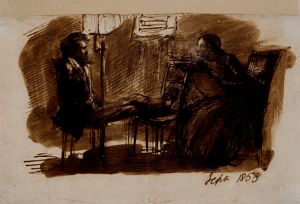
Fig. 3 – Dante Gabriel Rossetti. Dante Gabriel Rossetti Sitting with Elizabeth Siddal, 1853. Pen and brown ink shaded with finger on writing paper; 4 ¼ x 6 9/16 in. Birmingham Museum and Art Gallery.
Siddal’s own work largely drew upon literary sources and imaginary people. In Sir Patrick Spens (1856) (Fig. 4) Siddal draws upon a Scottish ballad, something she also did in Clerk Saunders (1854). The figure on the right in Sir Patrick Spens may even have been a self-portrait. She was also a relatively prolific poet, though none of them were published during her lifetime, being later published first by her brother-in-law William Rossetti in the 1890s.
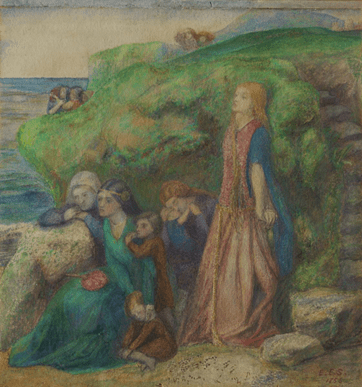
Fig. 4 – Elizabeth Eleanor Siddal, Sir Patrick Spens (1856). Watercolour on paper. 241 x 229mm. Tate Gallery.
In 1857 Siddal was the first and only woman to exhibit her art with the Pre-Raphaelites in Fitzroy Square, London, a significant feat for someone deemed merely a model and, later, a victim to Rossetti’s obsessional nature. Of course, her promising ability was noted at the time, at least by Ruskin and Rossetti, but her premature death and subsequent infamy for arguably all the wrong reasons have obscured both her life and her talent. Siddal may well have been remembered very differently as the instrumental part of Pre-Raphaelitism that she was if not for her marriage, her death or its mythologised memory – it is perhaps a tragedy of the Victorian reality of womanhood, if nothing else.
Bibliography
Bradley, Laurel. “Elizabeth Siddal: Drawn into the Pre-Raphaelite Circle.” Art Institute of Chicago Museum Studies 18, no. 2 (1992): 137–87. https://doi.org/10.2307/4101558.
Marsh, Jan. “Imagining Elizabeth Siddal.” History Workshop, Spring, 1988, No. 25. (Spring, 1988). 64-82. https://www.jstor.org/stable/4288819
Rumens, Carol. 2015. “Poem of the Week: Dead Love by Elizabeth Siddal.” The Guardian, September 14, 2015. https://www.theguardian.com/books/booksblog/2015/sep/14/poem-of-the-week-dead-love-by-elizabeth-siddal.
https://www.tate.org.uk/art/artworks/rossetti-beata-beatrix-n01279
https://collections.vam.ac.uk/item/O15042/elizabeth-siddal-drawing-rossetti-dante-gabriel/
https://rossettiarchive.iath.virginia.edu/docs/s440.rap.html
https://www.tate.org.uk/art/artworks/siddal-sir-patrick-spens-n03471
Featured Image Credit: Elizabeth Siddal in John Everett Millais’ Ophelia, 1851-2.
 Retrospect Journal