
Written by Abby Hughes
Eighteenth-century literature on manners, propriety and taste cultivated the idea of aspiration for an emerging British urban middle class. For this societal stratum, upward social mobility, and emulation of the noble-born aristocratic could be achieved only through the framework of commercial gain. Keen to distinguish themselves both morally and aesthetically from the increasing swathes of urban working-class communities, middle-class individuals leaned on these constructed notions of ‘politeness’. The imaginative pleasure of politeness came in the form of its empty promise to elevate the middle class, despite the fact that they were unable to compete with the gentry. Nonetheless, polite conventions legitimised themselves through connection to civil pleasures and emotions, namely those connected to aesthetic pursuits. With the moralised writings of Alison, Hume and Addison all distinguishing a ‘polite’ emotive experience from base emotions, the definition of an acceptable middle-class pleasure became increasingly rigid.
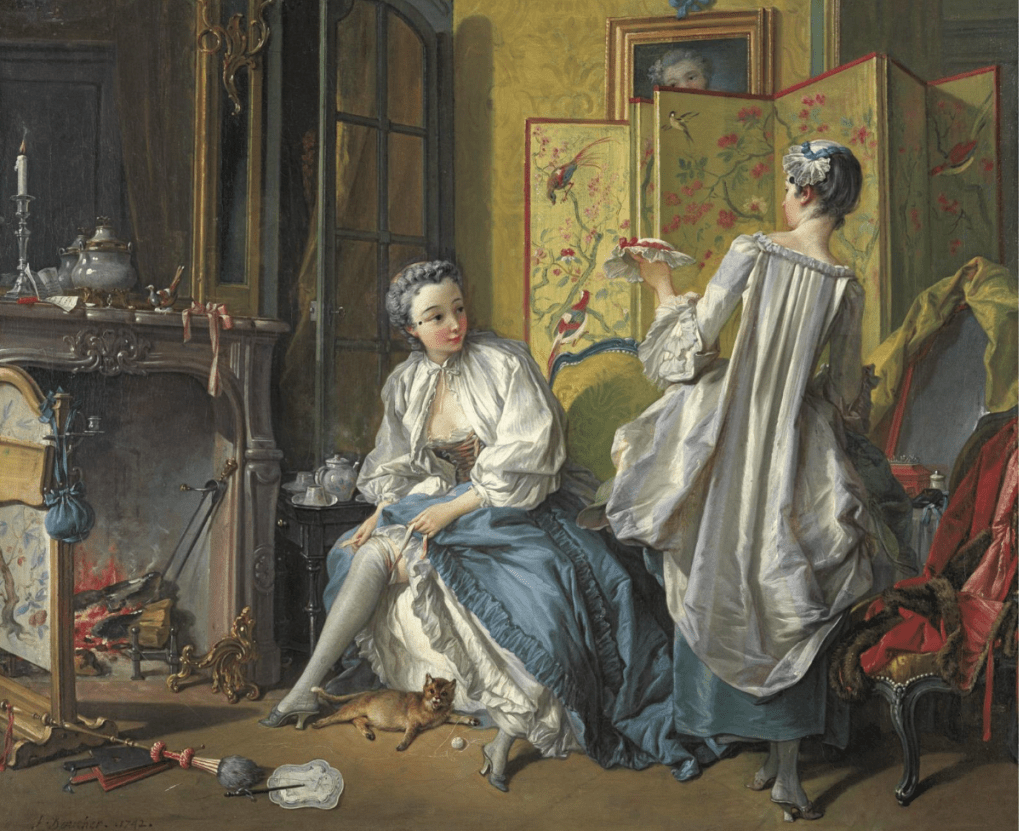
But how was such social aspiration attempted? In an era when industrialisation increased the commodification of fashionable items, and Britain’s imperial ties opened up trade routes, commercial culture became an increasing influence on the value and attainability of polite pursuits. Outward appearance was essential to the middle-class image of politeness; one needed to appear economically and morally justified in their social standing, thus imbuing inanimate signifiers of class with power. As such, fashion contributed heavily to the aesthetic image of gentility.
British fashion in the eighteenth century circled around the influence of a royal Parisian court. Influenced by only the highest social circles of aristocracy and royalty, this culture was defined by its elite exclusivity, making its fashion slow to filter through to the rest of society. This can be explored through the French fashion doll, still in use throughout the first few decades of the eighteenth century. Life-sized and circulated only through European courts to display the latest modes of dress, the market this fashion doll was intended to influence was an elite one. However, as industrialisation gave rise to factories that could increasingly produce materials at fast rates, a new fashion market opened up for the urban middle class. This can be traced through the invention of the English fashion doll, which became particularly popular towards the close of the eighteenth century. Smaller than the French doll which inspired it, and constructed from cardboard, the English fashion doll had cheaper, replaceable outfits. The creation of this doll indicates the role of industrialisation in shifting the ways in which tastes were dictated. Rather than descending from aesthetic principles as determined by the rarefied elite, fashion trends were increasingly susceptible to what factories could produce, and what salesmen could easily sell. The impact of the fashion doll in increasing the audience of popular fashion consumption was evident. In 1790, it cost only three shillings, and in the proceeding decades would cost no more than a few pence. Popular German magazine Journal des Luxus und der Moden described the “revolutionary invention” of the doll, characterising its influence as a “conquering [of] the market from 1790 onwards”. From this brief analysis, it can be determined that the constant striving of the middle class to achieve elite status was dependent not only on their performance of aesthetic politeness, but also on the shifts within an expanding commercial culture. Through industrialised urban centres, previously inaccessible fashion was increasingly visible and tangible to a new social stratum.
And yet, despite the role of commercialisation in widening the market for British fashion, the aristocratic elite maintained their influence as “the legislators of taste”. Conventions of politeness remained fundamentally class-based, as the early nineteenth century would continue to indicate. As luxury became democratised, its morals and materials more accessible to a wider public, politeness itself was forced to adjust. “Pulling up the ladder”, polite communities were forced to adhere to the standard of gentility even more ardently. The maintained influence of the elite can further be seen in Scotland, where the Musical Society of Edinburgh, formed in 1728 allowed the congregation of polite society during weekly concerts. Harris and McKean state that, due to “opportunities for enrichment overseas, rising land prices and rental incomes”, a Scottish landed class exerted inflated influence over urban cultural scenes. The influence of elites thus remained paramount in determining cultural standards. McKendrick further argues that, while the eighteenth century saw monarchs “more soberly dressed”, this should not be taken as an indication of the decline of their cultural power. While certain “pleasures” were more accessible, including art, theatre and music, the polite class that was given access to these arts was able to do so at the expense of other forms of popular expression. Increasingly deemed “primitive”, cultural performances of ballads, folktales, woodcuts, and seasonal festivals, for example, were driven into a sphere of social conscience deemed impolite and unfashionable, thereby leaving manipulation of cultural performances to the elites who demarcated the high arts. As such, aesthetic principles were inherently tied to the elites, since politeness defined itself through exclusivity. While commercial culture allowed the middle class a taste of elite status through a ‘polite’ performance, expressed through cultural acts and fashionable dress, therefore, they were unable to access any functional rise in status, kept from the economic, social and political powers of the upper class.
To the ‘polite’, artistic pleasures and fashionable attributes defined not only a person’s social standing, but their moral calibre. The works of Joseph Addison, for example, who acted as a gatekeeping arbitrator of taste, embedded in the codes of politeness a “higher aim of encouraging Christian belief and piety”, as highlighted by Boulard-Jouslin. Inherently moralised, politeness denied the worthiness of certain artistic pursuits, celebrating those that emanated from aristocratic origin. Mass production undoubtedly threatened the exclusivity of these pursuits and yet would only encourage further snobbery. As cheaper versions of fashionable items fell into the hands of the working class, the middle class were simply further motivated to legitimise their established moral hierarchy through aspiration to luxury. Despite once appearing liberating in its ability to spur on social mobility, politeness therefore reinforced the social hierarchies of its time.
Bibliography
Boulard-Jouslin, C. in Gheeraert-Graffeuille, C. and Vaughan, G. (eds.) Anti-Catholicism in Britain and Ireland, 1600-2000 Practices, Representations and Ideas (2020) pp. 163-179 https://uk1lib.vip/book/11212789/acf567 (18 June 2022).
Brewer J., The Pleasures of the Imagination: English Culture in the Eighteenth Century (Oxford, 1997)
Harris B. & McKean C., The Scottish Town in the Age of the Enlightenment, 1740-1820 (Edinburgh, 2014)
McKendrick, N. ‘The Commercialisation of Fashion’ in N. McKendrick et al (eds.), The Birth of a Consumer Society (London, 1982)
Whitlock, T. Crime, Gender and Consumer Culture in Nineteenth-Century England, (Oxford, 2005)
Featured Image Credit: Museo Nacional Thyssen-Bornemisza: https://www.kunsthalle-karlsruhe.de/boucher-in-a-nutshell/beauty-im-rokoko/
 Retrospect Journal