
Written by Owen James
When taught about World War Two at school, Asia is often overlooked and treated like an afterthought. Certainly, within the British educational system, Japan is usually given attention from 1941 onwards, following the December bombing of Pearl Harbor. China is seldom mentioned. One could put this down to Eurocentric biases: why would we want to learn about somewhere so far away? However, that does not render events in Asia as insignificant at all, rather the contrary.
I am not seeking to fundamentally revolutionise the way we think about one of the most consequential events in human history. Rather, I wish to highlight how little we know in Western historiography about the importance of one of the major conflicts of WW2, the Second Sino-Japanese War. With total war beginning in 1937, some 14 million Chinese died, with postwar population counts suggesting this number could be even greater.
So, if the events in Asia are so important, why do we view 1939 as the starting date of WW2? To put it simply, it is because this is when conflict in Europe began. As well, the prelude to WW2 was extremely eventful, rendering the start date of the conflict as arbitrary. One thing that can be agreed upon, though, is that the seismic and unprecedented impact of WW2 cannot be overexaggerated. A dangerous culmination of ethnocentrism, totalitarianism and expansionism led to the deadliest conflict in human history.
A European conflict?
The most widely accepted date for the start of WW2 is 1 September 1939, which was when Poland was invaded. In the subsequent days, Britain and France, alongside their respective empires, declared war on Nazi Germany. By the end of 1940, The Third Reich had expanded significantly into Europe. Nevertheless, for 1939, and certainly a large part of 1940, the conflict was fought on a continental scale, not a global one. It only became a world war in 1941, after Operation Barbarossa, more frequent campaigns in North Africa and, most importantly, the entry of the United States into the war.
That last factor, the entry of the United States, is pivotal in understanding the importance of Japan and China in the overall scope of the conflict. This is because the United States entry bridged together two regional wars into a global one: the one raging in Europe, but also the Second Sino-Japanese War.
As such, WW2 was never solely a European war. It began as two regional wars, one in China in 1937, and one in Poland in 1939, becoming truly cemented as a global conflict following the entry of the United States of America.
The road to 1937
One of the most important things to understand is that, similarly to Europe, the conflict in Asia did not arise out of the blue. Japan had been at odds with China since the late nineteenth century, as it looked to realise its imperialist ambitions by annexing Korea, Taiwan and Manchuria, all of which eventually became Japanese territory by 1931.
Japanese imperial ambitions were not monocausal, but if we look through the lens of the late nineteenth and early twentieth century, the motive behind Japanese expansionism in East Asia can be better explained. Colonial empires, strong industrialisation and a modern military were all hallmarks of international prestige, largely exhibited by Western powers. Japan understood these indicators of global prowess and sought to replicate them. As well, China’s decaying empire meant that Japan was able to exercise greater control over the East-Asian sphere due to the lack of effective power to resist colonial attempts over Manchuria, Korea and Taiwan. In essence, Japanese colonialism was situational, rather than deliberate, fuelled by a widespread ideological indoctrination that promoted an unrealised imperial destiny.
By the mid 1930s, two opposing ideologies, Chinese nationalism and Japanese imperialism, were coming to a head. Unfortunately for China, Japan was far superior in terms of industrial strength and modernisation, whilst the former remained a largely agrarian society. It is vital to understand that China is still a loosely strung together republic, troubled by an internal communist presence and regional power bases which are run by warlords. In fact, China’s fragility allowed for frequent Japanese incursions into its northern regions where the Kuomintang [KMT] exercised limited control.
Tension ultimately culminated into a small clash on 7 July 1937 near the Marco Polo Bridge in the Beijing district, where locally garrisoned Japanese troops claimed that a soldier was missing (funnily enough, he had simply gone to the toilet and had already returned!). The seriousness of the incident was dramatically heightened as Japan then demanded railway rights within northern China, which would ultimately cede control of northern China to Japan. After many years of Generalissimo Chiang Kai-Shek’s unwillingness to address the Japanese threat, he was left with little choice but to deliver his ‘limits of endurance’ speech on the 10 July 1937, which announced KMT resistance against Japan, ultimately triggering total war.
It is worth noting that Japan never thought of China as a formidable enemy; after all, they had defeated the Qing dynasty in the First Sino-Japanese War in 1895. Yet, Chinese resistance was unexpectedly stubborn, and by the end of 1937, Japan had committed 700,000 troops to the campaign, essentially the entire size of their standing army. This figure then peaked at around 850,000 by 1943.
The importance of the China and Japan
Undoubtedly, both China and Japan are fundamental players in WW2. China was the first country to face an Axis onslaught, and both countries had suffered from increasing Western colonial efforts in East Asia from the late nineteenth century. Therefore, the countries were not isolated from global diplomatic affairs, if anything they were deeply entangled.
By 1938, Nazi Germany were beginning to sever ties with nationalist China, looking to strengthen its alliance with Japan by recognising its puppet state of Manchukuo. It is unsurprising that Hitler preferred securing an alliance with Japan as he shared its militaristic, fascistic and ultra nationalistic ambitions. We can draw parallels from the German annexations of Austria and Czechoslovakia, and Japan’s acquisition of Taiwan, Korea and Manchuria, with both cases typifying their imperialist dreams. One can argue that all other things being equal, the expansionist ambitions of Germany and Japan led directly to broader conflicts in both Europe and Asia. In September 1940, Japan signed The Tripartite Pact alongside Germany and Italy, ratifying its place as one of the major Axis forces.
Conversely, following the Pearl Harbor attack in December 1941, China firmly became part of the Allies. Not only did China manage to resist the Japanese invasion, aiding the Allied war effort, they also suffered the third-most military deaths between 1939-1945, trailing only behind Germany and the USSR.
We simply cannot discredit the Second Sino-Japanese War as being an isolated event between two countries when their global significance was explicitly demonstrated through respective alliances and war contributions.
American entry runs through Asia
As I mentioned earlier, the United States entry into the war is important in understanding the significance of the war in China. America enters the war following the bombing of Pearl Harbor in December 1941; however, the Japanese motivations behind the Hawaii Operation requires further context and understanding.
By 1941, the Japanese army had been sinking into a quagmire in China. Chinese counterattacks were effective, and the size of the Chinese army was far greater. The United States, Great Britain, The Netherlands, and China had also placed oil embargoes on Japan, causing a further scarcity in resources. Japan was now severely deprived of resources necessary for both their own economic survival, and their war efforts in China.
Coupled with this dwindling number of resources and a desire to create the Greater East Asia Co-Prosperity Sphere, Japan had limited options. Abandoning their imperial ambitions would never have been a solution, so, in order to replace its natural resources, Japan planned to expand their sphere of influence and invade territories such as Thailand, the Dutch East Indies and the Philippines. For this plan to succeed, they would need to nullify the United States navy that had the potential of thwarting shipping lanes. Hence, the attack on Pearl Harbor aimed to stop American interference in the Pacific but ended up backfiring when the United States declared war on Japan the following day. As Paine succinctly puts it, ‘a regional war in Asia made another regional war in Europe global when the Japanese and German declarations of war relegated U.S. isolationism to the trash heap of history.’
Final thoughts
I hope by now that you understand both China and Japan’s significance in WW2 and that they were not simply peripheral players. Identifying the start date of the conflict as 7 July 1937 does not diminish the importance of events in Europe, it merely provides a more complete outlook of the war, reflecting historical reality rather than Eurocentrism. Most importantly, we would be doing a disservice to Chinese war efforts if we continue to overlook the significance of 1937.
If you’d like to explore this topic further, I thoroughly recommend listening to or reading some of Rana Mitter’s work on this subject. It is both important and compelling.
Bibliography
Bragg, Melvyn. ‘The Sino-Japanese War’ on In Our Time, (2014), retrieved from: https://open.spotify.com/episode/5k2PcgwQbrUMS0uetzxJK7?si=55269d5277f64728
Coox, Alvin D. ‘‘The Pacific War.’’ in The Cambridge History of Japan, ed. Peter Duus. Cambridge University Press, 1989.
Hackler, Jeffrey. ‘‘Japan’s Motives for Bombing Pearl Harbor, 1941.’’ Education About Asia 6, no.1 (2001): 54-58.
Mitter, Rana. China’s War with Japan, 1937-1945 The Struggle for Survival. Penguin Books, 2014.
Paine, S.C.M. The Wars for Asia, 1911-1949. Cambridge University Press, 2012.
Peattie, Mark R. ‘‘The Japanese Colonial Empire, 1895-1945.’’ in The Cambridge History of Japan, ed. Peter Duus. (Cambridge University Press, 1989.
Sandbrook, Dominic, and Holland, Tom. ‘China and World War II (Part 1)’ on The Rest is History, (2022), retrieved from: https://open.spotify.com/episode/5a47wCGdU70n8p0bJqFhk5?si=3240365b7eb34e92
Si-Yu, Lin, and Minoru, Kitamura. The Reluctant Combatant: Japan and the Second Sino -Japanese War. Translated by Connie Prener. University Press of America, 2014.
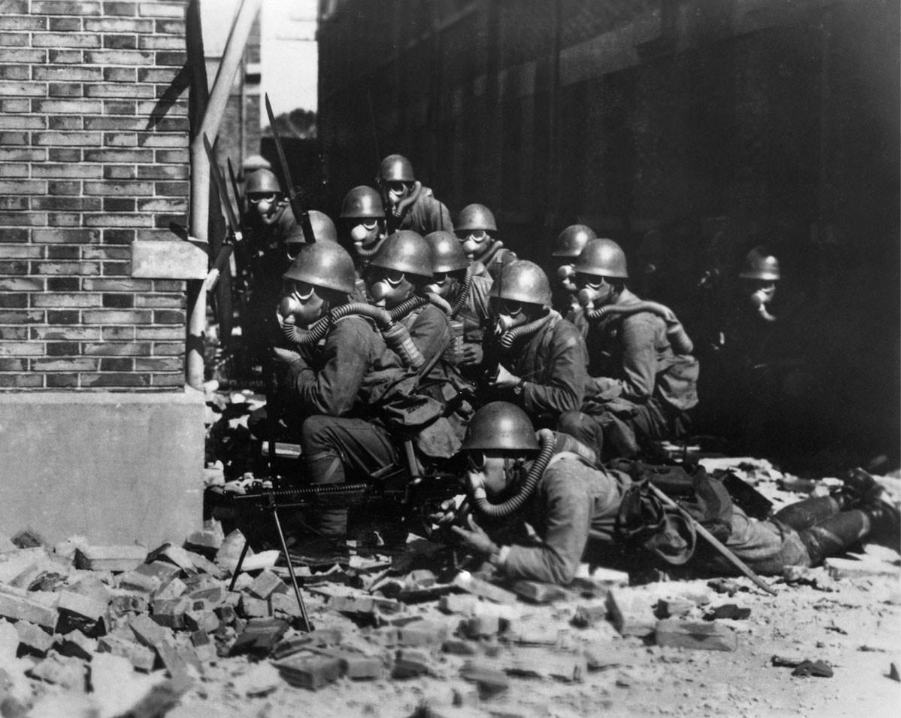
Featured image credit: Unknown photographer, Ministry of the Navy, Public domain, via Wikimedia Commons. Japanese Special Naval Landing Forces in Battle of Shanghai 1937 https://commons.wikimedia.org/wiki/File:Japanese_Special_Naval_Landing_Forces_in_Battle_of_Shanghai_1937.jpg
 Retrospect Journal