
Written by Peiqi An
16/02/25
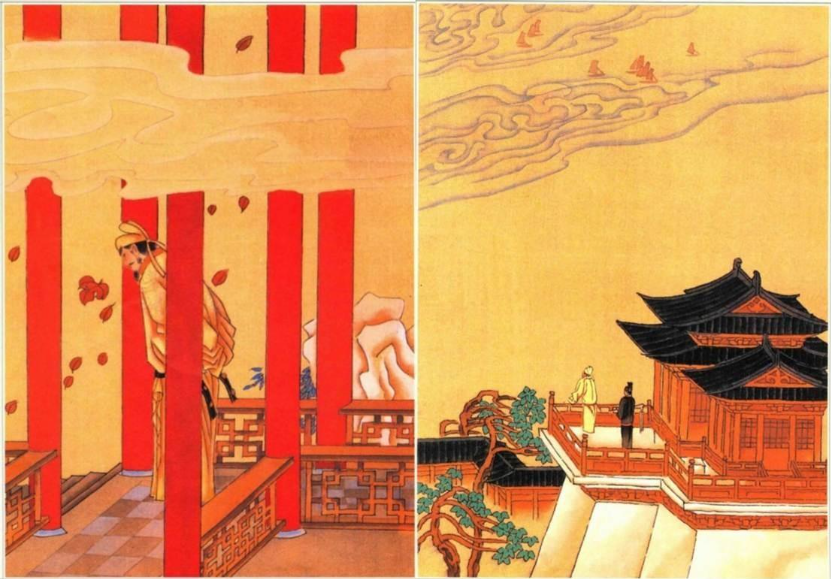
“Wordless, I ascend the west chamber. Silent, I behold the hooklike moon.
The plane trees lonesome and drear, locked in the courtyard, autumn clear.”
無言獨上西樓,月如鉤。寂寞梧桐深院鎖清秋。
The above lyrics are excerpted from the ci-style poem A Joyful Rendezvous (相見歡 or烏夜啼) composed by Li Yü (李煜,937-978 C.E.), the last ruler of the Southern Tang (937-975 C.E.). It can be argued that Li Yü was overall unsuccessful as a monarch. His rule is often associated with indecisiveness and a self-indulgent life. However, as a poet, Li Yü is considered unparalleled in his time. His literary achievements can be observed, albeit on a very limited scale, from his development of poetic language in the ci genre
A ci poem is a lyrical form composed according to pre-existing musical tunes and governed by fixed rhythmic and tonal patterns. A great portion of Li Yü’s ci poems are read as lyrical expressions of personal feeling, a dimension often enhanced by poetic imagery that evokes emotional synchronicity. A close engagement with Li Yü’s ci poems reveals at least two modes of imagistic language that recur throughout his work, one rhetorical and the other descriptive. In the rhetorical mode, the images themselves carry emotional weight, allowing subjective attitudes to be conveyed indirectly through the poetic scene; this strategy is evident in the tunes, A Joyful Rendezvous and Spring in Jade Pavilion. In the descriptive mode, by contrast, emotion is manifested as a reflective response prompted by objective phenomena, as exemplified in the tune The Beauty Yu. While conceptually distinct, the two modes frequently overlap in practice, as we explore below. This article turns to lunar imagery, a motif favoured in Li Yü’s ci oeuvre, to explore how poetic images may both directly and implicitly articulate the poet’s own lyrical persona.
A Joyful Rendezvous was likely composed during Li Yü’s captivity following the fall of his kingdom to the Northern Song. The poem opens with the poet drifting into a small chamber within his courtyard, a confined domestic space that quietly mirrors his political and personal imprisonment. Stripped of power and held by his conquerors, Li Yü finds the moon as his only companion. Its “hook-shaped” form, partial and incomplete, becomes a charged emblem of rupture, reflecting the broken state of his former realm.
The moon also operates as a metaphorical hook, pulling the fallen monarch’s thoughts back toward memories of past splendour now rendered unreachable by humiliation and confinement. This sight unsettles the poet, stirring a tide of sorrow that unfolds into prolonged, mournful introspection. In this moment, the moon’s rhetorical power lies in its ability to compress dynastic collapse and personal loss into a single, haunting image.
Tune: Spring in Jade Pavilion (excerpt)
“Do not light on my returning way a candle red,
The hooves shall trace the limpid moonlight they tread.”
玉樓春 (節選)
歸時休放燭花紅,待踏馬蹄清夜月。
Spring in Jade Pavilion is an autobiographical record of Li Yü’s life at the zenith of his powers. The excerpt above captures a moment in which the heavily intoxicated monarch returns to the palace from an extravagant banquet. Declining the lanterns offered by his attendants, Li Yü instead chooses to ride beneath the pure, limpid moonlight. While, as a whole, the poem appears to celebrate an indulgent regal existence, the image of the moon gestures towards a more illusory, inward aspiration.
In his memorandum submitted to the emperor of Song, Li Yü wrote that, “I was born as a prince…but my heart was never inclined toward advancement after having finished schooling……I spent my days in leisurely ease. I long sought to follow in the faint traces of Chao Fu and Xu You.” By invoking these legendary hermits who rejected offers of kingship, Li Yü casts himself as temperamentally detached from political ambition, longing instead for a life unburdened by worldly obligations. This self-portrayal agrees with anecdotal accounts of his early inclination toward withdrawal from secular clamour.
That same sensibility resurfaces in Spring in Jade Pavilion. As in the above excerpt, Li Yü rejects the lanterns, emblematic of the court, and instead follows the moonlit path, which figures a symbolic departure from kingship. The moon is recontextualised as a site of spiritual purity and innocence onto which the poet projects his unspoken desire for retreat. Within the limpid moonlight, the monarch momentarily casts aside the weight of sovereignty and drifts into a carefree state of mind.
Tune: The Beauty Yu (excerpt)
“When will spring flowers and autumn moon shed their colours
Leaving me with those memorable hours?
The east wind returned, haunting my chamber till the morrow
Steeped in moonlight, the waning kingdom enfolds me in unbearable sorrow.”
虞美人(節選)
春花秋月何時了?往事知多少!
小樓昨夜又東風,故國不堪回首月明中。
The Beauty Yu was composed in Li Yü’s final years. Having endured profound reversals of fortune, the fallen monarch gazes up at the autumn moon, and in an instant, it is as though the spectre of his former life comes into view. At a single glance, the poet is submerged in a multitude of anguish, nostalgia, and solitude. The autumn moon, seemingly immortal, continues its cyclical waxing and waning, unbothered by the vicissitudes of human affairs. By contrast, the brief history of the Southern Tang appears as little more than a fleeting moment, recoverable only through memory.
The moon thus comes to signify eternity, against which the poet measures the ephemerality of his lost kingdom. The vastness of the moonlit realm evokes the boundlessness of time itself, within which Li Yü’s individual destiny is cast as a temporal fragment consigned to the past. A similar meditation on temporal flow and stasis, also mediated through a lunar imagery, appears in Li Yü’s lyrical memorial to his deceased wife, in which he writes:
“By the railings, I stood bemused. The daytime drifted away.
The flute songs and crescent moon stay as they once were.”
憑欄半日獨無言,依舊竹聲新月似當年。
In these lines, the bamboo flute melodies and the crescent moon return as they have year after year, yet the beloved partner with whom such moments were once shared is irrevocably absent. Once again, lunar imagery renders the idea of infinity from an obscure concept to a perceptible object set against the impermanence of human life. Through lyrical depiction and metaphorical resonance, The Beauty Yu and the Memorial alike transform the moonlit world into a vast sensory expanse, within which the poet’s rumination over his past transcends into a universal reflection on time itself.
Although the moon is only one among many recurring images in Li Yü’s oeuvre, its persistent presence points towards a broader tendency in Li Yü’s work. Rather than presenting insensate scenery for aesthetic ornamentation, images like that of the moon are consistently infused with subjective feelings to foreground sensory experience, adding to the emotional expressiveness of his poems. Whether dim or bright, waxing or waning, the moon echoes the fluctuation of emotions across Li Yü’s poems, becoming a lyrical vehicle for the pervasiveness of the poetic persona. Li Yü’s synesthetic engagement with the surrounding environment not only deepens the interpretive richness of his poems but, from a historical perspective, also contributed to the conventionalisation of certain imagery–emotion correspondences in the world of classical literature.
Bibliography
Chang, Kang-i Sun. The Evolution of Chinese Tz’u Poetry: From Late Tang to Northern Sung. Princeton, NJ: Princeton University Press, 1980.
Li, Yü. “Ji wei shang Song Taizu biao” (Memorial to Emperor Taizu of the Song upon Accession). In Quan Tang wen (Complete Prose of the Tang), edited by Dong Gao, vol. 128. 1819.
Li, Yü. Selected Poems of Li Yu. Translated by Xu Yuanchong. Shijiazhuang: Hebei People’s Publishing House, 2006.
Sun, Chengjuan. “The Hidden Blessing of Being a Last Ruler: Anecdotes and the Song Dynasty Interpretation of Li Yu’s (937–978) Lyrics.” Chinese Literature: Essays, Articles, Reviews 34 (2012): 105–129. Available at: https://www.jstor.org/stable/43490146.
Featured Image Credit: Li Houzhu. In Zhongguo caihui lianhuanhua jijin (An Anthology of Chinese Colour-Story Books). Beijing: Zhongguo Shufang, 2008, 151–52.
 Retrospect Journal