
Written by Darcie Rogers
15/02/2026
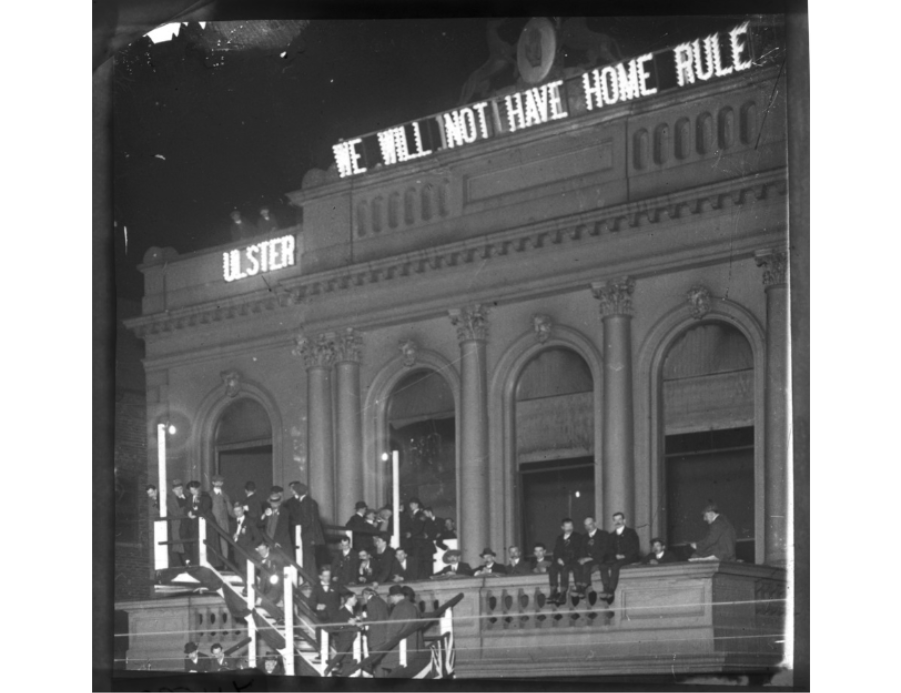
Populism is difficult to pin down as a political label. Defined by Paris Aslanidis as a ‘thin-centred ideology,’ easily attachable to different national and ideological contexts, populism’s central conflict is between that of a ‘pure people’ and a ‘corrupt elite,’ who have appropriated power for themselves and their own interests. A tendency to offer simple solutions to complex issues is another common feature, as is, in some cases, militaristic rhetoric or action. The term has only been used in its current form in political scholarship since the 1950s, and even later than that in reference to political developments in the UK. It stands to reason, then, that when asked to conjure up an image of a populist movement in Europe, the Ulster Unionist opposition to the Third Home Rule Bill in the early 1910s is not one that typically springs to mind. Overshadowed by the outbreak of the First World War, set in the less-than-glamorous theatre of Edwardian Belfast, it is easy to overlook the frankly fascinating events, movements and characters of the ‘Home Rule crisis’ – not least, as I will argue, what could be termed the first populist movement in the UK: Ulster Unionism.
I use the phrase ‘first populist movement in the UK’ on account of the interconnectivity between unionism in Ireland and the Conservative Party in Britain at this time. The Government of Ireland Bill, introduced in April 1912, was the third of its kind to come before the Houses of Parliament. Proposing what would be recognised today as a limited form of devolved government for Ireland, the ‘third Home Rule bill’ was the culmination of efforts by the Irish Parliamentary Party since the 1870s to gain some measure of self-rule for the island. The IPP had been the dominant force in Irish politics for decades, constitutionally advocating more autonomy but not complete independence for Ireland. As had been the case for decades before and indeed for decades to come, unionists opposed the proposed reforms for fear of weakening the connection between Ireland – though particularly Ulster, the northernmost province with the largest Protestant population – and Britain. Unionists believed Irish Home Rule would wreak havoc on the economy, bring religious persecution against Protestants, and represent the first step towards a fully independent Ireland; whether these fears were justified is a different question entirely, but the fact remained that incredible strength of feeling against any form of Home Rule existed within this minority in Ireland.
The dawn of the era of ‘mass politics’ at the beginning of the 20th century was no better encapsulated than by the shift in the Irish unionist movement. It represented a break from traditional, metropolitan, polite, landowning middle-to-upper-class Southern unionism and towards a movement that placed all its eggs in the demographically strong basket of Ulster. Where Southern unionism leaned less heavily on religion, Ulster Unionism was intensely Protestant with strong links to the Orange Order. It was diverse in class terms with significant grassroots participation and a large industrial, working-class base. It was confident in its own means of resistance, self-reliant in its attitude, and was (most significantly) not afraid to threaten extra-parliamentary means of resistance to Home Rule. Being a mass movement, it is important to note, is not the same as being populist in nature; but populist movements tend to rely on an idea of speaking for ‘the masses.’ Edward Carson and James Craig, the leaders of the anti-Home Rule drive, made mass participation a cornerstone of their strategy. Rallies became a typical feature of the movement from the assumption of Carson’s leadership of the UUC in 1910 onwards. In September 1911, a crowd of over fifty thousand marched from Belfast to Craig’s residence; a crowd double the size (including 70 Conservative MPs and Andrew Bonar-Law, their newly-elected leader) attended a rally at Balmoral in April 1912. If they could prove the strength of Ulster’s opposition, they believed, the Liberal government would scrap Home Rule entirely. The idea of partitioning Ireland was unthinkable. In Carson’s words: ‘if Ulster succeeds, Home Rule is dead.’
The positioning of Ulster Protestants as the ‘pure masses’ and the proponents of Home Rule as a ‘corrupted elite’ took on a potent, highly religious tone in the early 1910s. Nowhere is the former seen better than during the events of ‘Ulster Week’ in September 1912. An organised period of campaigning in the lead-up to the signing of the Ulster Covenant, the week took on a tone not only of deep political but religious significance. At a rally in Belfast on the 27th September, a banner said to have been carried by William of Orange at the Battle of the Boyne in 1690 was unfurled before the crowd, Carson declaring that the flag would ‘ever float over a people that can boast of civil and religious liberty’. Resistance to Home Rule was described in oratory throughout the week as a ‘duty’. Even the term for the petition signed on the 28th September, the ‘Solemn League and Covenant’, had religious significance with links back to Scots Presbyterianism. All of this served to imbue the followers of Carson and Craig with a sense of righteousness, divine ordainment, and vindication that they were a beleaguered Protestant minority fighting to protect their very existence.
In 1910, Herbert Asquith’s Liberal government lost the landslide majority it had obtained in the previous Parliamentary elections. Considering the notoriously difficult and politically contentious feat of reducing the powers of the House of Lords after it vetoed the government’s ‘peoples’ budget,’ Asquith looked to the Irish Parliamentary Party for support. Recognising the Lords’ role in voting down the previous iteration of the Home Rule bill in the early 1890s, IPP leader John Redmond agreed to lend support to the Liberal budget, as long as the government made a solid commitment to reducing the powers of the Lords. No promises were made – Asquith warned the IPP there was a chance the proposals would not go through – but the Ulster Unionist opposition capitalised on the informal arrangement as a ‘dirty deal’ between a power-hungry Liberal government and conspiring Irish nationalists. Central in promoting this rhetoric was the Tory party leader, Andrew Bonar Law. Lending his support to unionists in the North, Bonar Law’s speech at Blenheim Palace took on a revolutionary tone, strange for a leading Conservative politician. The Liberal government, he claimed, was ‘a revolutionary committee which has seized upon despotic power by fraud.’ ‘I can,’ he continued, ‘imagine no length of resistance to which Ulster can go in which I should not be prepared to support them.’ A member of His Majesty’s opposition advocating an armed revolution of the ‘righteous people’ against the will of a government supposedly abusing its power for its own ends was hardly a common phenomenon and displays the extent to which the Ulster Unionists relied on populist rhetoric to boost the dynamism, sense of betrayal and rugged isolationism of the movement.
Another feature of the Ulster Unionist movement that aligns well with many comparable older populisms are its previously alluded-to militaristic tendencies. The combination of a sense of religious ordainment, fear of persecution and vindication from leading political figures provided ideal conditions for a thriving militarism within the movement, which the UUC eventually sought to bring under central control. The Ulster Covenant was unveiled and signed, with men’s and women’s versions, by a collective four hundred and seventy thousand people, on the 28th of September 1912. This document was not to be used as a petition to Parliament to repeal Home Rule or force the Liberal government to reconsider; it was seen by leading figures as a democratic mandate to resist the imposition of an Irish Parliament. In the wake of this, the Ulster Volunteer Force, a paramilitary group sanctioned by the official Ulster Unionist body, was created with the aim of recruiting a hundred thousand men. In early 1914, the UVF smuggled tens of thousands of rifles into the province from Germany, organised by a man who was reputed to have signed the Covenant in his own blood.
By the end of the 1910s, none of the Ulster Unionists’ aims had been achieved. Simple solutions and obstinacy were the political currency of the day where understanding and compromise were desperately needed. The political currents in Ireland were comparable to an unstoppable force and an immovable object. Ireland was partitioned on the basis that this was a temporary arrangement; over a hundred years later, the country remains divided. Politics took on a hyper-sectarian nature, particularly in the North. This period of history is frequently overlooked in favour of the (admittedly significant) advent of the First World War; but by looking at what could well be termed, by modern standards, the ‘first’ populist movement in Britain and Ireland, we can obtain fascinating revelations into the creation of the Irish state, a national story characterised by contention and the continuing grip populism continues to hold over politics in Northern Ireland today.
Bibliography
Laffan, Michael. The Irish Revolution. Introduction, Episode 1 & Episode 2. https://open.spotify.com/show/62HtoLDzUiD386VDNxCUjX?si=7c2bdbd6febe4c72
Aslanidis, Paris. “Is populism an ideology? A refutation and a new perspective”. Political studies, 64, 2016, p.88-104. https://journals.sagepub.com/doi/full/10.1111/1467-9248.12224
Killeen, Richard. A Brief History of Ireland. Gill Books, 2010.
Stewart, ATQ. The Ulster Crisis: Resistance to Home Rule, 1912-1914. Blackstaff Press, 1997.
Rees, Russell. Ireland 1900-25. Colourpoint Educational, 2008.
Jackson, Alvin. Ireland: 1798–1998: Politics and War (History of the Modern British Isles). Wiley-Blackwell, 1999.
Featured image credit: https://collections.nationalmuseumsni.org/object-belum-y11592
 Retrospect Journal