
Written by Millie Oliver
The showgirl. She’s been on our stages and screens for decades. She comes and goes in a glittering mirage of feathers and sequins, the epitome of Las Vegas luxury and performance. But where did the showgirl come from? And what is her place in the modern-day cultural zeitgeist?
How has the role of the showgirl changed since its inception, and what does she mean to today’s women?
Humble Origins
Our story begins in eighteenth-century England where the term ‘showgirl’ was used to describe young women with a ‘showy’ attitude used to gain male attention. The term quickly underwent a drastic transformation however, and by the mid-nineteenth century it was used to mean singers and dancers in musical acts.
The women we understand as showgirls today were born on the stages of 1800s Parisian music halls and cabarets. Some of these establishments such as the Moulin Rouge and Le Lido have remained intrinsic to the global definition of musical theatre to this day. However, despite their European origins, the showgirl is certainly more synonymous with North America in the twenty-first century. Showgirls were introduced to the United States in 1907 where they made their Broadway debut to a huge success. By the 1950s there were permanent troupes that toured from Paris to Las Vegas, where the permanent residence of the showgirl would be set up.
Viva Las Vegas
The very first casino on the Vegas strip to employ dancing girls as an interlude in between performing acts was El Rancho Vegas in 1941. Initially, their role was limited to opening and closing for headliners, however it would seem their allure was so enchanting that by the 1950s and 1960s they began to take centre stage, no longer as attractive commodities but as the main event.
Showgirls performed at every single hotel and casino on the Vegas strip, becoming integral to the city’s allure. And as the competition between casinos for ticket sales grew more intense, so did the shows and costumes, which became increasingly lavish and tantalising.
The showgirl formed just one of the many identities that shaped female talent in the golden age of Hollywood. Their recent prevalence in twenty-first century media tells us just how significant their impact was on society during their breakout into showbusiness.
However, as quickly as they rose to stardom, they fell, with the popularity of showgirl shows in Las Vegas quickly declining in the 1960s and most major shows closing by the early twenty-first century.
The end brings forth new beginnings
You would assume that the decline in Vegas interest for the showgirl would mean the showgirl genre would simply disappear, another fleeting obsession in a long line of new cultural fascinations. However, this was not the end.
Perhaps the quintessential image of a showgirl crafted in 1950s Vegas no longer really existed, but as times changed so did the definition of what it meant to be a showgirl. As a result, this gave rise to all kinds of different reimaginings of our 1950s stars.
Modern burlesque performers have reanimated the showgirl aesthetic, breathing new life into the dying art form. Someone such as Dita Von Teese (the aptly named ‘Queen of Burlesque’) is just one example of how the vintage ideals of the showgirl can be adapted for a modern audience. Instead of just recycling old trends, however, burlesque presents itself as a newer, more modern adaptation of the showgirl which adds nuance to the vintage role.
Perhaps burlesque’s most important difference to its vintage counterpart is the power of women on the stage. It’s no secret that the showgirls of the 1950s experienced abuse, misogyny and fetishisation by their predominantly male audiences and managers. Modern burlesque incorporates the vintage elements of showgirl aesthetic but without the vintage attitudes towards the women themselves, choosing to prioritise female agency and control over their own sexuality and how they choose to display it. It’s not surprising then to discover most modern burlesque audiences are now female, which marks a change in how showgirls are viewed in the modern era. In an interview with The Guardian, Dita Von Teese goes on to say, “it’s not just about ogling naked girls, burlesque is really like a powerful message of self-creation and showing people another form of beauty and how to create glamour.”
“You can’t dictate to a woman what makes her feel sexy”
From taboo to finding power in female sexuality, the ‘showgirl aesthetic’ did not end with the popularity of burlesque but instead found a new face in celebrity culture. There have been several people who have utilised the showgirl aesthetic, but all add something new and different to what it means to be a showgirl.
Pamela Anderson’s 2025 film The Last Showgirl depicts veteran performer, Shelly, who is forced to confront her life choices since the Vegas show she’s headlined for thirty years is closing. This film takes the iconic showgirl caricature we’ve all come to love and breathes humanity into the stage role, giving sympathy to these women who sacrifice everything for the stage but can be discarded so easily.
This commentary on the deeper, more poignant side of showbusiness is no more prevalent than in Taylor Swift’s 2025 album The Life of a Showgirl. This album focuses on her experience performing on the Eras tour which dominated her life from 2023 to the end of 2024. This brings similar nuance to the popular genre, again emphasising the sacrifices that women in showbusiness make for their craft despite the constant trials and tribulations.
It is put no more aptly than in the titular song on the album “The Life of a Showgirl ft. Sabrina Carpenter” which tells the story of aspiring showgirl Kitty. In the song, she will stop at nothing to achieve her dreams of fame whilst acknowledging in retrospect the immense dark side to the career, stating at one point in the song “that’s not what showgirls get, they leave us for dead.”
Curtains closing
It is no secret that the history of the showgirl is a complicated one, from national symbols of optimism, glamour and hedonism to more emotionally complex figures who represent sexual liberation in the modern era.
The reason why the showgirl has become an iconic aesthetic in music and Hollywood comes as no surprise. From its humble stage origins, the showgirls from the 1800s up until now, whether they be cabaret performers, burlesque dancers or pop singers, they all speak to the glamorous performative sides of us who want to put on feathers and diamonds and perform freely with no judgement. For so many marginalised groups, the stage is considered a home where dreams come true, and because of that the showgirl will always be a beloved figure in popular culture. The real interest is how the showgirl will evolve next.
Bibliography
https://en.wikipedia.org/wiki/Showgirl
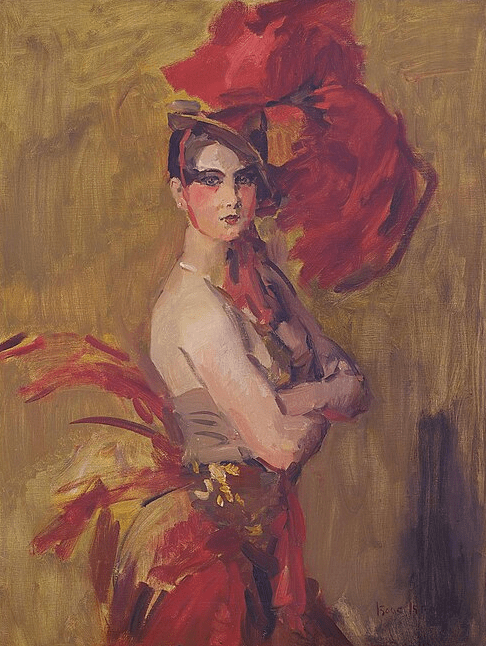
Featured Image Credit: Show-girl (La Cocotte[1]) in Bouwmeester Revue [nl][2] at Scala Theatre, Wagenstraat, The Hague; by Isaac Israëls, 1920s
 Retrospect Journal