
Written By Jake Mayhew
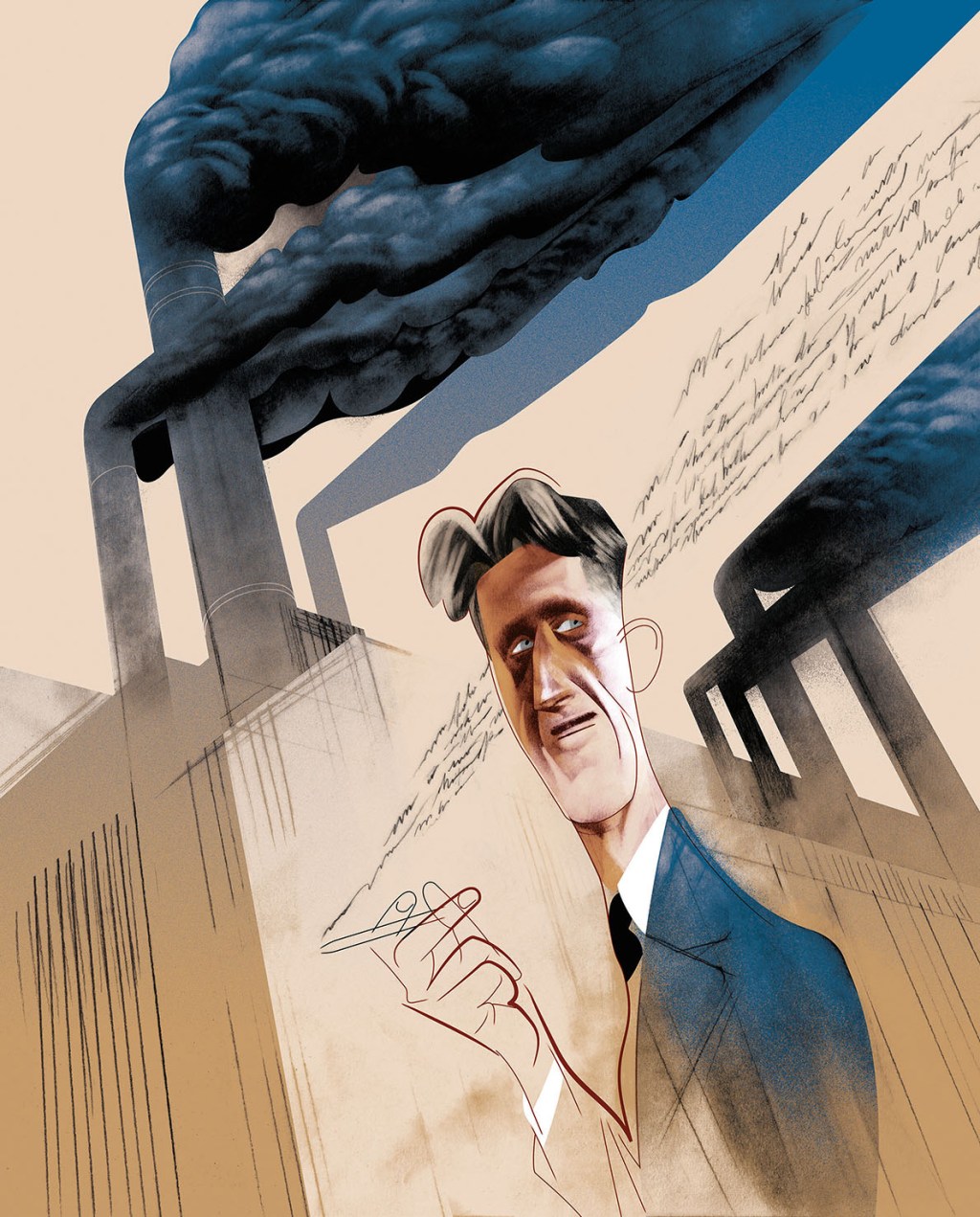
Eric Arthur Blair wrote The Road to Wigan Pier in 1936; he would now be 122, and would likely hold a similarly despairing view of today’s social disparity amid the onslaught of the internet age, as he viewed Industrialisation and its effect upon the lives of working men and women in the mining towns of England.
Blair first wrote under the pseudonym George Orwell when publishing Down and Out in Paris and London in 1933. When researching both works, Orwell lived under false pretenses in order to immerse himself within the privations of working life. Orwell’s graphic prose cut a powerful depiction of the depths of depravity occurring in London, Paris, and subsequently Northern mining towns when he travelled the roads north to Wigan from London. He obtained an ability to convey vividly the chaotic noise of impoverished towns, the visible toll of hunger and poor sanitation upon the faces of miners and invited readers to smell the squalid conditions which temporarily became his home. Orwell spent time as a pot wash in Paris, a tramp in London, and a transient and disheveled traveler for two months in Sheffield, Wigan, and Barnsley.
The visceral metaphors and adjectives used to convey the appalling conditions frequently faced by Britain’s working class served as a backbone to the brilliant social commentary of Orwell, which is truly the most compelling aspect of The Road to Wigan Pier. Orwell was employed by Victor Gollancz in 1936 to write about the condition of the English working class, in line with a tradition of post Wall Street Crash literature, containing a largely statistical analysis of Britain’s working class. Orwell largely stuck to this structure for the first part of The Road to Wigan Pier but broke from this mold in part two. The second half contained a stunning polemic against what Orwell viewed as a confused desire on behalf of the Western world to constantly seek “progress” no matter the implications, a concern no doubt familiar to many today. Orwell’s brand of socialism, notably bearing the earmarks of an aristocratic upbringing, brought a comparative aspect to his descriptions of mining towns. His style was highly opinionated and contained views frequently at odds with modern readers, owing to Orwell’s steely, emphatic tone. His openly unobjective stance freed him from the artistic constraints of objectivity, enabling deeply moving passages, at times marked by gross generalisations, that nevertheless drew increasing attention to the stagnant and ridiculous state of British class distinctions.
Orwell stated clearly his intention to “be one of them and on their side against their tyrants.” In this case, the tyrants included the peers of his upbringing; hence why Orwell adopted his nom de plume, upon the recommendation of Gollancz, to protect his middle-class family from the embarrassment which such a reactionary commentary would provoke at the time. Gollancz did not agree with the deeply cynical second part of Orwell’s The Road to Wigan Pier, which was not requested within Orwell’s original commission. Gollancz particularly objected to the stern criticism of whisky-sipping armchair intellectuals who dominated socialist discourse at the time. Orwell, rather ironically, had no time for middle-class intellectuals claiming to fully understand working struggles. Orwell was particularly unkind to doctrinarian oddities, including those socialists “wearing sandals and burbling about dialectical materialism” who he believed discouraged working people from engaging in socialist politics and prevented socialism from achieving party political success in Britain. A view which perhaps many still resonate with today.
Gollancz knew that the second part of the book would be divisive within his own Left Book Club, of which he was a founding member. Fortunately, Gollancz published The Road to Wigan Pier in its entirety, and the book has never been out of print since. Worryingly, the desperation Orwell felt in 1936, if he had been born a century later, would likely be felt in 2026. At the time of the book’s publication, Orwell had recently arrived in Spain to join the socialist cause against Francisco Franco in the Spanish Civil War. Orwell was adamant in viewing popular democratic socialism as the only convincing defence against fascism. Orwell in today’s world would likely maintain his stance, objecting to the frequently held middle-class perspective that the proletariat is confined to the labouring classes of society. Orwell, if still alive, would wish to shake the engineer, lawyer, and Deloitte auditor of today and convince them that they are indeed members of the proletariat. Orwell, in a characteristically indelicate fashion, would describe the bourgeoisie-proletariat divide as irrelevant to whether an individual may pronounce their “h’s” or not. Instead, the relationship is between the creators and owners of capital. Orwell’s stance on this divide is particularly prescient at a time in which we may experience an intellectual equivalent to the industrial revolution in the form of artificial intelligence, throwing into question the future of many middle-class professions. Orwell would insist that those resting on the taller steps of the meritocratic stepladder must shed their “nervous prejudice” against socialism and ally themselves with those who are ideologically not entirely aligned but who yet still hold the same core principle of opposing tyranny and populism. Orwell’s call for unity still feels appropriate at a time in which his prior concern of a developing “slimy Anglicised form of Fascism”, hidden behind a respectable façade, bears resemblance to today’s political landscape.
Bibliography
Orwell, George. The Road to Wigan Pier. London: Gollancz, 1937
Featured Image Credit: Illustration by André Carrilho
 Retrospect Journal