
Written by Sam Mackenzie
Theresa May, and Abraham Lincoln. If asked, most would say that the two leaders have very little in common beyond that fact, that they were both leaders.
Theresa May was Prime Minister of the United Kingdom from 2016–2019. Before that, she held the office of Home Secretary from 2010–2016, as well as being Minister of Women and Equalities from 2010–2012. May had been in parliament since 1997, being one of the few new Conservative MPs to manage to break through in the Labour landslide in that year’s elections.
Abraham Lincoln was, of course, President of the United States, from his inauguration in 1861 to his assassination in 1865. Lincoln had previously been a Congressman from Illinois, as well as a state senator.
Lincoln is naturally most famous for his role in the Civil War in the United States. He held the nation together as the Confederate States in the South attempted to break away from the Union, primarily in order to retain slavery. Lincoln assembled a cabinet of some of the best and most qualified men in the country, almost all of whom had attempted to beat him in the Republican Primary for President a mere few months earlier.
For Secretary of State, Secretary of the Treasury, Attorney General, and eventually Secretary of War, he chose men with big personalities, all of whom were bigger names than he was, and were thought to be greater men. These men had differing opinions than Lincoln on almost every issue, and all thought very little of the “Fence Builder from Kentucky.”
By the time of his death, his biggest rival, William H Seward (Secretary of State) referred to Lincoln as “The best and wisest man I have ever known.” Together, his “Team of Rivals” led the nation through the trying era of Civil War, and to a greater unity and peace.
Now I’m almost certain you’re wondering how this is an article about Theresa May…
May came to office amid the firestorm of BREXIT. The infamous process by which the United Kingdom left the European Union after the referendum vote on 22 June 2016. The vote to leave had been narrow (52 per cent – 48 per cent) and the referendum campaign had got pretty ugly.
The Ruling Conservative party had torn itself to shreds during the campaign, with senior Cabinet ministers coming down on the opposite side to then Prime Minister David Cameron’s official government line of Remain. May had been a Remainer, but had not been involved in the rough and tumble of the debate, and had managed to emerge relatively unscathed and above the fray.
With the unexpected result for the referendum, a leave victory, David Cameron quite suddenly resigned. The British Pound tumbled on the international market, and the entire Civil Service began to panic as everyone quickly realised “There’s no plan.” Almost no plan had been made for the very real possibility that the British public might defy the will of the Westminster establishment and actually vote to leave the EU.
This lack of planning by any level of government meant that the entire nation was basically frozen. Enter Theresa May.
After a somewhat shambolic leadership election in which the paragon of the Brexiteers, Boris Johnson, was backstabbed by Micheal Gove, who accidently drove the knife in too far and stabbed himself as well, Theresa May sailed to an easy victory and secured the keys to 10 Downing Street.
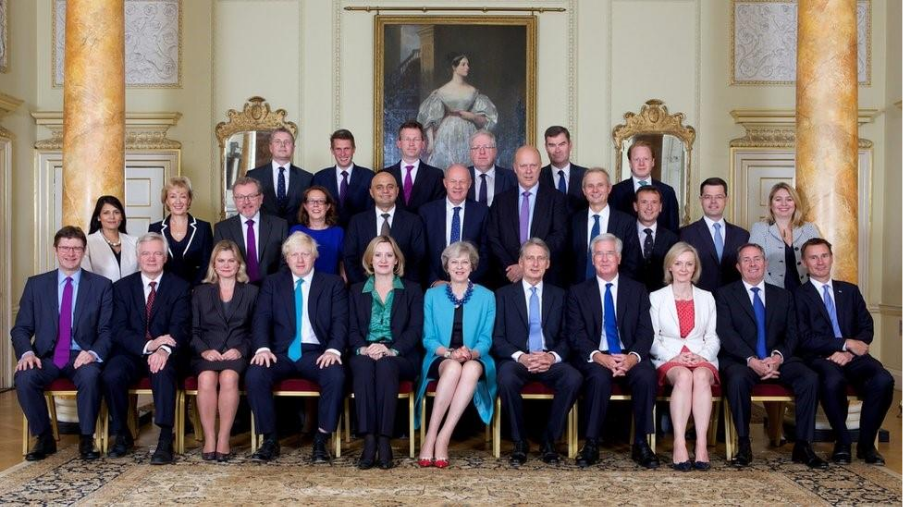
Immediately, we can see echoes of Lincoln in May’s strategy. She assembled a cabinet made up of people from both sides of her parliamentary party, with seven prominent Brexiteers on the front bench immediately, with more to come. To start, she had Boris Johnson (Foreign Secretary), David Davis (Brexit Secretary), Liam Fox (International Trade Secretary), Priti Patel (International Development Secretary), Chris Grayling (Transport Secretary), Andrea Leadsom (Secretary for the Department of Environment, Food and Rural Affairs (DEFRA)), and Natalie Evans (Leader of the House of Lords). Future ardent Brexiteer and Prime Minister Liz Truss was also in as Justice Secretary, but at the time she was a Remainer.
Boris Johnson and Andrea Leadsom had been the only two big beasts in the Tory party who had even a chance to beat May for the leadership of the party. While both had failed for their own reasons, each of them still had significant support within the party, and had sharp knives that the new Prime Minister was all too aware of.
Thus, Theresa May had assembled her “Cabinet of Rivals” in a similar vein to Lincoln’s. and this is where the major diversions in success rate immediately begin.
Lincoln, in his own way, commanded his cabinet. He curtailed the ambition of Bates for the presidency, he managed the bruised ego of Seward, and he managed to court one of his harshest critics in William Stanton to come aboard the cabinet in the Department of War, and impressed him with his ability to manage the goings-on of the war.
Conversely, May never quite managed to get the collar and leash on Johnson, before his machine was working to undermine her. May’s cabinet was filled with people who, unlike Lincoln’s, were not working toward a common goal despite their differences, but were working to spite each other because of them.
Chancellor Philip Hammond and the Treasury wanted the softest Brexit possible, with a firm customs union, and trade agreements lined up with other major partners globally to make up for the shortfall caused by the trade that would be lost with the EU.
Meanwhile, Boris Johnson and David Davis, the loudest voices at the Cabinet table for Brexit, basically wanted to smash their way out as quick as possible, possibly with the mind to call an election after they’d done it, or immediately challenge May for the leadership.
May fought her way through the slogs which were her cabinet meetings and took her bashings in the commons from the opposition benches, all while planning for an election to sure up her position. Some have often wondered, and many have outright stated, that many MPs within the Tory Party’s Brexit-wing, wanted, nay worked towards, a Tory defeat in that election, so that May would simply have had to go.
As Tory MP Steve Baker said, “I spent weeks… absolutely waging war on the government”, and this war seemed to work. Theresa May’s 2017 snap election was a disaster.
May tried to gain a majority of her own, and she wanted one which was significantly larger than the one she’d inherited from David Cameron. One which would be large enough that she could bulldoze the opposition, both within and without her party and push a soft-ish Brexit deal through the commons before 2018. Instead, May lost her majority, and with it almost all the authority that she had left with her parliamentary colleagues.
This was her Bull Run, or more accurately, her Chancellorsville. May had been upwards of 20 per cent ahead in the polls before election day, but a fractured party and an unpopular manifesto led her to manage to lose thirteen seats, bringing her under the level required for an absolute majority, and meaning she had to do a deal with the DUP in Northern Ireland to get the business of the Government through.
This alliance made negotiations with the EU nearly impossible. This, combined with the fact that the Brexiteers had taken more of a stranglehold on the parliamentary Tory Party at the election, meant that May’s time was up. She limped for just over a year more, failing to pass her Brexit deal three times before she finally resigned in 2019, leading to Boris Johnson’s disastrous tenure as PM.
Where did Theresa May go so wrong? When people speak of her, it is very rarely with contempt, even people (like myself) who detest Tories, speak of her with sympathy; “she did her best”, “Well she never really had much chance, did she?” and “She was a good person, just not quite up to the job” are all quotes I’ve heard from my family members. All of whom actively disliked her government.
You can’t quite picture Lincoln being spoken of in the same way, can you? With sort of a strained sympathy even though deep down we don’t mind he’s gone, we acknowledge that what came after was worse.
May’s fundamental miscalculation when compared to Lincoln is that May thought that bringing the wings of her party together on an equal footing into cabinet would mean that they would get behind her and help lead the nation forward. Instead, position overtook patriotism for so many of the Brexiteers and Remainers in her cabinet, and they chose to let it all burn so that they might become Secretary of State for embers when it had all finished. She overestimated the decency within the British political establishment, and they killed her for it.
“If destruction be our lot, we must ourselves be its author and finisher.” – Abraham Lincoln.
“Brexit Means Brexit!” – Theresa May.
“Politics. The word is taken from the Ancient Greek ‘Poly’ meaning ‘many.’ And ticks are tiny, bloodsucking insects.” – Francis Urqhuart, House of Cards.
Bibliography
BBC NEWS (2016). EU vote: Where the cabinet and other MPs stand. BBC News. [online] 22 Jun. Available at: https://www.bbc.co.uk/news/uk-politics-eu-referendum-35616946
Who’s who guide: Theresa May’s cabinet. (2018). BBC News. [online] 8 Jan. Available at: https://www.bbc.co.uk/news/uk-politics-42615109
Mason, R., Walker, P. and Elgot, J. (2016). Who’s who in Theresa May’s new cabinet. [online] the Guardian. Available at: https://www.theguardian.com/politics/2016/jul/13/who-theresa-may-cabinet-boris-hammond-rudd
Kearns, D. (2013). Team of rivals : the political genius of Abraham Lincoln. London: Penguin.
May, T. (2023). The Abuse of Power. Hachette UK.
Casalicchio, E. (2019). Philip Hammond, David Gauke, Rory Stewart, David Lidington quit UK Cabinet. [online] POLITICO. Available at: https://www.politico.eu/article/philip-hammond-david-gauke-rory-stewart-quit-uk-cabinet
Political TV (2023). Laura Kuenssberg: State of Chaos | Episode 1 | May/Johnson. [online] YouTube. Available at: https://www.youtube.com/watch?v=Svh4G-zTnaU
Dobbs, M. (2014). House of Cards. Sourcebooks, Inc.
Featured Image Credit: https://www.bbc.co.uk/news/uk-politics-37365509
 Retrospect Journal