
Written By Edie Christian
08/02/2026
The role of women within the Soviet state has been consistently deemphasised within traditional historiography. The Bolsheviks’ promises of social equality and rhetoric of the centrality of female emancipation to the revolution belie the actual impact upon the byt, or daily life, of women within the Soviet Union. Many of the tangible advances made in women’s rights derived from the Zhenotdel, the women’s division of the Central Committee. Since its establishment in 1919, tensions remained over its relation to the Party and its revolutionary role. Once it was regarded as no longer serving the Party’s rhetoric during collectivisation, it was dissolved on 5 January 1930 – this was subsequently designated by Wendy Goldman as the point at which the Party “explicitly jettisoned its commitment to a revolutionary vision of women’s liberation”.
The Zhenotdel’s founding in 1919 was a result of the efforts of revolutionaries Aleksandra Kollontai and Inessa Armand. Its primary focus was promoting a programme for women’s liberation “based on women’s full and equal participation in public life through the socialization of the domestic sphere”. The advancements of the state in their commitment to gender equality were primarily enacted through legal codes that did not transform attitudes towards women and the reality for their everyday lives. An example of this would be the 1918 Code on Marriage, the Family and Guardianship, which established marriage equality, eliminated the validity of religious marriage, and provided for easy divorce. Although progressive for the era, it was not introduced with the provisions to redress centuries of gendered inequality, particularly the expectation for women to share a disproportionate role in domestic labour – the resulting “double burden” from increased numbers of women in the work force meant that although gender equality was legally codified, it was not implemented in practice.
The Zhenotdel aimed to specifically improve women’s quality of life with branches throughout the Soviet Union, with local party committees holding elections for female delegates. The concept of organising women in a separate organisation was controversial, and tensions continued within the Party throughout the Zhenotdel’s existence – even older female Bolsheviks believed that the organisation was not sufficiently integrated into the Party framework. Furthermore, changes in state policy toward gender equality, to which the Party was purportedly committed, was unlikely to improve hostility towards women in everyday life. The political and economic landscape of the 1920s within the Soviet Union presented significant obstacles to the promotion of women’s liberation; this was particularly true of the introduction of the New Economic Policy (NEP) in 1921, which reduced centralised economic control and led to significant cuts to social spending.
Despite these funding limitations, the Zhenotdel was able to implement a wide range of improvements to hundreds of thousands of Soviet women. It organised programmes that helped to train and recruit women into the workforce, as well as groups that represented women within the workplace. As well as focusing on women’s working life, the Zhenotdel helped to assuage the “double burden” by opening laundries, canteens, and nurseries that would assuage the same level of domestic labour. Zhenotdel volunteers traveled across the Soviet Union, holding meetings, producing publications, and setting up “reading cabins” to teach literacy. Despite these achievements, existing tensions as to Zhenotdel’s role worsened throughout the 1920s, particularly as the Party turned towards rapid industrialisation. What Goldman terms as the Party’s “narrow redefinition of women’s liberation as labor-force participation” illustrates the tension between the Party’s understanding of the role of women and those of Zhenotdel activists, who advocated for a fundamental reform of byt.
These tensions came to a head in spring 1929 with a proliferation of bab’i bunty, protests by peasant women that were characterised by their spontaneity. They were vehemently opposed to collectivisation measures which merged individual farms into state-controlled kolkhozy (collective farms) and sovkhozy (state farms). Not only did this aim to accelerate industrialisation but to eliminate the class of kulaks (wealthy peasants), who had been increasingly villainised for hoarding grain. In response, the bab’i bunty obstructed these measures through disrupting meetings and forcibly reclaiming seized property. The Bolsheviks had a particularly low opinion of peasant women, and these protests only increased the perception of kulaks as a fifth column within Soviet society – they were believed to be manipulating the women into rioting against the state. In response, the Party announced Zhenotdel’s new role in channeling its activism for the improvement of women’s daily life towards support of collectivisation in summer 1929. The organisation began to be used as a tool by Stalin for the promotion of his economic goals; many of the improvements made in women’s byt were lost due to this repositioning, as the policies they advocated for were often particularly damaging to, and unpopular with, peasant women.
By removing the fundamental principle of Zhenotdel – improving women’s daily life – the organisation soon lost its purpose. Former Zhenotdel workers ended up strongly advocating for its disbandment due to its diversion from its original aims. The concept of gender equality was less important to the Party under Stalin than under Lenin – Stalin wished to mobilise all the Soviet Union’s resources towards rapid industrialisation. Even so, most within the Party believed it to be unnecessary, as the gender question had been “solved” by the introduction of the socialist state. As a result, the Central Committee disbanded the Zhenotdel on 5 January 1930, as part of a larger restructuring. In theory, women’s rights would be incorporated into the Party as a whole; in practice, however, many of the gendered aspects of society reemerged following its disbandment.
Despite their groundbreaking achievements at the time, the Zhenotdel’s legacy has been tarnished and overlooked by its subsequent discontinuation. This dissolution was symptomatic of the “Great Retreat” during the 1930s, in which Soviet policy shifted to promoting more pre-revolutionary values, particularly regarding family life. Marriage and motherhood were encouraged, and the legalisation of abortion was reversed, demonstrating that the dissolution of the Zhenotdel was indicative of a wider shift towards traditional gender roles and away from the revolutionary transformation of the byt. Once women’s liberation was reduced to labour-force participation and its aims were subordinated to rapid industrialisation, the Zhenotdel became incompatible with Stalinist ideology. Despite the significant strides it made in addressing the “woman question”, its dissolution and subsequent revival of gendered inequality is demonstrative of the broader Stalinist retreat, which subordinated revolutionary promises to prioritise industrialisation and state control.
Bibliography
Goldman, Wendy Z. “Industrial Politics, Peasant Rebellion and the Death of the Proletarian Women’s Movement in the USSR.” Slavic Review 55, no. 1 (1996): 46–77. https://doi.org/10.2307/2500978.
Schneider , Ann. “The Soviet Union’s Forgotten Feminist Revolution.” The Indypendent, October 17, 2017. https://indypendent.org/2017/10/the-soviet-unions-forgotten-feminist-revolution/.
Viola, Lynne. “Bab’i Bunty and Peasant Women’s Protest during Collectivization.” Russian Review 45, no. 1 (January 1986): 23. https://doi.org/10.2307/129400.
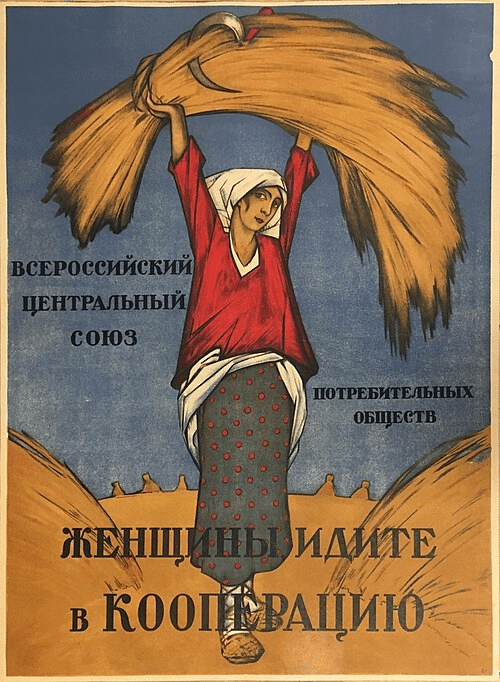
Featured Image credit: https://en.wikipedia.org/wiki/Zhenotdel#/media/File:I._Nivinskiy_-_Women,_Go_into_Cooperatives_(1918)_2.jpeg
 Retrospect Journal
_2.jpeg)