
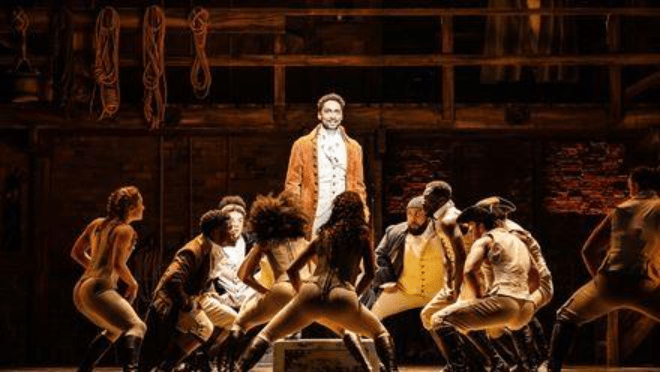
Written by Manahil Masood
08/02/26
In February 2015, Hamilton opened on Broadway, turning the life of an 18th-century American statesman into a pop-culture juggernaut. Written by the legendary Lin-Manuel Miranda, the show blended hip-hop, R&B, and traditional show tunes to tell the story of Alexander Hamilton, “the ten-dollar Founding Father,” from his impoverished Caribbean childhood to his fatal duel with Aaron Burr. Eleven years on, Hamilton has won a Pulitzer Prize, 11 Tony Awards, a Grammy, and a place in the cultural lexicon; quoted in classrooms and streamed globally via Disney+ (and, even before that, via bootleg “slime tutorial” YouTube videos).
This Christmas, I was lucky enough to be gifted a ticket to see the show live, and I have been thinking about it “Non-Stop” since. While my 16-year-old self was obsessed with the catchy songs, for historians (as I would now tentatively class myself), the 11-year anniversary offers not only a chance to celebrate its reach, but also to assess its legacy as a work of public history. How accurate is it? Is accuracy even important? And how does it fit into the wider tradition of presenting the past on stage?
A Tradition of Musical Histories
Despite Hamilton’s acclaim, the show did not invent the historical musical genre. From 1776, which set the signing of the Declaration of Independence to choral harmonies, to Les Misérables, which turned the Paris Uprising of 1832 into a global phenomenon, theatre has long been drawn to history. What Hamilton did was fuse historical narrative with contemporary musical idioms, framing politics in a way that resonated with younger audiences in unprecedented ways.
This trend of engaging younger audiences through music has continued in recent years. Six reimagines the six wives of Henry VIII as a pop-singing girl group, sharing Hamilton’s appetite for anachronism. It distils complex Tudor politics into witty one-liners, encouraging audiences to empathise with women who have often been reduced to textbook footnotes or a single line in a nursery rhyme about a fickle king. Like Hamilton, Six plays fast and loose with chronology but uses this freedom to spotlight historically sidelined perspectives in a way that clearly resonates with wider audiences.
Even children’s show Horrible Histories, with its irreverent parody songs about everything from Georgian highwaymen to Charles II’s Restoration, belongs in this discussion. Its comedic sketches and catchy songs package complex histories for younger viewers, with the understanding that entertainment may spark curiosity more effectively than precision alone (it certainly worked on me).
Fact, Fiction, and Flow
Indeed, Miranda has been candid about his willingness to compress timelines, rearrange events, and streamline historical “characters” to make the narrative flow best. Critics and historians have scrutinised the show’s inaccuracies, pointing out how Angelica Schuyler’s initial portrayal as a single woman romantically interested in Hamilton reduces her to a peripheral love interest, despite her already being married at the time of their meeting. Other historical figures have similarly been reduced to stock characters, such as fourth president James Madison, who is portrayed as Thomas Jefferson’s sickly sidekick, despite in reality being considered a political “giant” by scholars such as Oakland University Professor Todd Estes.
Arguably, some inaccuracies are structural necessities for entertainment and drama. In one interview, Lin-Manuel Miranda stated that he “felt an enormous responsibility to be as historically accurate as possible, while still telling the most dramatic story possible… and when I did depart from the historical record or take dramatic license, I made sure I was able to defend it… none of those choices are made lightly.” Indeed, musicals run on emotional arcs, and Hamilton’s fast-paced rap battles compress years of political rivalry into just minutes of impactful stage time. With this in mind, the fact that Hamilton never “punched the bursar” is arguably irrelevant, since the throwaway line helps early on to establish his rash decision-making and diamond-in-the-rough characterisation.
Perhaps the most revolutionary choice in the show was the casting of Black and Latinx actors as the Founding Fathers and their contemporaries. Rather than being read as an attempt at historical re-enactment, many praise this choice as an act of historical reframing. By separating the performers’ racial identities from those of the historical figures, Miranda invites audiences to claim ownership of a history traditionally dominated by white narratives. This artistic decision has been widely lauded for diversifying the image of America’s origins, though some critics argue that it risks softening the reality of the Founders’ complicity in slavery.
Indeed, while slavery is acknowledged in the show, it is not explored in depth, and Hamilton is depicted as more of a progressive figure on the issue than many historians would agree with. Despite co-founding the New York Manumission Society, which advocated for gradually ending slavery in New York State, Hamilton advocated for manumission rather than abolition. This distinction is important, as manumission depended on slave owners voluntarily freeing the enslaved people under their control rather than codifying government intervention to end slavery. Pulitzer Prize–winning historian Annette Gordon-Reed emphasises that the titular statesman “bought and sold slaves for his in-laws…opposing slavery was never at the forefront of his agenda.”
Miranda addressed the resurgence of this criticism on Twitter when the musical was added to Disney+, explaining that while he grappled with the “sheer tonnage of the complexities and failings” of these historical politicians for six years, he ultimately fit in as much as he felt he could in a 2.5-hour musical. This criticism has generated a productive and necessary conversation about the realities of historical figures and the ways in which we should navigate these more unsavoury truths and sidelined narratives in our cultural understandings.
The Historian’s Dilemma
The question, then, is not whether these works are perfectly accurate (none are), but whether they encourage engagement with the past. There is a pedagogical argument to be made that a musical like Hamilton functions as a “gateway drug” to history, prompting audiences to seek out the real story. Teachers have reported students independently researching the Federalist Papers or the duel at Weehawken after seeing the show.
Notably, this does bring a risk of popular portrayals becoming the default narrative understood as truth. When a version of history is as emotionally compelling and widely circulated as Hamilton, it can overshadow the messy, less flattering truths found in archives or textbooks. In some cases, audiences may remember the soundtrack better than the actual historical scholarship.
Over a decade on from Hamilton, it seems to me that historical musicals are subversive interpretive acts. They should not serve as replacements for academic history, but as powerful translations of it that make the past feel more immediate and accessible.
Indeed, Hamilton’s influence on historical storytelling is undeniable, making the idea of singing about political history seem not only viable but commercially attractive. Achieving this while also raising expectations of entertainment means that audiences now look for wit, diversity, and musical innovation in their historical education. For many historians, the genius of Hamilton is not that it gets every detail right, but that it engages us enough to tell human, individual stories, and encourages us to dig deeper by questioning media and narratives that are traditionally championed.
Bibliography
Chernow, Ron. Alexander Hamilton. Penguin Press, 2004.
Delman, Edward. “How Lin-Manuel Miranda Shapes History.” The Atlantic, 29 September 2015. https://www.theatlantic.com/entertainment/archive/2015/09/lin-manuel-miranda-hamilton/408019/
Gonzales, Erica. “Lin-Manuel Miranda Addresses Claims That Hamilton Glorifies Slave Owners.” Harper’s Bazaar, 7 July 2020. Available at https://www.harpersbazaar.com/culture/film-tv/a33218336/lin-manuel-miranda-hamilton-slavery-controversy/
McCarthy, Bill. “Fact-Checking ‘Hamilton’ the Musical’.” Politifact, 1 July 2020. https://www.politifact.com/article/2020/jul/01/fact-checking-hamilton-musical/
Miranda, Lin-Manuel, and Jeremy McCarter. Hamilton: The Revolution. Grand Central Publishing, 2016.
Featured Image Credit: https://www.visitlondon.com/things-to-do/event/44256202-hamilton-the-musical-tickets
 Retrospect Journal