
Written by Elizabeth Hill
In 1613, at the wedding of his daughter, Princess Elizabeth Stuart, James VI and I proclaimed that ‘no Lady or gentlewoman shold be admitted to any of these sites with a verdingale [farthingale], which was to gaine the more roome, and I hope may serve to make them quite left off in time’. The ‘verdingale’ of which he spoke, which had been prevalent in English courtly fashions since the 1540s, had been much criticised and shamed by contemporary male writers, as it served as a way to completely displace men in the public sphere. James was not the only male monarch to ban such skirts; Charles IX of France similarly proclaimed that farthingales were not to reach more than 1.8 metres in circumference. No farthingales from the period survive, and almost all of the sources about them come from men, particularly the moralists and satirists who did not write about them, or the women who wore them, kindly. We are, then, only able to see the skirt through a male perspective – but what Elizabethan and Jacobean men thought helpfully reveals a great deal about why the farthingale was indeed such a powerful weapon.
Royal Women: Origins of the Farthingale
Though the farthingale skirt only appeared in England in the 1540s, it had been a feature of Spanish fashion since the 1460s. The most popular origin story of the skirt – though likely a myth – was that Joana of Portugal had used it to conceal an illegitimate pregnancy. Katherine Parr, Elizabeth I and Mary I were among the first women to wear and popularise the style in England, the latter likely due to her marriage to Philip II of Spain in 1554. The Spanish style was characterised by a cone-shaped under-structure that was then echoed in huge funnel-shaped sleeves, all to accentuate the narrow waist (Figs. 1-2). This shape remained in fashion at the English court until the 1580s, when the French wheel farthingale – which featured several whalebone hoops that were positioned outwards in a wheel shape, enabling the fabric of the skirt to fall dramatically – emerged. At the turn of the sixteenth century, farthingales only increased in size and splendour, which is best shown in the Ditchley Portrait of Elizabeth I (Fig 3). Elizabeth’s kirtle extends almost horizontally due to her wheeled farthingale in this portrait, allowing her to embody much of the space within the painting. The width of farthingales made female monarchs and courtiers largely unapproachable, enhancing the image of prestige for the woman wearing them. Farthingales were useful for showing off wealth and power; not only were the farthingales themselves expensive, they were used to display swathes of ornate, elaborately embroidered fabrics that often contained threads of gold and silver, as well as other precious gemstones. For non-royal female courtiers, the farthingale became an emblem for their father or their husband’s wealth, but nonetheless it was not appreciated by men of the court or in wider society.
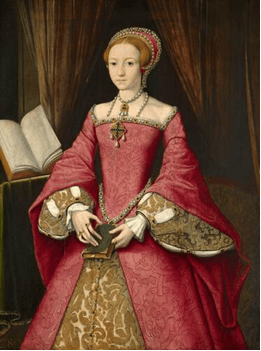
Fig. 1 – William Scrots (active 1537-53), Elizabeth I when a Princess, ca. 1546.
Source: Royal Collection Trust
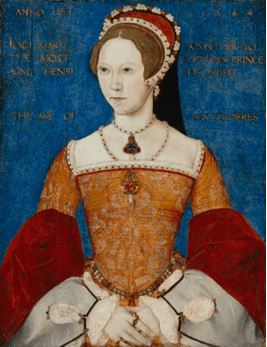
Fig. 2 – Master John (active 1544-45), Queen Mary I, ca. 1544.
Source: National Portrait Gallery

Fig. 3 – Marcus Gheeraerts the Younger, Queen Elizabeth I (‘The Ditchley Portrait’), ca. 1592
Source: National Portrait Gallery
‘No Lady Should be Admitted’
Why did men object so vehemently to a woman’s underskirt – and why would multiple male monarchs go to such trouble as to ban, or at least restrict, the farthingale? It perhaps comes as no surprise that James would see women in extravagant, expensive and large gowns as a threat; he appreciated fine clothes well enough, but on himself or other men, and certainly not in a manner that allowed his wife, Anne of Denmark, to outshine him in their portraits together. Anne’s body significantly dominates and outshines the figure of her husband in their portraits – it is her that draws the eye, rather than the King, making him visually subordinate to her (Fig. 4). James’ 1613 proclamation may, on the surface, suggest that farthingales were problematic because of the physical space they took up, but depictions like these illustrate just how much power farthingales gave women. Though contemporary moralists and satirists often exaggerated their size – for example, the Venetian ambassador wrote in 1617 that Anne of Denmark’s farthingale was so expansive that it was ‘four feet wide in the hips’ – it was considerably unlikely that any farthingale could be more than 1.3m wide in the hips. For it to be any bigger would make it nearly as wide as the average Tudor woman was tall (158cm). It was, then, not the actual consumption of literal space that was the problem; it was the idea of women transgressing their social enclosures, violating what men had assigned for them. Women were now able to define their own space – specifically, urban women.
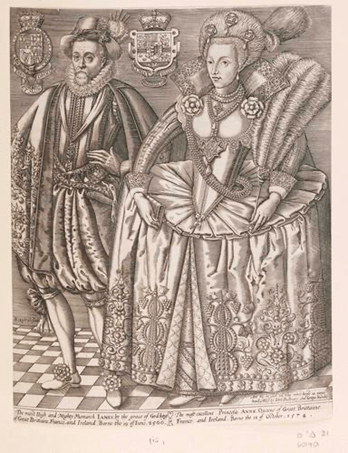
Fig. 4 – Renold Elstrack (1570-1625), James I and Anne of Denmark, c. 1616-19
Source: Royal Collection Trust
Farthingales not only enabled elite women to appear more physically and metaphorically domineering as they took up a new level of space, but they enabled lower-class women to socially climb through the farthingale’s more accessible and cheaper sister, the French ‘bum roll’. Urban women began to wear farthingales and bum rolls less than two decades after they were first recorded in the royal wardrobe in the 1540s; to enlarge the width of a gown, and thus go to somewhat great expense to be able to use more fabric, reflected a level of social mobility that startled contemporary men. Farthingales were not particularly practical for urban women; movement and space was easier for those in Whitehall and other aristocratic spaces, but the winding and narrow streets of cities and towns were not so conveniently designed for splendour; by choosing to shape their bodies in this way and take up more physical space, city women were pushing the boundaries of acceptable social behaviour and status by aiming to do what only the elites could in their large estates, and thus challenging their role against men and the patriarchal societal structure.
The farthingale was also closely associated with sexual morality, due to its nature as an undergarment and its origin myth as a cover for Joana of Portugal’s pregnancy. As a form of undergarment, it was often used as a scapegoat for the moral fears around women’s bodies and sexual indiscretions. Many contemporary sources express this; Stephen Gosson’s Pleasant Quips for Upstart Newfangled Gentlewomen (1595) links farthingales to female sexual deviance in three dedicated stanzas, stating that ‘these hoops did help to hide their sin’. Accounts from the period illustrate a deep unease over the changing of social and gender dynamics brought about by farthingale skirts. The fears over female sexual morality were closely linked with those about women’s social status; women were thought to be avoiding the societal duty of motherhood by allegedly concealing their pregnancies through the skirt and thus breaking away from what male society had set for them. In a portrait of Anne of Denmark (c.1606-8), the emergence of new trends for how the garment could be worn also displays women’s ability to shape how their bodies were presented through the farthingale (fig. 5). With a shortened hem, feet, which Anne wears in heeled shoes, were visible for the first time; Anne also enjoyed gowns with low necklines that revealed the bust, enhanced by the lace collar. Another of the Venetian ambassador’s comments was that Anne’s ‘bosom was bare down to the pit of her stomach’ – though this is unlikely, as contemporary portraits attest, it is telling of what men thought women’s choices in clothing said about them.
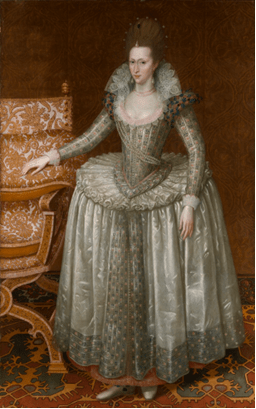
Fig. 5 – John de Critz the Elder (circa 1550-1642), Anne of Denmark, c. 1606-08.
Source: National Portrait Gallery
Queen Anne insisted on the farthingale being worn at the English court long after it had gone out of fashion elsewhere, and the style lingered after her death in 1619 – and after her husband’s proclamation against them in 1613 – until about 1625. The power that the farthingale offered women was clearly not something to be ignored, both for aristocratic and urban women. This is perhaps why the style persisted for nearly a century, despite all the male opposition to it, as James’ proclamation evidently made no difference. Maybe women enjoyed the display of wealth and social standing, or maybe they enjoyed being an inconvenience and angering the patriarchy around them – with only male voices to document the period, it is difficult to understand whether this was the case. Though the farthingale did inevitably fall out of fashion with the changing tides of European aristocratic tastes, the desire to control the skirt and, thus, women’s bodies, did not – the eighteenth-century hoop skirt and the nineteenth-century crinoline can attest to that. The farthingale remains, though, a unique and underestimated example of female rebellion and agency.
Bibliography
Bendall, Sarah A. “‘Take Measure of Your Wide and Flaunting Garments’: The Farthingale, Gender and the Consumption of Space in Elizabethan and Jacobean England.” Renaissance Studies 33, no. 5 (2019): 712–37. https://www.jstor.org/stable/26839857.
Bochicchio, Sarah. 2018. “1580-1589 | Fashion History Timeline.” Fitnyc.edu. 2018. https://fashionhistory.fitnyc.edu/1580-1589/.
Bochicchio, Sarah. 2020. “1590-1599 | Fashion History Timeline.” Fashionhistory.fitnyc.edu. January 5, 2020. https://fashionhistory.fitnyc.edu/1590-1599/.
Chrisman, Kimberly. “Unhoop the Fair Sex: The Campaign Against the Hoop Petticoat in Eighteenth-Century England.” Eighteenth-Century Studies 30, no. 1 (1996): 5–23. http://www.jstor.org/stable/30053852.
De Young, Justine. 2019. “1540-1549 | Fashion History Timeline.” Fashionhistory.fitnyc.edu. July 2, 2019. https://fashionhistory.fitnyc.edu/1540-1549/.
De Young, Justine. 2020. “1600-1609 | Fashion History Timeline.” Fashionhistory.fitnyc.edu. January 10, 2020. https://fashionhistory.fitnyc.edu/1600-1609/.
De Young, Justine. 2020. “1610-1619 | Fashion History Timeline.” Fashionhistory.fitnyc.edu. January 11, 2020. https://fashionhistory.fitnyc.edu/1610-1619/.
Miller, Julia-Rose. 2024. “Curtailed Consumption: Formal and Informal Controls on Dress in Early Modern Great Britain C. 1560-1730.” The Webster Review of International History 4 (1). https://websterreview.lse.ac.uk/articles/59.
Image credit:
https://www.rct.uk/collection/404444/elizabeth-i-when-a-princess
https://www.npg.org.uk/collections/search/portrait/mw01957/Katherine-Parr
https://www.npg.org.uk/collections/search/portrait/mw02079/Queen-Elizabeth-I-The-Ditchley-portrait
https://www.rct.uk/collection/601401/james-i-and-anne-of-denmark
https://www.npg.org.uk/collections/search/portrait/mw202589/Anne-of-Denmark
Featured Image Credit: Marcus Gheeraerts the Younger, Queen Elizabeth I (‘The Ditchley Portrait’), ca. 1592
Source: National Portrait Gallery
 Retrospect Journal