
Written By: Abby Hughes
Nowadays, we might think of sight as an objective reality. Seeing, therefore, believing. After all, the same rays of light that enter our eyes, thus allowing our brains to perceive the world around us, bind us living creatures in a shared experience of visual reality. However, this unconscious process has not always been thought of as a passive state of being. To see has not always been to ground oneself, but at certain times has been an active process, a fraught tussle for control, and a real, embodied power. A positive or negative look cast could be a tool, promising protection or risking pollution.
To the Ancient Greeks and Romans, sight was an active engagement. As much can be concluded from the prominent anxiety attached to the persistent symbolism around ‘evil eyes’. To be fascinated by something was not to draw oneself towards it, but to ‘suffer from the malevolent gaze of another’, as stated by Hamann. Thus, sight to the Ancient Greeks and Romans was ‘extromissive’, in which eyes saw by emitting their own force of vision onto an object, rather than receiving an external reality. The anxiety surrounding polluting forces of sight was grounded and evident. Amulets called ‘fascina’ were often forged from bronze or bone and served to guard against the evil eye. Often taking the form of a phallus, these objects represented emission, attacking the potentially damaging gaze and thus redirecting it in its tracks. Not only did these amulets attract the eye by representing something typically unseen and potentially crude, but they targeted the polluting vision of the evil eye, guarding against its projection.
The legacy of this extromissive interpretation of sight can be traced through to the Early Modern period. In his 1411 treatise, Tratado de la fascinación o de aojamiento, Enrique de Villena details the process of visual infection. He details that some people are so poisonous ‘that by their sight they poison the air’. As an example, he refers to ‘the damage of the gaze and infection of menstruating women who, looking in the mirror, cause stains and marks in it’. Beyond sight itself functioning as a weapon, the extent of its damage is evidently dependent on its wielder, according to Villena. Informed therefore by preexisting notions of what constitutes the infectious, anxiety surrounding sight reveals societal concerns with purity. Those deemed imperfect or unclean were therefore regarded with fear, not only because of their individual state, but the risk they posed in corrupting their wider environment. While we regard the body as a contained organism, the Early Modern body was evidently a semi-permeable one, receiving and transferring the conditions of its world in a fluid exchange.
To combat the evil eye, Villena recommends the use of amulets, such as ‘small hands of silver’, and ‘broken pieces of mirror’. Beyond the form it might represent, the particular concern with the materiality of the amulet is of interest here. Hamann notes that ‘Early Modern protections against the evil eye were often shining things.’ Partly, the intention behind this design was a desire to attract the eye, misdirecting the vision of another and thus guarding the individual’s own body. We might also consider that the use of represented body parts, such as Villena’s recommended hand amulets served to combat the eye’s attack, similarly to the Roman use of phallic amulets. Beyond illustrating a differing understanding of vision, these accounts suggest to us a world that was occupied by warring forces of affecting sight, and people who sought to guard themselves from a constant barrage of contamination.
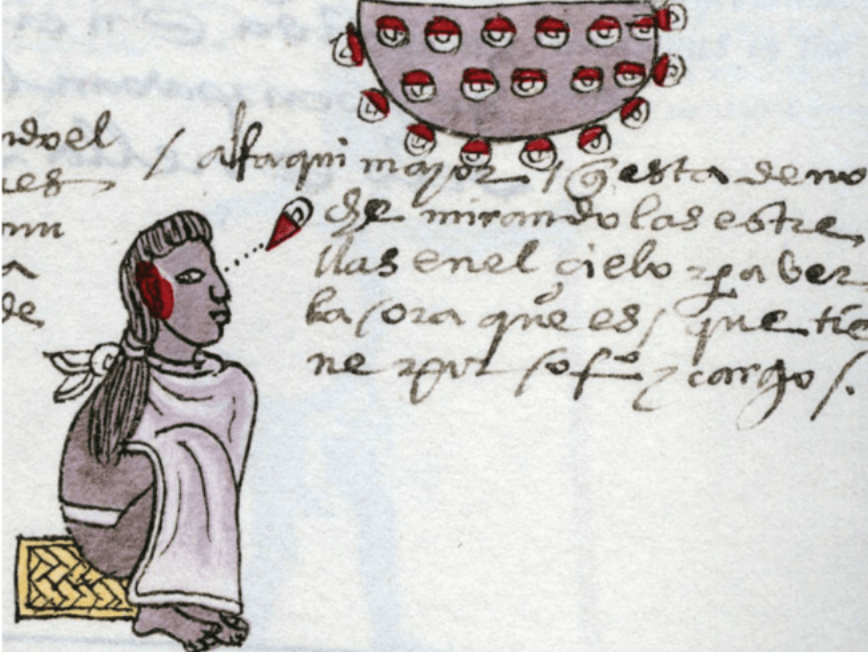
In this same porous world, pre-Hispanic Mesoamericans shared a similar conception of active sight. The Pre-Hispanic Maya hieroglyph for the verb ‘to see’ depicts an eyeball in profile, with two lines of vision emerging from its pupil. However, unlike the European concern with the unclean gaze of those who were themselves polluted, Pre-Hispanic conceptions of visual power were closely tied to social hierarchy. Nobles were commonly depicted with ‘fiery’ or ‘smoking’ sight, through which their projective power of sight influenced and ordered the world around them. The power of human sight was certainly something to be feared, though the ability to harness it is lorded in this case. The same can be illustrated from the Popol Vuh, a Quiché Maya sacred history written in the late 1550s. Detailing human creation, it suggests that the gods quickly realised their creations were too powerful, as ‘they saw everything under the sky perfectly … they understood everything perfectly’. As a result, the gods limited human vision, and therefore complete understanding of the world around them, so as to diminish their threat to the gods themselves. In this example, sight is not merely an affective power to influence and control other humans but contains within it the seeds to philosophical understanding of the world.
We must consider that vision has acted as a localised, embodied and physical force. Guarded against by material creations, and the source of bodily anxiety, it is evident that this was a force which was believed to have not just spiritual but physical effects, often where the two were indistinguishable as one. This was a power acting upon the body, but also located within it, imbuing each person with the ability to influence and affect. To Pre-Hispanic Mesoamericans, sight was not only a source of particular anxiety, but an effective tool in the ordering of society. More than this, the Popol Vuh indicates that, at its height, the ultimate power of sight lay in its ability to unravel the mysteries of the universe and provide divine understanding of the world. Considered in tandem with our own scientific understanding of sight, we might begin to unravel the power and yet limitations imbued in our definition. Do we think of sight as a tool, a human power in our philosophical mission of truth, or does it act as a veil of perception to an unseen and unattainable truth?
Bibliography
Brittenham, Claudia. Unseen Art: Making, Vision, and Power in Ancient Mesoamerica, New York, USA: University of Texas Press, 2023
Gell, Alfred. 1998. Art and Agency: An Anthropological Theory. Oxford: Clarendon. pp. 16-2
Hamann, Byron Ellsworth. “The Higa and the Tlachialoni: Material Cultures of Seeing in the Mediterratlantic.” Art history 41.4 (2018): 624–649.
Featured Image Credit: Codex Mendoza f. 63r (detail: priest-astronomer).” Wikimedia Commons, uploaded by Andrew Dalby, 2 Apr 2018, https://commons.wikimedia.org/wiki/File:Codex_Mendoza_63r_astronomer.jpg.
 Retrospect Journal
