
written by Connie Greatrix
23/11/2025
Feminism developed in Algeria as part of the solidarity movement in the anti-colonial struggle against French rule. Women heavily participated in the war for independence but became sidelined in post-colonial Algeria as nation-building became the priority. Despite this, political consciousness did not dissipate, and after the roots of the nation-state stabilised, women began to challenge the misogynistic notions the new state was built upon. This delayed response was partially due to the fear of potential neo-colonial manipulation of their struggle under the mask of Western feminism.
The Algerian War took place between 1954 and 1962 as a response to French colonialism. The Front de Liberation Nationale (FLN) saw armed struggle as the only viable option for liberation from the French. Women suffer a double burden of oppression under colonial rule. Women were often abused and raped by the French, which in turn left them as outcasts within society due to the dishonour and stigma surrounding sexual violence. This pushed women into the private sphere to protect their honour and their lives. This increased their dependency on men as sole earners and pushed many families into more extreme poverty. Nationalist parties began to emerge, focussing on the education of women to gain a political consciousness that tied their oppression together with colonialism. This helped develop a national consciousness and solidarity through feminism and anti-colonialism.
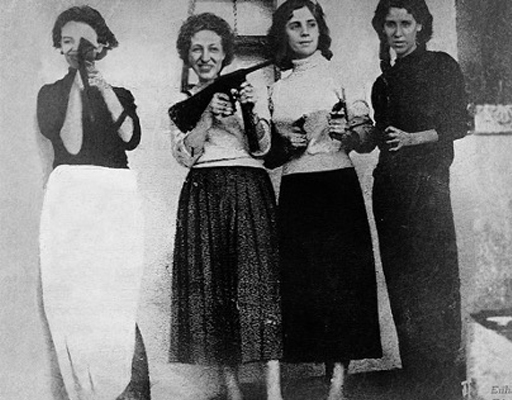
Women began to assert their own agency in the fight for liberation as active participants. Many developed de facto roles in the urban networks associated with the movement and suddenly shifted heavily into the public sphere, requiring a response from the FLN. Roles consisted of bomb carriers, doctors, and even fighters. This was a fight against colonialism and its relation to women’s position in society. In this, they saw liberation as a route to their emancipation.
As nationalist movements built, the French worked to fracture Algerian society and saw the emancipation of women as a method to reach assimilation and colonial dominance through breaking into the private sphere. This agenda was also rooted in promoting an international image of their presence in Algeria being necessary as a saviour of women. The FLN began a similar propaganda campaign in which they sought to gain legitimacy through the promotion of women to an international audience. They used photographs of women in guerrilla units to demonstrate to the international community the progressive nature of the movement and to defeat orientalist stereotypes of the oppression of women outside of the West. They also hoped to encourage female participation in the movement. There remained some opposition to female involvement, particularly in the more conservative armed wing of the FLN (the ALN), but women were allowed to participate even if their roles were limited, and strict boundaries preventing too much gender mixing were put in place.
The veil became a political symbol of the colonial and anti-colonial movement. For the French, the veil stood as a symbol of backwardness, and they saw a moral duty to encourage unveiling as a civilising and modernising mission. There was also a colonial desire and a fetishisation of the veil. Through propaganda campaigns around the veil, they sought to continue their attempts to conquer Algerian society.
The wearing of the veil was context-driven as well as a religious expression. In rural areas, the veil was less common, as there were fewer interactions with potentially dishonourable outsiders. It was also seen as impractical for manual labour. However, in urban areas, the veil was worn more often and allowed women to move more freely without being at risk of being seen as engaging in dishonourable interactions. For the urban poor, Macmaster describes the Haik as being a ‘cheap uniform’, allowing for less obvious class identification based on clothing to occur. The urban poor who chose to unveil were often labelled as prostitutes, and more widely, women were seen as westernised and European collaborators.
Unveiling ceremonies became a point of potential European propaganda. There remains an historical debate over whether poor Algerians were coerced into unveiling at these protests, or if they were a point of joy and unity between Europeans and Algerians in expressing a choice for women to unveil.
This demonstrates how politicised the veil had become. As the war continued, women used the veil to cover guns, grenades, and messages. Those unveiled used their projected Europeanised appearance to engage in the resistance, carrying bullets in their handbags. The female body became a battleground for suspicion. The veil became a symbol of patriotism or assimilation. This challenged the Western view of Muslim women as passive in their sometimes-violent assertion of their own autonomy for liberation.
In 1962, Algeria became independent. A liberal faction and a conservative faction emerged, with the conservatives winning out. They called for an Islamic cultural revival as a security guarantee for the enormity of the task of nation-building. Women were recognised as a cornerstone of cultural resistance and maintainers of the nation, but their position as fighters and liberators was forgotten by the new regime. Instead, they were sidelined and encouraged to return to the private sphere. Ties between Algerian men and women forged in the liberation movement were decimated. Women’s emancipation was not a priority for the new state. Although the revolution can be seen as a failure for women, in the private sphere they continued to promote education and political consciousness, with 40% of school students being girls in the 1980s.
Many that engaged with the FLN were willing to prioritise the nation over their own oppression until the Family Code was introduced in 1984. This codified the subordination of women, with no right to marriage, divorce, or travel without the approval of a male guardian. Women who had put aside their rights for nationalism stood up against this. With the stability of the state growing, there was less fear about Western interference manipulating their ideas. The movements continued, and in 2005 there was reform to the code, but this was extremely limited. There have remained calls to abolish these laws, but power remains consolidated in conservative and religious actors.
Feminism became part of anti-colonial solidarity, with female oppression recognised as inherently linked to colonialism. The French attempted to manipulate the female emancipatory agenda to gain support for the colonial regime and further assimilation. The liberation movement relied upon the work of many women and the development of a feminist, anti-colonial political consciousness, but as happens around the world (not exclusively in MENA countries), the social issues of women were made secondary as the nation-state was realised.
Bibliography
Cheriet, B. (1992) ‘Islamism and Feminism: Algeria’s “Rites of Passage” to Democracy’, in Phillip C. Naylor & John P. Entelis (eds.) State and Society in Algeria. 1st edition [Online]. United Kingdom: Routledge. pp. 171–215.
Fanon, F. (1980) A dying colonialism. London: Writers and Readers Publishing Cooperative.
MacMaster, N. (2020) Burning the veil : the Algerian war and the ‘emancipation’ of Muslim women, 1954-62. [Online]. Manchester, UK: Manchester University Press.
Salhi, Z. S. (2011) ‘Algerian women as agents of change and social cohesion’, in Moha Ennaji & Fatima Sadiqi (eds.) Women in the Middle East and North Africa. 1st edition [Online]. Routledge. pp. 149–172.
Seferdjeli, R. (2012) RETHINKING THE HISTORY OF THE MUJAHIDAT DURING THE ALGERIAN WAR: Competing Voices, Reconstructed Memories and Contrasting Historiographies. Interventions (London, England). [Online] 14 (2), 238–255.
Vince, N. (2020) The Algerian War, The Algerian Revolution. 1st ed. 2020. [Online]. Cham: Springer International Publishing.
Featured Image: Four female members of the National Liberation Front c. 1956 who planted bombs during the Battle of Algiers: Samia Lakhdarri, Zohra Drif, Djamila Bouhired and Hassiba Ben Bouali
https://al24news.dz/en/the-indomitable-spirit-of-algerian-women-in-the-revolution-for-independence/
 Retrospect Journal