
Written by Arianna North Castell
When we see an advert for the new Boss cologne plastered across a billboard, it brings a strange echo of a darker past to realise that the same brand was actively promoted by the Nazi regime. Today, you can buy the newest trending fragrance; back then, you could buy your husband’s all-black SS uniform and your son’s Hitler Youth outfit from Hugo Boss.

Advertisement for Nazi uniforms by Hugo Boss, 1933.
Many German companies were built on foundations laid during the Nazi period. It’s an undeniable part of their history and heritage. Raising this history is not about holding today’s company responsible for the actions of its founder, but about recognising the stories (and the losses) that sit beneath the success of a brand still bearing his name. Acknowledging this past does not assign blame; it restores visibility to the lives that were exploited in the making of that legacy.
The exact details of Hugo Boss’s personal involvement with the Nazi Party vary, but the core facts are clear. He became an official party member in 1931. Although he did not design the SS or other Nazi uniforms, his company was one of the principal manufacturers supplying the regime from 1924 until the end of the war in 1945. During this time, Boss employed around 140 forced labourers from the Soviet Union and Poland, as well as roughly 40 French prisoners of war.

Boss’ Nazi Party membership card, 1931.
Boss’s own sympathies are often debated. Some argue he joined the party primarily for economic security – a claim he himself put forward after the war, when he was initially classified as an “active member” before the charge was reduced to “follower”, granting him a lighter penalty. But ultimately, the question of his personal beliefs matters far less than the reality: his company profited from, supported, and grew alongside the Nazi state.
Hugo Boss was essential to wartime fashion in Germany, but it’s important to recognise what came before him. In the early twentieth century, Berlin was a major fashion capital – largely thanks to the Jewish businesses that powered it. The 1920s saw the rise of ready-to-wear clothing, and many of the leading firms, including the famous Nathan Israel department store, were Jewish-owned. Hitler’s rise to power marked a collapse for the thriving fashion industry in Berlin. His election in 1933 brought nationwide boycotts for Jewish businesses, and designers and retailers were soon barred from securing bank loans – a financial chokehold that made it impossible to stage fashion shows or maintain production. To stay afloat, many were forced into taking Nazi Party members on as business “partners”, handing over control at a fraction of the true value.
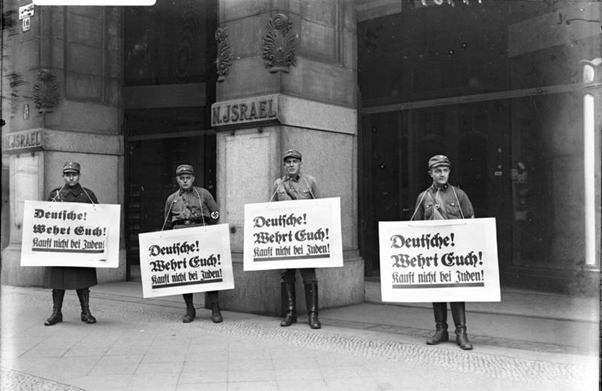
Nazi SA paramilitaries outside the store on April 1, 1933, holding signs: “Germans! Defend yourselves! Don’t buy from Jews!” (Deutsche! Wehrt Euch! Kauft nicht bei Juden!)
This tightening of economic restrictions was only one arm of a wider antisemitic programme that would ultimately culminate in open violence. During the November pogroms of 1938, Nazi supporters ransacked hundreds of fashion businesses. Of the 2,700 Jewish fashion companies operating before the attacks, only 24 remained by the end of that year. Amid this decimation, Hugo Boss – who had himself gone bankrupt a decade earlier – emerged as the region’s dominant textile manufacturer. Classified as a wartime “essential” producer, his factory was protected and able to expand while Jewish competitors were stripped of their livelihoods.
The human cost cannot be overlooked, especially a loss at the foundations of a company with so much success today. One name survives as a stark reminder: Josefa Gisterek. On her grave, the inscription reads in Polish: “Cruel fate tore me from my family and swept me away to a foreign land.” It is a bleak testament to a life uprooted and consumed by the forced-labour system that underpinned companies like Hugo Boss.
Josefa, a young Polish woman, was one of the forced labourers working in the Boss factory with her sister Anna in October 1941. Within weeks of her placement, she attempted to return home to help her father care for her family. She was then detained by the Gestapo, deported first to Auschwitz and then to Buchenwald, where she was beaten repeatedly. Eventually, Hugo Boss used his connections within the Nazi Party to have her transferred back to his factory in Metzingen. His motives remain unclear: whether out of guilt, self-interest, or a desire to reclaim labour at a time of shortages.
The conditions she returned to were dire. Other workers recall harsh 12-hour work days and routine humiliation with Polish labourers forced to wear a “P” badge on their clothing. Anna says they would sometimes remove them during the little time off they had to feel like normal girls again. Another worker, Maria Klima, who was 14 at the time, remembered being called “Polish pigs” by supervisors. She remembers the factory’s enforcer, Boss’s own son-in-law, Eugen Holy, was known for beating the workers physically, giving them blows to the neck, his vitriol often directed to the Eastern-European forced labourers. Under this pressure, Josefa’s health collapsed. After repeated pleas, she was granted a short medical leave and allowed to see a doctor. She returned home, exhausted and severely weakened. On 5 July 1943, her landlady found her lying on the kitchen sofa. Josefa had ended her life using gas from the stove. There was no suicide note – only a poem in her diary. Boss later paid for her funeral and covered her family’s travel costs, a sympathetic gesture that came far too late.
Today, the name Hugo Boss evokes high-end luxury tailoring and fragrances with matching glossy advertising campaigns, not the erased fashion houses of Berlin or the story of a young woman like Josefa. But history does not vanish simply because a company reinvents itself. Hugo Boss himself died in 1948, just three years after the war’s end, leaving little space for any genuine reckoning or reflection. In the decades that followed, the company acknowledged its wartime role, marking a clear boundary between the modern brand and its past.
Remembering the foundations on which companies were built is not about assigning guilt to a modern label; it is about refusing to let the stories of people like Josefa, and the 2,700 erased Berlin fashion houses, fade beneath the smooth surface of branding. To look at a billboard and know what came before it is not an accusation – it is an act of recognition.
Bibliography
de Klein, Dirk. “Hugo Boss’s Empty ‘Noble’ Gesture.” Dirkdeklein.net, 16 Oct. 2024, https://dirkdeklein.net/2024/10/16/hugo-bosss-empty-noble-gesture/.
Kober, Henning. “On the Treatment of Forced Laborers at Boss.” Metzingen Zwangsarbeit, 29 July 2001, http://www.metzingen-zwangsarbeit.de/Kober-Studie/1_Thema/Presse-Veroffentlichung/body_presse-veroffentlichung.html.
Lasky, Shlomit. “How the Nazis Destroyed Berlin’s Thriving Fashion Industry.” DW, 7 Oct. 2023, https://www.dw.com/en/how-the-nazis-destroyed-berlins-thriving-fashion-industry/a-66172345.
Lyons, Jeremy. “Was Hugo Boss Hitler’s Tailor?” War History Online, 24 July 2018, https://www.warhistoryonline.com/war-articles/hugo-boss-hitlers-tailor.html.
Image Credits:
Wikimedia Commons. “Boss 1933 Advertisement.” Wikimedia Commons, https://commons.wikimedia.org/wiki/File:Boss_1933_adv.jpg.
Wikimedia Commons. “Boss Nazi Membership Card.” Wikimedia Commons, https://commons.wikimedia.org/wiki/File:Boss_Nazi_membership.jpg.
Wikimedia Commons. “Berlin, Boycott Post outside Jewish Department Store (Bundesarchiv Bild 102-14469).” Wikimedia Commons,
https://commons.wikimedia.org/wiki/File:Bundesarchiv_Bild_102-14469,_Berlin,_Boykott-Posten_vor_j%C3%BCdischem_Warenhaus.jpg.
 Retrospect Journal