
Written by Elizabeth Hall
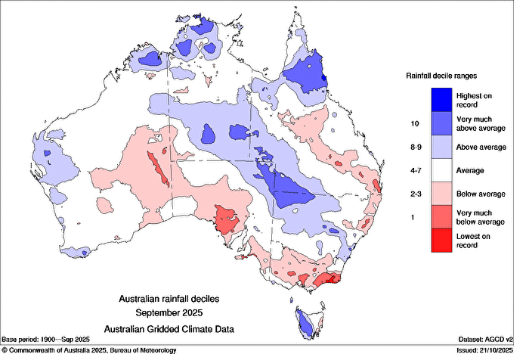
During the First World War, the Australian government developed the Soldier Settlement scheme, which would help the soldiers returning from the frontlines and their families to develop their own farms. After the war ended, in West Australia five thousand veterans took advantage of the scheme. However, by 1929, there were only three thousand five hundred veterans still remaining on the land. In 1929, Justice Pike Pike wrote a report for the Commonwealth which highlighted how decreasing profits and general instability were some of the reasons why the veterans were leaving the land. In the same year, the Wall Street stock market crashed causing the Great Depression, a worldwide economic recession. The Australian economy was heavily based on agricultural exports, but the United States of America, Canada and Argentina began exporting wheat and sheep, buying out the Australian market. In the 1920s, the price of wool had fallen as an over-estimation of the gold prices had caused British trade prices to go up, while profits dramatically decreased. Australia was heavily impacted by the Great Depression. Unemployment reached a peak at thirty-two per cent in 1932 and sixty thousand Australians were forced to rely on susso, state-based subsidised payments, to live. Australia is also incredibly prone to droughts. Australia receives wind from the Indian Ocean bringing wet conditions to South Australia in the negative cycle, but in the positive cycle, less moisture is picked up, causing less rainfall reducing wet conditions in South Australia. (see Figure 1)
However, difficult weather conditions and economic troubles were not the only, or the biggest, problem the farmers faced. There was a force causing even more trouble for the farmers.
The emu is a flightless bird, standing at 1.60-1.90m tall, and can only be found in Australia. Emus are normally solitary, except when they are young or it’s their breeding season, when all the emus congregate. During the breeding season of 1932, twenty thousand emus were forced to destroy the rabbit-proof fences because the drought had destroyed all viable food and water sources except from farmlands. The rabbit-proof fences, later known as vermin fences, had been under construction since 1901 to stop any wildlife. The farmers, growing tired of the relentless wave of emus destroying their fields, went to the Australian Defence Minister, Sir George Pearce. Pearce made the decision to use heavy artillery to fight against the emus, as machine guns would have been very ineffective to use.
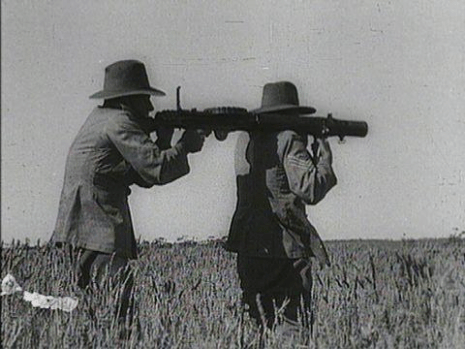
On 2 November 1932, three members of the Royal Australian Artillery, Major Gwynydd Purves Wynne-Aubrey Meredith in command, Seargent S. McMurray, and Gunner J. O’Halloran, were deployed to the Campion region of Western Australia. They had been equipped with two Lewis machine guns and ten thousand rounds of ammunition. They were also joined by the farmers and a cinematograher. (see figure 2)
Their mission was to kill all twenty thousand emus who had migrated onto the farmer’s field. The soldiers began to attempt to lead ambushes against the emus, all to varying success. The guns often became jammed, and the emus would often be fast enough to run away. There was an attempt by the soldiers to catch the emus on truck, but one crashed and they were unable to catch up to the emus. There was also a new, strange behaviour of the emus seen by the soldiers: wherever a mob of emus went, there was always a leader who would, if they had noticed a soldier, give a signal to tell the other emus to run away. The soldiers also saw some of the emus be shot without being killed immediately. Maj. Meredith wrote about the emus saying;
“If we had a military division with the bullet-carrying capacity of these birds it would face any army in the world…They can face machine guns with the invulnerability of tanks. They are like Zulus whom even dum-dum bullets could not stop.”
The soldiers were taken off the field on the 8 November 1932. After firing an estimated two thousand five hundred rounds of ammunition, the soldiers had only managed to kill around fifty emus. However, Pearce received support from the Western Australian Premier and Governor James Mitchell, demands from the local farmers for the soldiers return and a report from base camp which stated how the operation had been successful, as it had managed to kill three hundred emus. Thus, on 12 November 1932, the soldiers were redeployed to Western Australia. This time they surprisingly had more success at fighting the emus as the soldiers managed to kill eight hundred sixty seven.
Thus, the great emu war was officially ended on 10 December 1932, with the emus being unofficially declared as the victors of the war. In total there was only about nine hundred confirmed kills with over two and a half thousand rounds of ammunition shot. The government began to give the farmers enough ammunition to deal with the problem themselves and they developed a bounty hunting system, which allowed the farmers who shot the emus to receive money if they were handed in. In just six months, there had been about fifty-seven thousand bounties collected. In the 1950s, the vermin fences were reconstructed: standing at a meter tall, they had barbed wire place along the top of the fences which was a more effective and permanent way of keeping the emus out. But the war has been seen by many as a joke and a waste of time, money and effort as the emus are still thriving in Australia.
Bibliography
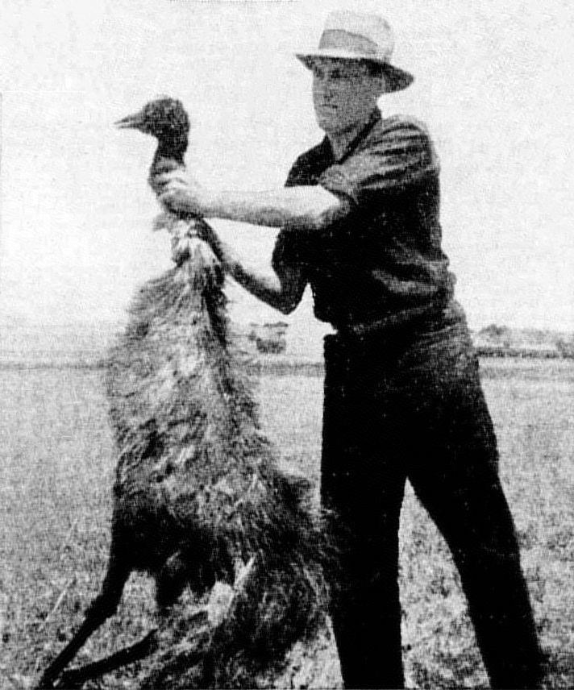
Featured Image Credit: Deceased emu during Emu War (1932) The Land Newspaper. Available at: https://picryl.com/media/deceased-emu-during-emu-war-ed4d60)
 Retrospect Journal