
Written By: Kate Taylor
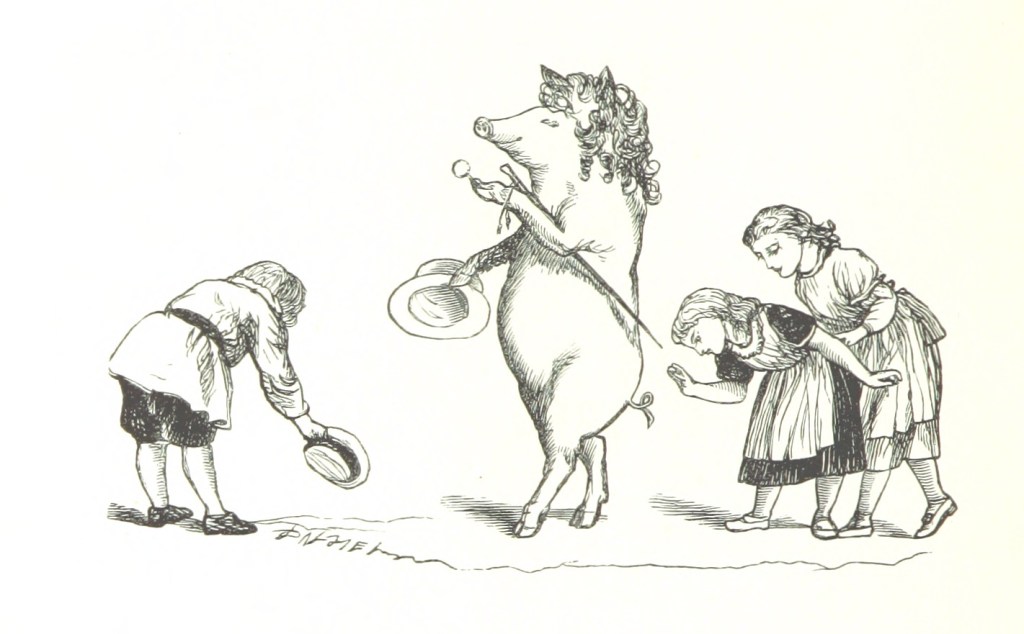
When thinking of the outbreak of wars between powerful states, the mind is immediately drawn to complex argument and military provocation. You would not, therefore, think of pigs. Not even a drift of pigs, but a singular pig. Yet that is exactly what happened in 1859 on San Juan Island, in a series of events that could easily have sparked war between Britain and the USA.
Following the 1846 Treaty of Oregon, the disputed boundary between British Columbia and Washington Territory was redrawn and agreed by all sides: the water between Vancouver Island and the US mainland would mark the new division. Through error or misjudgement, it appears that diplomats from both nations overlooked the existence of a group of islands within these waters, the largest of which, San Juan, spans over fifty-five square miles. As a result, both sides believed that they held rightful claim to the island.
In 1851, the British-controlled Hudson Bay Company established salmon curing stations on the shores of San Juan, and two years later the Belle View Farm was established. As word spread of the island’s fertile soil and the possible deposits of gold ore, settlers from the US came (albeit in small numbers, with only eighteen people recorded by 1860) to extract value from land they considered their own. One of these people was Lyman Cutlar.
On 15 June 1859, Cutlar caught one of the Belle View Farm’s pigs in his garden, eating potatoes he was growing. By all accounts, this was not the first time that Cutlar had discovered the farm’s animals picking through his vegetable patch. Some sources even claim that the farm had previously advised him to “build better fences” to keep the animals out. Nonetheless, enraged by what he says was the farm’s mismanagement, he shot the pig. The subsequent dispute, in which the farm’s owners demanded £100 in compensation for the loss of their pig, grew larger when the British authorities on the island threatened to arrest Cutlar and remove the other American settlers from San Juan. In defiance of the British, a US flag was hoisted over the farm on 4 July.
The conflict quickly intensified. The 9th US Infantry mobilised to assert control over the island, and James Douglas, Governor of Vancouver Island, ordered HMS Tribune, HMS Satellite, and HMS Plumper to prepare for engagement. It appeared, at that point, that war was inevitable. By the end of August nearly five hundred American troops were stationed on the island, and the British were conducting regular gun drills. Perhaps the greatest quirk, and the main reason the situation did not descent into open conflict, was the fraternisation between officers from both sides, who attended church services together and shared cigars and whiskey.
By this stage, word had reached Read Admiral Lamber Baynes, the British Naval Commander in the Pacific. Shocked at the prospect of the two great nations going to war over something as trivial as the killing of a singular pig, he refused to authorise any military action. Meanwhile, US President James Buchanan, equally perplexed by the situation, sent General Winfield Scott, a man experienced in resolving border disputes, to San Juan. After discussion between Scott and Douglas, a system of joint military occupation was agreed upon as a means of maintaining peace without immediately settling the territorial dispute.
Owing to other world events, particularly the US Civil War, the question of San Juan was largely forgotten and the joint occupation remained in place, entirely peacefully, for twelve years. It was not until 1871 that discussion began on finding a permanent solution. The matter was referred to an independent third party, the German Kaiser, who appointed a commission to consider the rival claims. After a year of deliberations, the commission ruled in favour of the United States. The British raised no objection and withdrew their remaining troops peacefully.
And so, the war that never begun was over. Its only casualty? The Belle View Farm’s unfortunate pig.
Bibliography
Crutchfield, James A. ‘The Pig War’. In It Happened in Washington : Remarkable Events That Shaped History. The Globe Pequot Press, 2015.
Miller, Rod. ‘Root Hog or Die: The Pig War’. In Lost Frontier : Momentous Moments in the Old West You May Have Missed. The Globe Pequot Press, 2015.
National Park Service. ‘The Pig War’. National Park Authority, 2025. https://www.nps.gov/sajh/learn/historyculture/the-pig-war.htm.
Sainsbury, Brendan. ‘The US Island That Nearly Ignited a War’. BBC. BBC Travel North America, 2022. https://www.bbc.co.uk/travel/article/20220911-the-us-island-that-nearly-ignited-a-war.
White, Frances. ‘The Pig War: The Real Story of 1859’s Strangest Conflict’. History of War, 2015. https://www.historyanswers.co.uk/history-of-war/the-pig-war-the-real-story-of-1859s-strangest-conflict/.
Featured Image Citation: Illustration from “A War Between the U.S. and the U.K. Over a Pig,” Regina Jeffers Blog, 7 June 2021. https://reginajeffers.blog/2021/06/07/a-war-between-the-u-s-and-the-u-k-over-a-pig/
 Retrospect Journal