
Written by Darcie Rogers
Surrealism has always been a versatile artistic tradition. It allows the practitioner to explore the fine lines between juxtaposing subjects: truth and lies, devastation and beauty, dreams and reality. It emerged as a movement in the early 1920s as a rebuke to the rationalist philosophies that guided much of European thought in the early twentieth century. The two artists I will compare in this article, operating in very different contexts, have each been influenced by surrealism in some shape or form. Lee Miller was involved with the Parisian surrealist movement from its inception, which went on to inform her reportage of events during and in the aftermath of the Second World War; while Shirin Neshat, an Iranian artist born over thirty years after the birth of surrealism, calls upon its foundational theme of the relationship between dreams and reality to draw attention to women’s experiences under the repressive post-1979 Iranian regime. This article will specifically explore the meanings and messages expressed in Miller’s Irmgard Seefried Opera singer, singing an aria from ‘Madame Butterfly’ (1945) and Neshat’s Marry (2023). Looking at the similarities and differences between these two photographers’ work and backgrounds demonstrates how surrealism has transcended temporal and spatial boundaries in communication of resistance.
“If anyone proves the adage true, ‘well-behaved women seldom make history,’ it is Lee Miller,” historian Jennifer Putnam has affirmed. Born in 1907 in the United States, Miller began her career as a model in New York before moving to Paris, where she established herself as a surrealist photographer. Living in England at the outbreak of the Second World War, Miller began working as a photographer for British Vogue. Her surrealist background intimately informed her portrayal of wartime London, revealing, as art historian Lynn Hilditch puts it, “surrealism’s love for quirky or evocative juxtapositions while creating an artistic visual representation of a temporary surreal landscape of fallen statues and broken typewriters.” In 1944, six weeks after D-Day, Miller travelled to Normandy to document the situation in US Army field hospitals, and after a few months in France, where she photographed the first recorded use of napalm and the surrender of the Wehrmacht commander Andreas von Aulock, she followed American forces eastward towards the newly liberated concentration camps of Buchenwald and Dachau. Miller used her camera to expose the horrors of the Third Reich, cabling her editor at British Vogue, Audrey Withers, “I IMPLORE YOU TO BELIEVE THIS IS TRUE.” Miller and her companion David E. Scherman later arrived at the 45th Division command post in recently captured Munich, where the division’s headquarters had been set up in Hitler’s private apartment. Miller and Scherman staged a bold, defiant photoshoot in Hitler’s bathroom, the bathmat caked in the mud of Dachau from Miller’s boots. These are undoubtedly the most famous images of Miller’s wartime correspondence, and certainly the ones which cement her legacy as an artist committed to resisting injustice and horror.
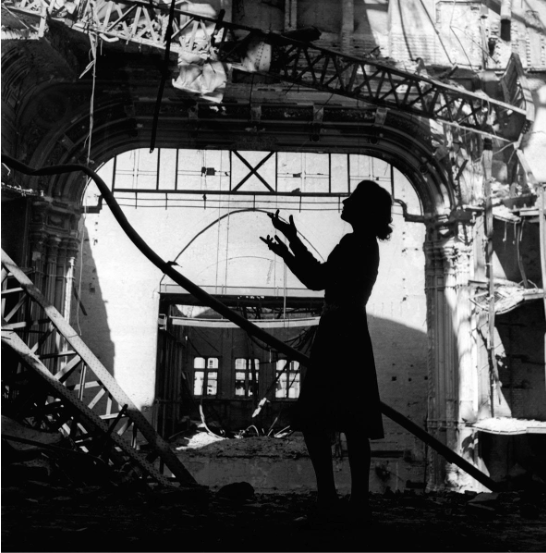
Miller’s 1945 photograph Irmgard Seefried Opera singer, singing an aria from ‘Madame Butterfly’ was taken in Austria as Miller documented the lives of Europeans in the immediate post-war period. It features the striking silhouette of the German opera singer, Irmgard Seefried, against the backdrop of Vienna’s war-wounded Opera House. Miller’s surrealist influences are immediately apparent upon looking at the monochrome image. The ‘frame within a frame’ draws the eye to the simple, softer human silhouette set against the harsh and complex lines of the destroyed theatre, the figure of Seefried taking striking precedence in the apocalyptic scene. Her upright, powerful posture speaks to feelings of hope, providing a characteristic surrealist juxtaposition. Advancing this idea is the balance in the composition of the piece. Areas of pure black in the silhouette and the bottom left of the foreground are evened out by thick architectural lines, which lead the eye towards the top of the frame. Repeated linear intersections across all planes of the image reinforce the sense of stability in the photograph. This is completely incongruous with its themes and iconography – there was little stability to be found anywhere in post-war Europe. Thus, Miller presents the devastation of war and the strange beauty of reconstruction in tandem, revealing the horror of the Second World War while equally giving voice to the strength and resilience of ordinary civilians throughout the conflict and in its immediate aftermath.

Shirin Neshat, meanwhile, is a contemporary photographer and visual artist. Born in Qazvin, Iran in 1957, she left the country aged just seventeen – a few years before the 1979 Islamic Revolution – to study art in the USA. In the time between the Revolution and her return from exile twelve years later, Neshat experienced what she calls a “collapse of her identity” that very much mirrored that of her country; she refused to create art for years, feeling she was not in the right place of mind to do so. Her first mature artwork, a compilation of photos entitled Women of Allah, was created between 1993 and 1997, and features striking portraits along with four symbols the West associates with Islam – the chador, the gun, Farsi text, and the subject’s strong gaze. Neshat created the series to explore the drastic change that had occurred in her home country that had gripped her imagination in her twelve years in the USA. Similarly to Lee Miller, surrealism intimately informs Neshat’s artwork, and in later projects, she turned to film to further explore the complexities of the relationships between women and men, the USA and Iran, and East and West. In an interview with Marta Gnyp in 2018, Neshat explained: “all the works that I’ve done, Women of Allah and later the Book of Kings, are about raising questions as opposed to providing answers”, and this is still very much true of her art today. Her later work took on an explicitly negative view of the Iranian regime and its oppression of women, as Neshat began to get involved in direct opposition to the state.
Marry, from Neshat’s film and photographic series The Fury, also explores ideas of beauty and conflict. The evocative portrait features a woman, shown from just below her hairline to her collarbones. She dominates the composition – the woman is all we see, posed in front of a blank background, contrasting Lee Miller’s Irmgard Seefried. The aim of Neshat’s work and The Fury as a whole, as the Gladstone Gallery highlights, is “[to focus] on the female body as both a battleground for ideology and a source of strength.” The halo of brighter tones in the centre of the image draws the eye to the centre of the piece, the woman’s eyes glistening brightly in comparison to the surrounding mid-tones. She gazes directly into the camera lens while Irmgard Seefried is more anonymous, bathed in shadow in Miller’s image. The viewer recognises the trauma and history reflected in the subject’s eyes, but equally her strength, dignity and defiance. Dark tones blending into the lighter central glow lend the image a beautiful softness, the subject’s stray hairs allowing her main form to do the same, giving the image a muted, almost dreamlike appearance. Looking closer at the portrait, we see intricate hand-etched Farsi lettering on the woman’s face. This is poetry by feminist Iranian writer, Forough Farrokhzad, whose literature Neshat previously drew upon in Women of Allah. The lettering is practically imperceptible from afar, but closer up, the viewer is invited to consider the photograph on a deeper level. The Fury, as a collection, speaks to the horrors of state repression and power imbalances between men and women – particularly sexual abuse – not only in Iran, but globally.

Ultimately, it is clear that while these two artists are operating within completely different frameworks – Miller, a journalist working in Europe in the 1930s and 1940s, with foundations in Surrealist Paris; and Neshat, a contemporary artist with a global outlook influenced by her Iranian roots – they both use surrealist traditions to eloquently communicate the effects of conflict and injustice, while simultaneously projecting ideas of resilience, hope and resistance. Miller is more journalistic in approach, surrealism influencing the technical side of her photos where it inspires the themes of Neshat’s work more. The addition of poetic lettering to many of the latter’s pieces compounds the thematic depth of her work, while Miller leaves her wartime work unaltered to present a clear, compelling narrative. Both these artists have amplified the stories of embattled people (particularly women, in Neshat’s case) within their respective historical contexts. Miller focused on exposing impacts of larger-scale conflict, while Neshat’s more introspective photography focused on the emotional toll of abuse and repression, begging the viewer to engage with subjects on both individual and thematic levels. Both build upon surrealist influences to draw attention to shocking and often controversial subjects. “The Fury”, the Goodman Gallery wrote of Shirin Neshat’s series, “seeks to capture the Zeitgeist: a sense of foreboding and dread sparked by the resurgence of fascism that we are witnessing” – the very same issues Lee Miller used her camera to expose over eighty years earlier.
Bibliography
Banks, Nargess. ‘Shirin Neshat’s ‘The Fury’ Is A Powerful, Politically Charged Artwork’ Forbes, October 26, 2023. https://www.forbes.com/sites/nargessbanks/2023/10/26/shirin-neshat-the-fury/
Gnyp, Marta. ‘Shirin Neshat’, Gnyp Art Advisory, March 2018. https://www.martagnyp.com/publications/shirin-neshat
Hilditch, Lynn. ‘A Surreal Landscape of Devastation: An Analysis of Lee Miller’s Grim Glory Photographs of the London Blitz,’ Imaginations Journal of Cross-Cultural Image Studies 4, no. 1 (2013): 21-28, http://dx.doi.org/10.17742/IMAGE. scandal.4-1.4
Horsburgh, Susan. ‘The Great Divide’, TIME Magazine August 28, 2000. https://time.com/archive/6953694/the-great-divide-3/
Mackenzie, Suzie. ‘An unveiling’, The Guardian Weekend, July 22, 2000. https://www.theguardian.com/lifeandstyle/2000/jul/22/weekend.suziemackenzie
Penrose, Antony. The Lives of Lee Miller. Thames & Hudson, 1985.
Putnam, Jennifer. ‘Lee Miller: Witness to the Concentration Camps and the Fall of the Third Reich’ The National WWII Museum, March 28, 2024. https://www.nationalww2museum.org/war/articles/lee-miller-witness-concentration-camps-and-fall-third-reich
‘Shirin Neshat ‘The Fury,’’ Gladstone Gallery, accessed November 7, 2025. https://gladstonegallery.com/exhibit/the-fury/
‘Shirin Neshat ‘The Fury,’’ Goodman Gallery, accessed November 7, 2025. https://www.goodman-gallery.com/exhibitions/london-gallery-shirin-neshat-the-fury-#selectedworks
‘Surrealism,’ Encyclopaedia Britannica, accessed November 7, 2025. https://www.britannica.com/art/Surrealism
Featured image credit: https://gladstonegallery.com/exhibit/the-fury/
Featured image credit: https://thewickculture.com/dream-and-discover-lee-miller/
 Retrospect Journal