
written by Helene Chaligne
16/11/2025
After two decades of Communist rule and Czechoslovakia being headed by the Stalinist Antoín Novotny, a shift occurred in Prague. In a climate of censorship, purges, and executions, Alexander Dubček managed to challenge his rival. He confronted Novotny at a meeting with the Central Committee. His actions led to the summoning of a Soviet leader, Leonid Brezhnev, who was surprised by the significance of support for the opposition and ultimately backed Novotny’s removal. Thus, Dubček became First Secretary on 5 January 1968.
What would come to be called the Prague Spring is often seen as starting with Dubček’s election; however, it is better explained as a phenomenon unravelling throughout the 1960s. Jacques Rupnik points out that it started with pressures for economic reforms and a gradual emancipation of the cultural sphere. This included less censorship and the development of an art scene that would leave a lasting impact throughout Europe. Authors Archie Brow and Gordon Skilling have argued that pre-war democracy, followed by a democratic interlude between 1945 and 1948, left its mark on society through the form of values and beliefs that stood in contrast to the Stalinist regime that surfaced in the 1960s. Rupnik thus outlines that the unfolding of the Prague Spring is important on many levels: the way it emphasised Czech democratic exceptionalism, and its representation of the most far-reaching reform of the system in the Soviet sphere. He underlines how this would inspire Mikhail Gorbachev’s failed attempt to save the reform oriented ideology, paving the way for the end of Soviet rule in 1989.
Alexander Dubček, following the wider cultural ideological shift and history, put forward his offer of “socialism with a human face”. This laid out a new economic plan for the country, which was deemed necessary after having judged the Soviet plan for industrialisation unfit for the country. He proposed opening relations with western nations, defying the Iron Curtain that Winston Churchill had warned was descending across Eastern Europe in 1946. His most controversial point was, however, the Action Program. This was an initiative to re-establish personal liberties in Czechoslovakia and grant freedom of travel, press, and assembly to the people. Dubček’s aim was thus to eliminate the most oppressive features of the leadership. He lifted censorship in June 1968, believing that he had tacit approval from the Soviet Union to carry out his plan. Recent changes made by Nikita Khrushchev caused Leonid Brezhnev to be seen as a transitional figure away from the past totalitarian regime, which led to conditions that allowed for the reforms to progress in the first place. However, as Anna Stoneman highlights, the liberalisation of the Prague Spring was a threat to the unity of the Soviet Bloc nations under stricter leadership and therefore the strength of the Soviet Union as a whole.
The Soviet response took the form of three stages. First, a period of surveillance which culminated in the summoning of Dubček to a meeting in Dresden in which the Soviet leadership demanded a repeal of the Action Program which Dubček refused. Secondly, political pressure accrued as the Prague Spring continued to grow in power. A meeting with other Soviet Bloc nations took place on 14 July 1968 in Warsaw to authorise an intervention as a last resort. Finally, Dubček was called into another meeting in Bratislava in August to negotiate the Bratislava Declaration, which stated that the Soviet Union could intervene if a bourgeois system was established with parties opposing the Communist Party of Czechoslovakia. They, however, also expressed that the socialist Czechoslovakia could continue on the basis of the principles of equality and national independence. This declaration soon turned out to be a ruse to buy time.
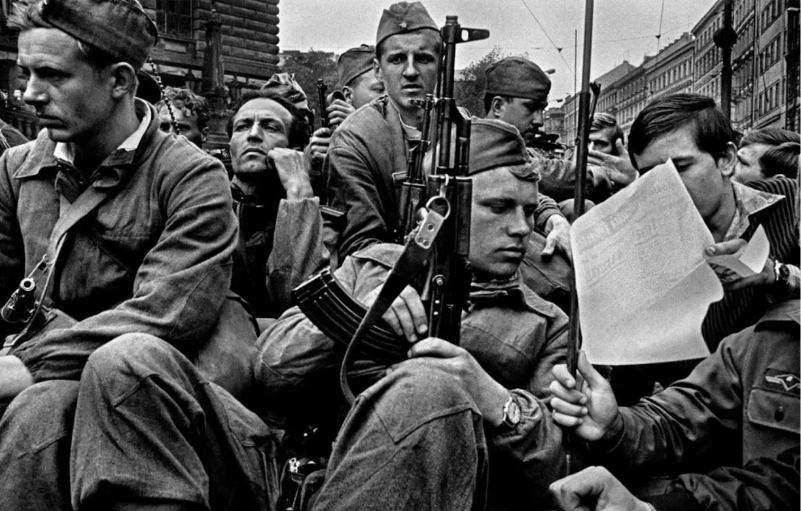
Two weeks after its signing, Soviet and Warsaw Pact troops were sent into Czechoslovakia to occupy the territory and brutally suppress the Prague Spring. In a midnight radio message, Dubček urged citizens to keep the peace and not resist the invasion, as the defence of borders was, at that point, impossible. Thus began a period of non-violent resistance as students and workers attempted to stop soldiers in their tracks and reason with them; however, the tanks and troops continued to arrive. A week into the invasion, 186 civilians had been killed and 362 gravely injured. Marc Santora highlights that one of the most important effects of the invasion was the exposure of the totalitarian nature of the Soviet regime on an international level. The photos taken by Josef Koudelka during the invasion show in intimate and vivid detail the often violent scenes on the streets. The most violent episode took place outside the radio station in Prague, the city’s only major bastion of defiance. Protestors, in an attempt to keep broadcasting, moved city buses around the building and set them on fire; retaliation by tanks led to defenders breaking the diesel fuel tanks, also setting them ablaze. Seventeen civilians died of the five hundred protecting the station.
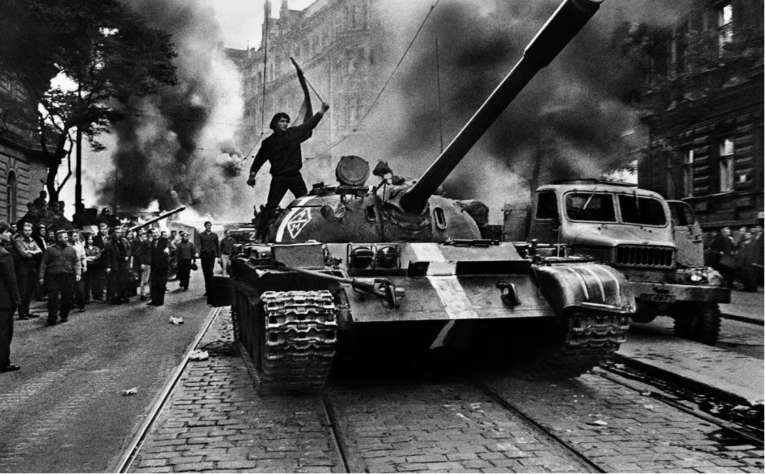
Fig 2: a protestor on top of a tank
The Soviets ultimately regained control, reforms were repealed, and Gustáv Husák became the new leader of Czechoslovakia. Those who had partaken in the reform movement were purged from their jobs, and censorship was fully reinstated. The period now known as Normalisation set in. It consisted in consolidating Husák’s leadership, re-establising centralised power over the economy and expanding ties to other socialist nations. Thousands were sent to re-education programs, leading to a period of loss of hope and despair after the invasion. That despair was encapsulated in the 1969 self-immolation of Jan Palach, a student at Charles University in Prague. He filmed the act of protest, and, several days later, thousands attended his funeral.

Fig 3: The funeral services for Jan Palach at Wenceslas Square in 1969.
Despite the defeat, the Prague Spring and the invasion did leave many legacies which helped usher in the democratisation in 1989. The most immediate one was the dissident movement: intellectuals who were kicked out of the government stopped focusing on reform and instead on overthrowing the government. Writers produced the Charter 77 Declaration which called the government to answer for violations of rights guaranteed in treaties signed by the Communist government. The document received 243 signatures but its authors were arrested and imprisoned. Political resistance then moved underground, and despite their continued control, the people considered themselves independent from their government. The idea that communism could be reformed thus died. Twenty years later, on the twentieth anniversary of Jan Palach’s act of protest, Alexander Dubček would return from exile and lead the movement of the Velvet Revolution towards the establishment of a democratic republic.
bibliography
Santora, Marc. 2018. “50 Years after Prague Spring, Lessons on Freedom (and a Broken Spirit).” The New York Times, August 21, 2018.
Stoneman, Anna J. “Socialism With a Human Face: The Leadership and Legacy of the Prague Spring.” The History Teacher 49, no. 1 (2015): 103–25.
Rupnik, Jacques. “Utopias and ‘Normality’: 1968 Revisited Fifty Years On.” Slavic Review 77, no. 4 (2018): 890–96.
Tait, Robert. 2018. “Prague 1968: Lost Images of the Day That Freedom Died.” The Guardian. The Guardian. August 19, 2018.
image credit
Fig 1&2: Josef Koudelka, Magnum Photos
Fig 3: Ulstein Bild, Getting Images
 Retrospect Journal