
Written By: Finley Farrell
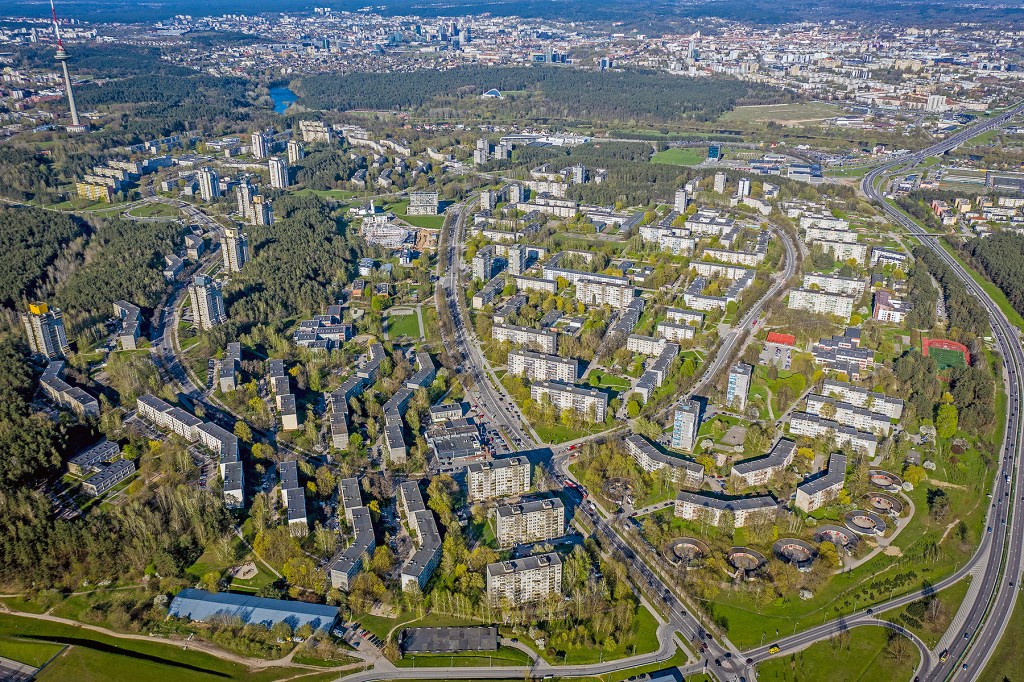
In struggles for environmental and ecological sustainability, cities have been a battleground against the smog, pollution, and ecological destruction they often cause. Yet a flight from urbanism is unlikely and abandons the productive potential of dense living that could be a tool for sustainability. Lazdynai, a district of the Lithuanian city Vilnius, was constructed in the post-Stalin era with deliberate care to create ecological resonance and a genius loci based on natural reliefs, history, and functionalism. The architects and engineers behind Lazdynai were awarded the Lenin Prize in 1974, the highest Soviet award for cultural achievements, the first time an architectural project had been awarded it. At the time, it had a 91.6 per cent satisfaction rate, with walkability, wide spaces, good views, fresh air, and clean rivers all being common comments on Lazdynai. However, there were complaints over poor construction quality and ‘emptiness’ of some wider green spaces. Lazdynai shows the importance of urban planning on the environment, both through physical structures and effect on human activity. It also shows the importance of publicly owned land, coherent planning, and social regeneration in the struggle for urban sustainability.
The main designers of Lazdynai, Vytautas Brėdikis and Vytautas Čekanauskas, were firstly influenced by post-war French modernism and zoning spearheaded by Le Corbusier. As with the whole Soviet Union, ideas of set districts and ‘micro districts’ providing walkable essential services suited the needs for huge construction projects. In each micro district, housing between six thousand and ten thousand residents, there would be a school and essential shops within one-hundred fifty metres. Within five-hundred metres there would be secondary needs, libraries, cinemas, healthcare facilities. This model was extremely convenient for children to walk to school, easy access to essential services, and safety. While most people didn’t own cars, strong public services allowed easy transport to the larger city Vilnius while maintaining walkability. This lack of roads allowed greater creativity with planning, and Lazdynai’s designers used this to integrate natural reliefs, views, and wild spaces into the placement and orientation of buildings. This integration was also only possible with the public land ownership under Lithuania’s communist government. For fully planned residential districts, especially a micro district model, full integration of the district into its services and workplaces in the wider city is essential. Lazdynai’s success in creating fully walkable and working services was only possible due to the freedom granted by public land. This freedom allowed its designers to design the district around natural landmarks and reliefs, rather than around areas of private ownership. Shops and cafes now served residents rather than vice versa, and similarly it was believed that cities should serve and harmonise with the land below it.
From 1959, Lithuanian architects travelled to Finland periodically to study Finnish urban design methods. These trips would heavily influence how Lithuanian architects thought about the ecological impact of urbanism. In the words of Lazdynai designer Vytautas Brėdikis: “buildings with unique architecture, well-arranged surroundings. Simple people interacting naturally. Good, humane architecture. A masterful harmony of buildings and nature”. These elements made up the wider desire to create a genius loci, a spirit of a place, while maintaining functionality and cost-effectiveness. Ecological attachment and sustainability were central to this goal. Finnish cities had a strong cultural tie to nature, and functional architecture was inherently catered towards harsh ecological conditions. Finnish architecture incorporated access routes through snow, attention to natural light in dark winters, and building along natural borders and reliefs. The idea that harmony with the local environment could foster an attachment to local area through functionalism, not despite it, was deeply inspiring to visiting Lithuanian architects. In Lazdynai, this approach was specifically used to add local character to prefabricated housing methods that were widely criticised for removing architectural identity. Use of natural materials, colours, and placement of districts along natural borders allowed Lazdynai to add cultural identity while keeping the functionality and cost-effectiveness of prefabricated construction. This was generally effective in creating the genius loci that was desired, with residents having specific fondness for the natural ‘feel’ in interviews and recounts. Residents also had identity with specific micro districts, and their own independent identity.
Another important, though sometimes overlooked, factor in the ecological impact of a city is how spatial planning influences the movement and activity of people. The activity of a populus can have a huge impact on the land being acted on, and urban planning has a key role in this. Walkable areas naturally are more positive than high-traffic roads, but on a deeper level high density living has great potential to maintain larger green spaces. In Lazdynai, the compactness, efficiency, and safety of residential living meant the districts did not sprawl into the surrounding areas. In fact, recreation often took place at nearby forests, lakes, and countryside. The closeness and effectiveness of services, and subsequent social regeneration, meant the areas were generally well-maintained. Overfishing, deforestation, poor waste management, and other poor ecological practices were not present. Poverty reduction is hugely important for wider ecological outcomes, and the sustainability of Lazdynai’s planning was effective in this way. However, this can be used against Lazdynai also. The district being separated from the industrial part of the city has been criticised for making the district feel ‘asleep’, without the usual bustle of city living. The building quality itself was also criticised for being too thin and having various defects.
Today, Lazdynai is often seen as a relic of an Eastern Bloc past, with its prefabricated construction and modernist style. Its famed wide green spaces have often been built on, and the reintroduction of private property has restricted the holistic planning style initially intended. However, it is an important case study in how urban planning can be ecologically transformative. Cities are a part of the future, and they can be made to serve their residents and the natural world they sit on. These elements are inseparable in imagining a sustainable future. The success of walkable ‘micro districts’, architecture set into the natural landscape, and fostering strong local connections with nature and architecture show how architecture and urban planning can be functional and sustainable. Lazdynai also shows the challenges in this mission, notable the importance of publicly owned land, cost, and construction quality. Urbanism that is sustainable locally and on a wider environmental scale is possible, as this case shows, and a “masterful harmony of buildings and nature”, as Vytautas Brėdikis said, is essential in this pursuit.
Bibliography
Dremaite, Marija. Baltic Modernism: Architecture and Housing in Soviet Lithuania. DOM, 2017.
Empson, Martin. Land and Labour: Marxism, Ecology, and Human History. Bookmarks, 2014.
Hautamäki, Ranja. “From Sparse to Compact City – Shifting Notions of Nature in Post-War Residential Landscapes in the Helsinki Region.” Planning Perspectives 37, no.6 (2022): 1179–1203.
Hess, Daniel Baldwin, and Tammaru, Tiit. Housing Estates in Baltic Countries: The Legacy of Central Planning in Estonia, Latvia and Lithuania. Springer Cham, 2019.
“Lazdynai – a constructed spirit of a place?”, http://archmuziejus.lt/en/lietuviu-lazdynai-sukonstruota-vietos-dvasia/, accessed 28th October 2025.
Maciuika, John. “Looking Westwards: Lithuanian Architects During the Soviet Era.” Interview by Roslyn Bernstein. Arterritory, August 4th, 2021. https://arterritory.com/en/architecture_design–fashion/interviews/25694-looking_westward_lithuanian_architects_during_the_soviet_era/.
Roggema, Rob. Nature Driven Urbanism. Springer International, 2019.
Featured Image Credit: Didžgalvis, Augustas. Lazdynai by Augustas Didzgalvis.jpg. 2021-05-11. Licensed under CC BY-SA 4.0. Wikimedia Commons. https://commons.wikimedia.org/wiki/File:Lazdynai_by_Augustas_Didzgalvis.jpg
 Retrospect Journal
