
Written by Abby Hughes
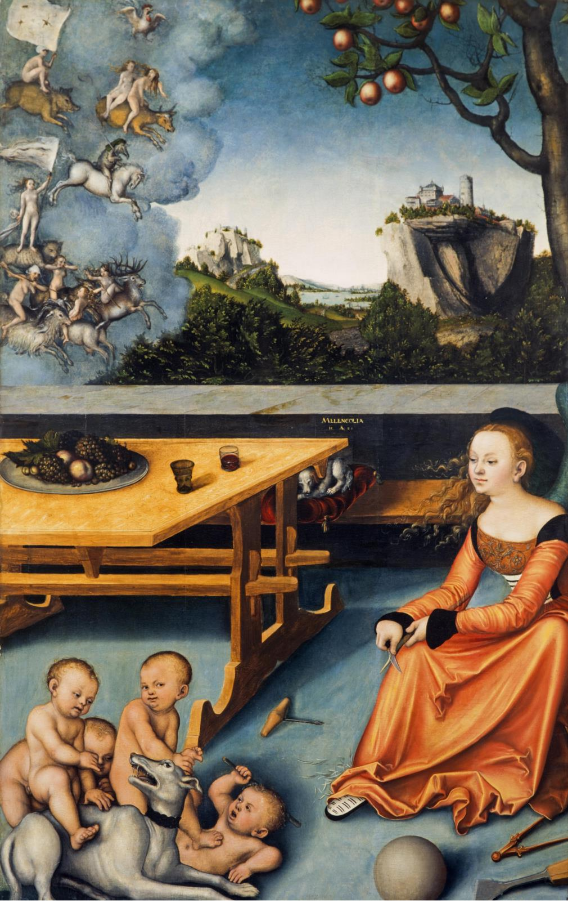
Lucas Cranach’s 1532 An Allegory of Melancholy opens onto a confused scene. Sat in an enclosed balcony, gaze wandering aimlessly across a rabble of playing children, an angel sits whittling a wooden stick. To her left, a dark cloud encroaches upon the scene. Looking closer, we can see a brigade of naked women and half-animal creatures, brandishing flags and riding the fume as if charging into war. Invading the painted scene, this omen of melancholy presents, not an inwards force emanating from a troubled mind, but the Early Modern anxiety of real, embodied, and devilish forces at work. Flanked by a myriad of warring imagery, the angel sits in the moments preceding the invasion of this ominous force. The viewer is left to devise Cranach’s Allegory. What are we to make of Early Modern melancholy with this oil painting as guide?
Cranach’s painting followed Albrecht Durer’s influential 1514 print, Melencolia I, in which he centred the humanist exaltation of learned melancholy. Surrounded by planetary ephemera, a sphere and polyhedron, for example, Durer’s subject portrays the Early Modern understanding of the innate influence of Saturn on potential sufferers of melancholy. Despite this, Panfosky has argued that Durer’s portrayal of melancholy is predominantly positive, departing from the medieval tradition and suggesting the intellectual potential of those predisposed to the state. Durer seemingly uses his Melencolia I to ask why all exceptional men in philosophy, poetry, and the arts prove to be melancholics. Here melancholy is not only portrayed as a burden, but with complexity, also a distinction. In contrast, Cranach’s reflection on melancholy seems to draw on an older tradition, highlighting a deeper concern with the moral failures of melancholy.
Stolberg argues that we are best suited to interrogate Cranach’s work with Martin Luther’s notion of melancholy as a “devil’s bath” in mind. A contemporary and acquaintance of Cranach, Luther conceived of melancholy as an illness rather than a temperament, which permeated throughout the human body. Describing melancholy this way, Luther expressed the condition as a danger best countered with “the spiritual joy of the pious Christian.” This framework suggests that, rather than an innate status, melancholy could be battled against with an active turn towards religious practice. We could also read this celebration of choice in Cranach’s Allegory. Directly above the angel, hanging in the open air, an apple tree frames the upper right corner of the painting. A biblical symbol of choice, this tree could allude to the inevitability of the original sin’s recreation. Nevertheless, we can determine that the potential for choice exists in Cranach’s imagined scene, even if yet unseen or unacknowledged by our angelic subject.
It is evident, therefore, that melancholy was not just a bodily state, but also a moral concern. A paragon of holiness, even the idle angel falls prey to the dark fumes of fantastical melancholy. The stick in her hands, which she is absent-mindedly whittling to a point could moreover be an allusion to witchery. Stolberg notes that the kind of sticks understood to be rode by witches were typically whittled, “to avoid spirits nesting between wood and bark.” The wood also appears to dissipate into thin air the closer we trace it to the angel’s breast, a further suggestion of its unnatural, magical state. Moreover, looking behind the balcony scene, we can see towns sitting atop crudely balanced rock formations in the painting’s background. This setting features near fantastical forms which look at risk of toppling over. With the angel’s head just beginning to crest the wall of the balcony, Cranach suggests that she is at imminent risk of transgressing this boundary, from the local world of the moral and grounded humanity to a dangerous and magical world beyond. Injecting into the scene a sense of urgency, the fate of the angel left to question, it could be argued that Cranach leaves the question of her redemption to the viewer, emphasising the universality of this choice to turn away from devilish temptation.
Ultimately, there was no clear consensus on the status of melancholy to the Early Modern European. Those such as Durer expressed the introspection characteristic of the melancholic and represented melancholy increasingly less as an illness than a predisposition. However, Durer still sets a certain religious implication within his prints. Melencolia I features a focal point of shining light, highlighting the divine origin of humanist pursuits. Similarly presented as a struggle to maintain order, Cranach’s Allegory seems to take the stance that melancholy risks leading one into a dangerous fantasy realm, if not into demonic evil.
Looking at Early Modern treatments for melancholy, we can determine that it was conceived of as a real, embodied disease. For example, medical manuals recommend treating the melancholicus with the use of a cautering iron, followed by the trepanation of the skull, to mend humoural imbalance. Located variably in the head, chest, or otherwise, it was a condition with a physical location and a tangible cause. And yet this physicality did not find itself in conflict with the moral consideration of melancholy. Cranach and Durer’s portrayals alike indicate that melancholy was imbued with a heavy religious sentiment. We can therefore read these Early Modern allegories as both medical, grounded in bodily anxiety, and also philosophical, involved in a moral fight for the human soul.
Bibliography
Inhringova, K. The Representation of Melancholy in the Visual Arts, Today and in the Past, European Journal of Media, Art and Photography, 2023.
Nelson, Jennifer. Lucas Cranach: From Myth to Reformation. London, 2024
Stolberg, M. Lukas Cranach’s Representations of Melancholia, and the Medicine of His Time. In, Medicine and the Body in Early Modern Europe, 2025.
Sohm, Philip. Dürer’s “Melencolia I”: The Limits of Knowledge Author(s): Studies in the History of Art , 1980, Vol. 9 (1980), pp. 13-32 Published by: National Gallery of Art Stable URL: https://www.jstor.org/stable/42617907
 Retrospect Journal