
Written by Lauren Hood
09/11/2025
The concept of a national, free at the point of access, health service is familiar to almost everyone in Britain today—thanks to the NHS. The National Health Service (NHS) is engrained into British culture and life. As a nation, we hold great pride in our health service, consuming media, both factual and fictional, which depicts what life is like working within the NHS. The scale of national appreciation held for the service today contradicts how many people across the country felt when it was first established. The idea of holding any negative feelings towards the NHS is alien and incomprehensible for many people today, so this article will explore those negative feelings, and how the government tried to ease them.
Prior to the NHS, access to healthcare across Britain was extremely varied, often determined by geographical location, gender, and social class. Many working men had access to healthcare through insurance systems, where they would pay small amounts weekly to have access to a doctor. These working-class schemes covered roughly twenty million people by 1939. Their wives and children were not covered under this system, often cutting them off from healthcare completely due to the cost of it. Wealthier people could more easily afford access to healthcare, but due to the cost many would only seek this for the most serious health issues.
To combat this unequal and often ineffective access to healthcare, charity hospitals provided care to those in need. Relying on charitable donations and doctors giving up their own time, these hospitals, alongside municipal hospitals offered by local authorities, were aimed at providing healthcare to society’s poorest. Despite this charitable aim, an individual’s access to these services depended upon their proximity to them; meaning that people in more populated areas, such as London, had more access than someone from a small rural area. Accessing charitable healthcare was aimed at the poorest, meaning that those who could pay were expected to, or were otherwise at risk of committing “an abuse of charity”.
Amid this system of unequal healthcare, it would be understandable to assume that a national health service which provided free national access to healthcare, albeit financed by taxation, would be welcomed with joy and celebration nationwide. This was not the case. In fact, the establishment of the NHS created new fears throughout the population, particularly over the role of doctors. Many doctors disliked the idea of the NHS, fearing that they would lose money under the nationalised system due to an obligation to treat more clients from poorer backgrounds. This led to government negotiations with the British Medical Association who represented doctors, until a compromise was reached. Doctors could retain some of their private clients while working within the NHS. With this compromise reached, it was time to win over the public who had their own fears about the NHS, particularly that it would become too impersonal, leading to a deterioration in the quality of service offered.
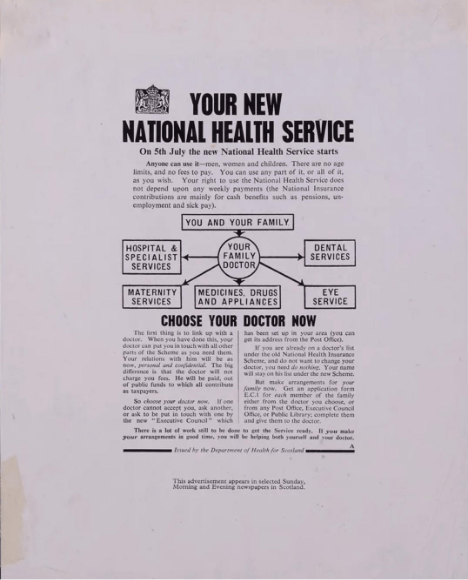
Figure 1: National Health Service leaflet, 1948.
In May 1948, the above advert appeared in Scottish newspapers to teach people about how the new, soon-to-be introduced National Health Service would work. Issued by the Department of Health for Scotland, the advert lays out the benefits of the new service while aiming to ease existing fears amongst the public.
The benefits of the new service are clear, emphasising the scale of departure from other healthcare systems. This advert stresses that the NHS is for everyone: “anyone can use it – men, women and children”. This wording stresses the extent of change offered by the new service: the whole family can use it! It offered a whole variety of new services which many people would not otherwise access, such as maternity care, dental services and eye services. This is a clear change to the insurance systems which only provided the working men of the family with access to a doctor, and charity services targeting only the poorest in society.
As well as laying out the benefits, this advert tries to ease public fears of the new NHS. It makes clear that the quality of the care provided is great, with the personalisation of the service contained, primarily through the continuing connection to the family doctor. The layout of this advert suggests that the new service is simple for the average citizen to follow, just “choose your doctor now” and they can help you access a wide variety of care and treatment. The repeated use of “your” makes it clear to readers that they can access it, that it is now their right to have access to it.
The advertisement issued by the Department of Health for Scotland makes it clear that the new national healthcare system is not perfect (yet) and that it is still a work in progress. This sentiment of the NHS not being perfect is, arguably, more relevant today than it was when the advertisement appeared in Scottish newspapers to promote the service. The health inequalities and unequal access to healthcare which the system was introduced to eradicate have, unfortunately, been present throughout the service’s history.
Many of the fears expressed at the time of the NHS’s creation still exist today, particularly fears over finance, quality of care and equality of access to care. Healthcare inequalities have long been understood amongst those impacted by them but came to the fore of public discussions of the NHS in 1980 via the government’s publishing of Inequalities in Health: A Report of a Research Working Group. This report, dubbed the ‘Black Report’, exposed inequalities in British healthcare based on race, class and financial backgrounds. A system which was established to purge British healthcare of inequalities was found to be perpetrating them.
These inequalities within the NHS are a major issue and cause many people who experience them a poorer quality of care than standard. This decline in quality is well-documented within conversations about the NHS in Britain, with the service seemingly in a constant state of decline and crisis. One step which consecutive governments have taken to tackle various issues within the NHS, such as ever-growing waiting lists, is to increase the involvement of the private sector. The 2010 Health and Social Care Act “ushered in a greater wave” of private sector involvement in the NHS than ever before. After this, the level of private sector involvement continued to increase; by 2015 private contracts given through the NHS were only one percent lower than the contracts held by “NHS bodies”. This raises questions over the quality of care provided – especially as 2015 also saw a five percent rise in deaths in Britain, which the government claimed was unrelated to increased privatisation. One in every ten adults opted for private care over the NHS in 2021, showing that more people are willing to pay the cost of private healthcare rather than wait for the same treatment on the NHS. This increased reliance on the private sector within British healthcare is reinforcing the unequal healthcare which it was partially introduced to solve. The rising cost of private medical services prevents many patients from accessing them, leaving it “an eccentric indulgence of a wealthy minority”.
The organisation of the NHS has always raised concerns about the quality of care provided, and despite government efforts to ease these concerns, such as the advert seen in various Scottish newspapers in May 1948, these concerns remain today. The National Health Service was created to make healthcare in Britain more accessible and equal, but it has fundamentally failed to achieve these goals, with healthcare inequalities remaining a prevalent part of the service. It makes you think, will the NHS ever improve “its unaccommodating, non-inclusive character” and provide a standard of care which merits the pride the country holds in it? Or will the country continue to accept the “belligerence, bravado and buffoonery” which got the service into the multitude of crisis which plague Britain’s healthcare today?
Bibliography
Digby, Anne and Nick Bosanquet. “Doctors and Patients in an Era of National Health Insurance and Private Practice”. Economic History Review 41 (1988).
Dorling, Danny. “How Austerity Caused the NHS Crisis”. Open Democracy. 4th January 2023. https://www.opendemocracy.net/en/nhs-a-and-e-delays-austerity-emergency-care-hospitals-hunt-hancock-lansley/ Accessed 17th February 2025.
Doyle, Barry and Rosemary Wall. “What was Healthcare Like Before the NHS?”. The Conversation. 3rd July 2018. https://theconversation.com/what-was-healthcare-like-before-the-nhs-99055 Accessed 17th February 2025.
Flynn, Cal. “The Birth of Britain’s National Health Service”. Wellcome Collection. 21st June 2018. https://wellcomecollection.org/articles/WyjHUicAACvGnmJI?gad_source=1&gclid=Cj0KCQjwhb60BhClARIsABGGtw_RmfVZXa7fB1JjU29SAbADGPMAkxh0d9iZlfrKA44bWnH5Deq8Y1waAklLEALw_wcB Accessed 17th February 2025.
Ford, Steve. “Find Out How Nursing Times Covered the Launch of the NHS in 1948”. Nursing Times. 20th June 2023. https://www.nursingtimes.net/nhs-75th-birthday/find-out-how-nursing-times-covered-the-launch-of-the-nhs-in-1948-20-06-2023/ Accessed 17th February 2025.
Gainty, Caitjan and Agnes Arnold-Forster. “Healthy scepticism”. Wellcome Collection. 17th January 2024. https://wellcomecollection.org/articles/ZWcdJxEAACgAVS_7?gad_source=1&gclid=CjwKCAjw8rW2BhAgEiwAoRO5rIM3auYUQTnIuZjlAc9CanfP2qfBgRQu1tC3zU__OSEK-AjErmKYzxoCCTkQAvD_BwE Accessed 17th February 2025.
Government Press Release. Government to Tackle NHS Workforce Crisis with Refreshed Plans. 8th December 2024. https://www.gov.uk/government/news/government-to-tackle-nhs-workforce-crisis-with-refreshed-plan Accessed 17th February 2025.
Lister, John. “A History of NHS Privatisation”. Tribune. 3rd July 2023. https://tribunemag.co.uk/2023/07/forty-years-of-nhs-privatisation 17th February 2025.
Cover Image Credit :https://www.historyextra.com/period/20th-century/nhs-history-pay-healthcare-free/
Image Credit 1: Clement, Michelle. “The Founding of the NHS: 75 Years On”. History of Government Blog. 13 July 2023. https://history.blog.gov.uk/2023/07/13/the-founding-of-the-nhs-75-years-on/ Accessed 17th February 2025.
 Retrospect Journal