

Written by Elizabeth Hill
The ‘New Woman’ was everywhere in fin de siècle society. Not only was she physically prominent, in her puffed sleeves and wide skirts, she was a smoker, she had her own money – or at least intended to, by earning her own living – and she belonged to new, all-female societies where the idea of equality and freedom was quickly spreading. Most importantly, though, the ‘New Woman’ was getting around on a bicycle. Female cycling was not an alien concept; women did initially ride bicycles alongside men, particularly on the three-wheeled tandem, but this form of female cycling only emphasised the accompanying function of women alongside men, rather than enabling women to cycle independently. Despite this, the bicycle soon became hailed as an ‘ally in the fight’ as clothing was adapted and more and more began to cycle independently of their male counterparts. A moral panic ensued: was it medically safe for women to ride the bicycle? Did it look right? Did it push the boundaries of Victorian gender too far? These issues created a dramatic increase in satiric cartoons and published concerns in journals, newspapers, and more in an attempt to dissuade women from taking up riding. Fortunately, the ‘New Woman’ was not to be discouraged.
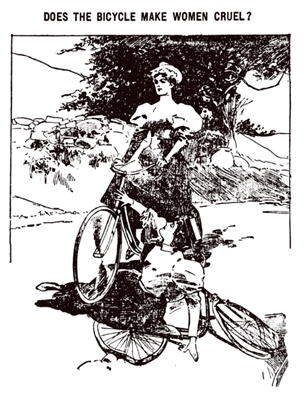
Fig. 1. American cartoon published in the Los Angeles Herald, 13 June 1897.
‘The Ladies Ride Anyway’
Throughout the fin de siécle, medical professionals and institutions seemed utterly divided on the topic of women cycling. Though most of the anti-cycling advice was based upon the actual physical effect of riding, neurological, nervous, and sexual ‘diseases’ also became part of the argument against it. As seen in Figure 1, popular cartoons of the time questioned whether cycling affected women’s neurological state, suggesting that cycling enabled women to take on the more masculine traits, like cruelty, as they began to move and act with increasing similarity to their male counterparts. It was also believed that the saddle could cause uterine displacement, pelvic and fallopian tube inflammation, and a disruption to menstruation, amongst a host of other issues. Furthermore, it was thought that cycling was, as Jennifer Hargreaves describes, an “indecent practice that could even transport women into prostitution”, and it became increasingly linked to sexual impropriety and loose morals. Cycling while pregnant was argued to lead to foetal deformities and an inability to breastfeed. Perhaps the most infamous of all these supposed afflictions was the bicycle face. The ‘disease’ caused a “pinched face, pointed nose, slack jaw, beady eyes, features pulled back, and a permanently frazzled expression”, and was considered by some to be utterly irreversible.
However, despite this seemingly endless onslaught of alarming diseases supposedly caused by cycling, many medical institutions offered genuine advice in order to prevent unnecessary injury. An issue of the British Medical Journal in 1895 asserted that:
“medical men who are consulted by ladies as to whether they may cycle should qualify their assent by insistence on the points that the pedals should be of the right length from the saddle, and the saddle of proper shape”.
Even this edition of the Journal was hardly the first to say so. Nonetheless, it seems that the warnings against cycling on the basis of health dangers did not deter female cyclists. As the Dutch physician Dr Pijnappel noted in 1897, “the ladies ride anyway”.
The Divided Skirt & The Battle Uniform
The more practical of objections to female cycling, by both the general public and medical practitioners, was the issue of clothing. The female safety bicycle differed to the man’s with the absence of the crossbar between the saddle and steering rod, but it had far less stability and much more weight while in use with the woman’s clothing bundled atop it. To use a man’s bicycle in long skirts was borderline impossible. The only option was to alter the clothing being worn, but this was easier said than done. Early solutions were impractical – skirts had to be wide enough to conceal the “ugly and inelegant” pedalling of the woman, but not so wide as to cause the cyclist to be thrown off balance in the wind “like a sailboat under full sail”, nor so wide as to incur the danger of the material getting caught in the spokes. It was thus no surprise that the issue was then sought to be solved more radically. The ‘Divided Skirt’ (as satiricised by Punch in Fig. 2) was the first compromise; bloomers, over which a woman wore a buttoned skirt that was then left unbuttoned while riding. The divided skirt was mocked and seen as an attempt by women to masculinise themselves, emphasising that to be a New Woman was hardly to be a woman at all.
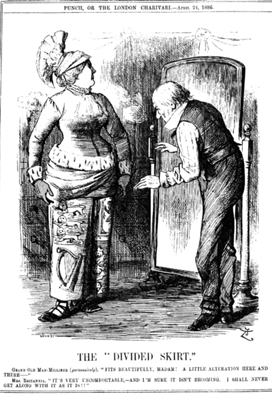
Figure 2: Punch, ‘The Divided Skirt’
Still, it was impractical; the safety bicycle virtually demanded trousers, rather than the divided or a normal skirt, as they enabled proper control of the body over the machine – no doubt because they were vehicles intended for male use. Some female cyclists, like Amalie Rother, were dedicated trouser-wearers and encouraged other women to similarly don their ‘battle uniform’ and to ride the male frame bicycle – but most women did not abandon the skirt, despite its impracticalities. The cyclist did not ride for herself; as a bourgeois woman, she rode for the benefit of others, demonstrating her father or her husband’s money in her expensive bicycle and tailored exercise clothes, as well as her excellent education in her graceful riding. Furthermore, accompanying men in their cycling illustrated their own masculinity and maturity in having a female companion. Cycling was as much of a performance as most of a woman’s life in the late nineteenth century, despite its close association with the New Woman movement.
Propaganda, Propagating?
So how did the bicycle become associated with the feminine quest for freedom? Between 1885 and 1900, no fewer than two hundred cartoons were published depicting the New Woman in innovative, athletic clothing. Punch magazine published the brunt of these, perpetuating the infamous image of the ‘New Woman’, thus enabling and validating women into these new athletic pursuits, though this was not, of course, their intention. The representation of the athletic woman was meant to be a parody – of course, who would aspire to such a thing? – but in the long term, this could not have better served the cause. Women now had an athletic image to look up to, with the new illustrations of their modified clothing putting them almost at equal with men; Punch’s cartoons consistently dressed women in traditionally male clothing. In 1896, Punch published an image of two women in the, by that point, popular bicycling costume for those who did not want their clothing to get caught in the spokes (Fig. 3) – the vicar within the cartoon mistakes them for men in their trousers and hats. Punch certainly exaggerated the changes in female fashion, though, as established, it was not without cause. By 1899, when Figure 4 was published, they no longer even characterised the female cyclist as the ‘New Woman’; the concept was so ingrained within the public perception, as a result of such heavy anti-cycling propaganda, it did not need pointing out. The bicycle had become almost synonymous with the emerging liberation movement.
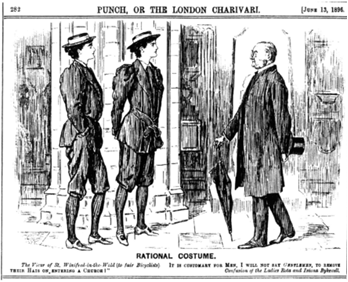
Figure 3: Punch, 1896
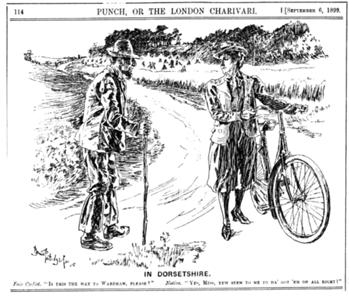
Figure 4: Punch, 1899
The New Woman and Freedom
Despite its origins among masculinity, cycling thus came to be seen as a feminine pursuit for emancipation. In her 1901 book The Woman Question, the German feminist Lily Braun celebrated the bicycle as a “strong emancipator[…], the effect of which contributes to the self-emancipation of the female gender, as already witnessed in the greater independence of young girls and their simpler clothing”. Another author in the De Hollandsche Lelie magazine described the female cyclist as “like a king on her steel horse”. It is certainly true that for women, cycling was a new revelation that enabled freedom and “independence in motion”, something that had rarely been seen before. Discovery and mobilisation was, on the other hand, a common experience for men. It is clear that whatever medicine had to say about cycling, the New Woman was not inclined to listen. Clothing was no impediment. Whatever the media attempted to ridicule only empowered her further. These changes, though not entirely severing women from their dependency upon men, nor offering the stirrings of political enfranchisement that were soon to come by the new century, certainly had a dramatic societal impact – why else would Punch publish so many caricatures over a fifteen year period, if not utterly captivated by the pedalling of the ‘New Woman’?
Bibliography
Collins, Tracy J.R.. “Athletic Fashion, ‘Punch’, and the Creation of the New Woman.” Victorian Periodicals Review 43, no. 3 (2010): 309–35. http://www.jstor.org/stable/41038818.
“Cycling For Women.” The British Medical Journal 2, no. 1825 (1895): 1582–83. http://www.jstor.org/stable/20234235.
Ebert, Anne-Katrin. “Liberating Technologies? Of Bicycles, Balance and the ‘New Woman’ in the 1890s.” Icon 16 (2010): 25–52. http://www.jstor.org/stable/23791374.
Hanlon, Sheila. “Bicycle Face: A Guide to Victorian Cycling Diseases”. January 4, 2016. http://www.sheilahanlon.com/?p=1990
“Lady Cyclists.” The British Medical Journal 2, no. 1749 (1894): 35–35. http://www.jstor.org/stable/20229150.
“The Bicycle And Diseases Of Women.” The British Medical Journal 1, no. 1984 (1899): 38–38. http://www.jstor.org/stable/20259145.
Image credit:
Figure 1:
Figures 2, 3, 4:
Collins, Tracy J.R.. “Athletic Fashion, ‘Punch’, and the Creation of the New Woman.” Victorian Periodicals Review 43, no. 3 (2010): 309–35. http://www.jstor.org/stable/41038818.
Featured Image Credit: American cartoon published in the Los Angeles Herald, 13 June 1897.
 Retrospect Journal