
Written by Edie Christian
The Weimar Republic has long been viewed as an inherent contradiction. Its decadent nightlife, relative liberation, and democratic system of governance was accompanied by the creeping rise of Nazism and fascist dictatorship during the 1920s and 1930s. Although the ‘Golden Twenties’ in Germany has long been heralded as a period of incredible artistic output, including the popularity of jazz and cabaret, it was underpinned by the worsening polarity of society and the instability of the republic’s political and economic institutions. This precariousness of Germany’s ‘democratic experiment’ was disastrously exploited by the rise of Adolf Hitler and the Nazi Party.
9 November represents the “Day of Destiny” within German history. It marks the fall of the Berlin Wall in 1989, paving the way for the reunification of East and West Germany. It is also a day of remembrance for the 1938 Kristallnacht (‘night of broken glass’) pogrom against the Jewish community. On 9 November 1918, Kaiser Wilhelm II abdicated his throne after worsening popularity following Germany’s loss in World War I; the monarchy was abolished and Wilhelm fled to exile in the Netherlands. Politicians met to establish a new democratic government, holding elections for the National Assembly in 1919 – Friedrich Ebert, the leader of the Social Democratic Party (SPD), became the first president. The Weimar Constitution established a representative democracy with universal suffrage over twenty-one, a bill of rights, and a parliament (Reichstag) that checked the power of the president. Whilst historians have long debated the factors leading to the eventual collapse of the Republic, there has been a pervasive idea that its fall was inevitable. This can be attributed, at least in part, to the unstable foundations of the new democracy as a result of the Treaty of Versailles. Germany was held solely responsible for the conflict, forced to dismantle its army, and lost significant amounts of its territory. This, as well as devastating financial reparations, provided the basis for the 1923 hyperinflation crisis and nationalist upsurge throughout the 1920s.
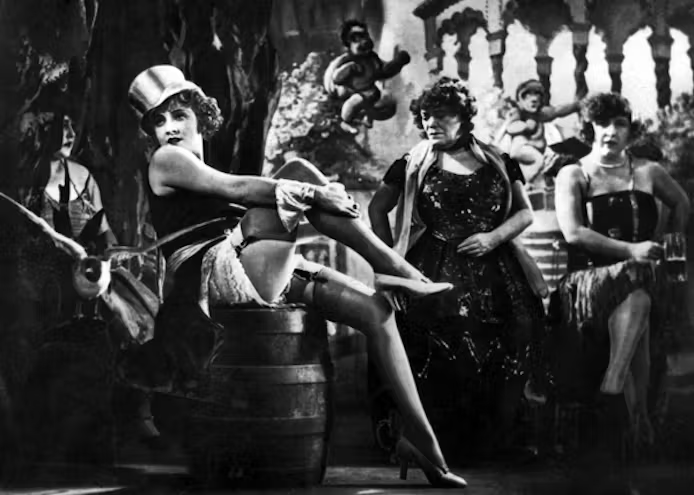
Despite this precarious economic situation, culture and nightlife flourished, providing the basis for many romantic views of the Republic. These views tend to mistakenly encompass the whole of Germany, whereas liberal reforms and culture were only prolific in cities such as Berlin. Even so, there was a surprising level of gender and sexual liberation, as well as unprecedented creative freedom as a result of a lack of censorship. Several clubs and cabarets welcomed those who subverted heteronormative expectations of gender and sexuality. Although male homosexuality was still illegal, urban spaces were viewed as relatively tolerant and permissive. This coincided with the relative emancipation of women, who were granted the right to vote in 1919. The increasing presence of the ‘New Woman’ – symbolised in the public eye by characters such as Cabaret‘s Sally Bowles – enthusiastically participated in this nightlife. However, the prosperity of this entertainment industry coexisted alongside rampant unemployment and disillusionment – this contradiction has led to critic Siegfried Kracauer labelling it as a ‘cult of distraction’.
This image of excess and decadence belies the economic crises of the Republic – in fact, it is often the duality of Weimar society that drew writers and artists to capture what many believed to be an inevitable collapse. The value of the Reichsmark, the German currency, had fallen considerably during the war, forcing the government to print more money. In 1922, the Allies refused Germany’s request to suspend reparation payments amidst their worsening economic crisis; they could not pay in their own currency, but rather gold marks, which retained their value. Germany was quickly unable to continue payments, resulting in a French and Belgian occupation of industrial centres within the Ruhr region in retaliation. This occupation resulted in the scarcity of goods on the German market, causing prices to skyrocket. The government felt obligated to print more money, plummeting the country into a hyperinflation crisis – a loaf of bread cost 200 billion marks by the autumn of 1923. Despite these bleak prospects, the election of Gustav Stresemann as chancellor in September 1923 represented a turning point for the Republic. His policy of ‘fulfillment’ prioritised the repayment of reparations in order to improve international relations and the German economy. The implementation of the Dawes Plan in 1924 stabilised the economy by reducing annual reparation payments, reorganising the Reichsbank under foreign supervision, and providing a large initial loan (primarily from America). This improvement in foreign relations and the economy between 1924-29 became known as the ‘Golden Years’, during which production of culture exploded, exemplified by the growth of the Bauhaus school. However, these years can be too easily romanticised; over two million people remained unemployed in 1926, and Germany had become increasingly dependent on foreign loans. This all came to a head with the 1929 Wall Street Crash – not only did the resulting Great Depression have economic implications globally, but the impact upon America led it to withdraw economic support. The Weimar Republic was plunged into another economic crisis.
Although the democratic Republic certainly extended the rights and representation of the population, it undeniably created a level of instability within Germany. The proportional representative electoral system meant that many different parties held small numbers of seats in the Reichstag – there was no majority government, necessitating the formation of coalitions who often fundamentally disagreed on matters of policy. The political and economic weaknesses of the Republic fostered a growing class of discontented young men who were motivated by a strong belief in German nationalism and a single strong leader over democracy. These views were bolstered by the growing popularity of the stab-in-the-back myth (Dolchstoßlegende), which argued that the German loss of WWI was not on the battlefield, but rather that Germany was betrayed on the home front by several groups, primarily the Jewish population. Extremist movements capitalised on this growing resentment among the German population; as well as exploiting ideological fervour, the Nazi Party rose to power through a calculated manipulation of democratic weaknesses within the Weimar government. Proportional representation gave such extremist parties a national platform, whilst emergency powers under Article 48 of the Weimar Constitution allowed the president to rule by decree. The passage of the 1933 Enabling Act marked the legal transfer of dictatorial powers to Adolf Hitler, thereby the transformation of the democratic Republic into the totalitarianism of the Third Reich.
The Weimar Republic remains one of the most paradoxical periods in modern history – its cultural dynamism and relatively tolerant attitude towards gender and sexuality was set against profound political fragility. Economic instability, structural flaws within the constitution, and resentment over the Treaty of Versailles made the Republic increasingly vulnerable to extremist influence. The compounded crises and instability within the Republic, and its increasingly inescapable exploitation, were echoed during testimony at the Nuremberg trials. Hans Frank, the Nazi governor of occupied Poland, commented that “the Fuhrer was a man who was possible in Germany only at that very moment.”
Bibliography
Anastasiia Kirpalov. “What Was Cultural Life in the Weimar Republic Like?” TheCollector, 23 Dec. 2024, http://www.thecollector.com/cultural-life-weimar-republic/.
“New Light on the Dark Interwar Years.” Www.ft.com, http://www.ft.com/content/1c069c91-1c05-4943-a7cc-b794f9a4ee01.
“New Women in the Weimar Republic.” Sites.barbican.org.uk, http://www.barbican.org.uk/s/intothenight-berlin/.
Ryback, Timothy W. “How Hitler Dismantled a Democracy in 53 Days.” The Atlantic, theatlantic, 8 Jan. 2025, http://www.theatlantic.com/ideas/archive/2025/01/hitler-germany-constitution-authoritarianism/681233/.
Silva, Eva. “The Weimar Republic: How Did It Allow Hitler’s Rise to Power?” The Collector, 21 Apr. 2022, http://www.thecollector.com/weimar-republic-hitler-rise-to-power/.
Featured image credit: https://www.carnegiehall.org/Explore/Articles/2024/02/01/Cabaret-in-the-Weimar-Republic
 Retrospect Journal