
Written By: Kirsty Rough
In its final years, a city on the Soviet Union’s periphery saw one of the first major demonstrations against the Kremlin’s hold on power. When the people of Alma-Ata, the capital of the Kazakh Soviet Socialist Republic, protested the dismissal of their longtime leader in December 1986, the wave of unrest saw thousands of arrests and an unknown number of casualties. Remembered as Zheltoksan, the Kazakh word for December, the protest was ultimately the dramatic culmination of both increasing resistance to the Soviet Union’s centralised power and of increasing feelings of national identity in the republics. Today, the full nature of Zheltoksan is still somewhat enigmatic, and despite its significance in the Soviet Union’s dissolution, few outside of Kazakhstan have even heard of it.
Ethnicity and national identity were central to Zheltoksan. Soviet policies were responsible for drastically changing the demographics of Kazakhstan over time. Kazakhs suffered immensely in the famines caused by Stalin’s collectivization, with 40 per cent of the population starving to death between 1930–1933. The population further changed when vast swathes of people from other republics migrated to Kazakhstan seeking land and work as part of the Virgin Lands Campaign, which aimed to invigorate Soviet agriculture and economy. But settling in Kazakhstan wasn’t always a choice. Thousands of people caught up in the Great Terror and repressions had the GULAGs of the expansive steppe as their final destination. Consequently, despite being the titular ethnic group of the Kazakh SSR, Kazakhs did not make up the majority of the population and were only the second largest group after Russians.
It was this background and the eventual arrival of Mikhail Gorbachev as Soviet leader in 1985 that made Zheltoksan possible. Gorbachev pursued a policy of perestroika (reconstruction) to resurrect the USSR after Leonid Brezhnev’s so-called “era of stagnation.” Within this, Gorbachev’s policy of glasnost’ (openness) theoretically provided Soviet citizens more transparency and freedom to question the state in a way that was virtually impossible before. Gorbachev should have anticipated the upheaval this would unleash.
For the Kazakh SSR, perestroika hit close to home when their beloved leader Dinmukhamed Kunaev was removed from his position after over twenty years in the role. Appointed in the Brezhnev era, he was the highest-ranking Kazakh politician in the whole history of the Soviet Union and was highly popular in his home republic: Kazakhstan developed immensely under his rule, and he advocated for Kazakh identity and culture. For Gorbachev, however, Kunaev’s removal was simply a necessary part of the clean break with Brezhnev’s corrupt rule.
There was to be further insult added to injury when Kunaev’s replacement was announced as Gennady Kolbin. An obscure Russian politician, the Kazakh population considered Kolbin experienced in the wrong way. He had formerly led the Ulyanovsk region in Russia, but he had no experience of working or living in Kazakhstan. Lawyer Amanzhol Malibayev, speaking in later years, expressed Kazakhs’ issue with the appointment clearly: “Kolbin came from Ulyanovsk and knew nothing of our problems.” In stark contrast to Kunaev, Kolbin was a nobody.
On 16 December 1986, the Kazakh Communist Party’s Central Committee voted unanimously to fulfil Gorbachev’s appointment of Kolbin as leader. The news travelled quickly around Alma-Ata, being met with anger and dismay. Gorbachev was about to see glasnost’ in action.
By the morning of 17 December, crowds of primarily Kazakh students had gathered in Brezhnev Square. At workplaces and schools, Kazakhs enthusiastically encouraged each other to go to the square. Roads became blocked and the city plunged into crisis; tension between Kazakhs and Russians, protesters and non-protesters, intensified. Protesters displayed banners demonstrating their cause – “The Kazakh Nation deserves a Kazakh Leader.” Their message was simple. They felt undermined by Moscow.
Gorbachev was facing the first blatant, potentially violent act of opposition to Moscow, and he could only really blame himself. It was glasnost’ which encouraged the protesters to voice their vexation with confidence, optimism, and strength.
The authorities failed to react decisively to the persisting protests. Some leaders tried to speak with the crowds, urging them to go home or risk the use of force, but ultimately they were perplexed with what to do. One witness put the authorities’ confusion down to the fact that they “are not used to talking to people.” It was unchartered territory for all.
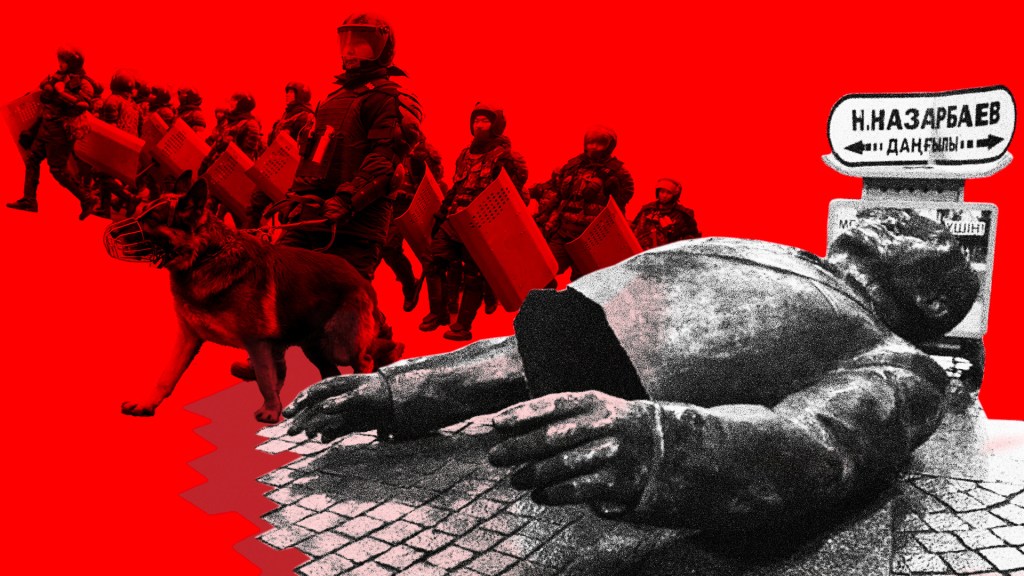
The crowds did not disperse, but rather increased. Tensions escalated as authorities recruited local Russians alongside utilising local militias, auxiliary police, and internal troops from Kazakhstan and other republics to deal with the protesters, who in response also turned to violence. The protesters used primarily rocks and bottles, whilst the troops used steel rods, dogs, and military shovels. It was an uneven match; there were even reports of pressurised water from fire engines being sprayed onto the crowds in the bitter winter night.
By 18 December, the protests had ceased. Official Soviet records show six hundred people were detained, close to four hundred hospitalised with injuries, and three killed. Forbidding foreign journalists to enter the city, Soviet authorities were quick to create their narrative and conceal numerous details of the events. Consequently, the true human cost of Zheltoksan remains unsettled. With some reports of hundreds of people being taken out of the city, shot, and buried in mass graves, some estimates put the number of deaths as high as two hundred.
As a final blow to the protesters and their demands, if the press did report on the events they were dismissed as a nationalistic outburst of drunk and drugged up students. The protesters were merely hooligans representing a bitter minority of the population, undermining the established peace and coexistence of ethnicities in the Kazakh SSR.
The protesters provide an alternative narrative. Kolbin’s Russian ethnicity did not incite protest; the issue was that he frankly had no ties to Kazakhstan. The core problem was that Kolbin had seemingly been randomly picked by the Soviet centre with no consideration of the people of Kazakhstan. Journalist Bakidzhan Mukuzhev confirmed that “the protest was not against a Russian, but against Moscow’s authoritarian pressure against the republics.” Had Kunaev’s replacement been a Russian from the Kazakh SSR, Zheltoksan may never have occurred.
Despite the mass outrage of Zheltoksan, Kolbin held the position of leader of the Kazakh SSR until 1989. His replacement, Nursultan Nazarbayev, went on to become the first president of the independent Republic of Kazakhstan. Winning his presidency with 95 per cent of the vote and as the sole name on the ballot, Nazarbayev remained president until a wave of mass protests saw his resignation in 2019.
This particular context has contributed to a less than transparent narrative of Zheltoksan even after the Soviet Union’s collapse. Nazarbayev and numerous other post-independence politicians held prominent positions in the Kazakh Communist Party at the time of Zheltoksan, and their role in the uprising remains largely unclear. Nazarbayev did inaugurate a monument to Zheltoksan for the 20th anniversary, but during his presidency there was never a definitive state investigation into the uprising, and for years survivors and relatives fought for official acknowledgment of the torture and deaths of protesters. Their struggle for the truth remains to this day.
Consequently, memory and understanding of Zheltoksan today is an interesting case. 17 December was declared as the Day of Democratic Renewal, emphasising officially that Zheltoksan is principally remembered as a manifestation of the Kazakh fight for independence and self-determination. For many the events are therefore viewed with pride, but controversy remains, given official narratives still understate the extent of violence and often completely disregard any dimensions of ethnic or national identity in the events.
Zheltoksan does undoubtedly deserve to be remembered as the first major protest against Moscow’s monopoly of authority. Yet, to only understand Zheltoksan in this manner arguably only minimises its overall significance in the Soviet Union’s unravelling. The ethnic and national dimension should not be ignored, as Zheltoksan was a consequence of rising national identity amongst people who were no longer content with following the Kremlin. Gorbachev’s glasnost’ invigorated Zheltoksan protesters, yet the suppressive reaction underlined the authorities’ ignorance to the growing extent of the national question in the republics. The blame was placed upon ethnic tensions whilst the deeper issue, that such tensions were simmering due to persistent centralised power, was ignored.
Whilst perhaps allowing Gorbachev to live a little longer with the belief that the Union was not in existential crisis, to ordinary people the attitude to Zheltoksan only devalued the promises of glasnost’ and perestroika. Calls of national representation and against the Russian-centric structure of power like those at Zheltoksan flooded wider Soviet public discourse. Before long, this unravelled into calls for independence. Ironically, it was precisely the authority’s attempts at downplaying Zheltoksan that allowed it to become this watershed moment.
Though Zheltoksan sparked the Soviet Union’s dissolution, coincidentally for four days Kazakhstan was its only member republic. Kazakhstan was the last republic to announce its independence from the Soviet Union in December 1991, exactly five years after Zheltoksan.
Bibliography
Whittington, Anna. ‘An Anxious Unraveling: Perestroika and the Fracturing of the Soviet People’. Kritika: Explorations in Russian and Eurasian History 25 (3) (2024): 513–45.
Conflict in the Soviet Union: The Untold Story of the Clashes in Kazakhstan. Helsinki Watch, October 1990, https://www.hrw.org/reports/KAZAK90O.pdf
Dukeyev, Berikbol. “‘Much Is Done, But to Make People Forget:’ The Story of Zheltoksan in Kazakhstani History Textbooks.” Nationalities Papers (2025): 1–18.
Kalinovsky, Artemy M. “‘The Pillars of Our Statehood:’ Glasnost’, Soviet Networks, and National Mobilization.” Russian history (Pittsburgh) 49.2–4 (2023): 264–288.
Mavrov, Greg. “Dinmukhamed Kunayev: The forgotten father of Kazakh modernisation.” TRT World, May 6 2022. https://www.trtworld.com/article/12788673
Pannier, Bruce. “Kazakhstan: Zheltoksan Protest Marked 20 years later.” Radio Free Europe/Radio Liberty, December 14 2006. https://www.rferl.org/a/1073453.html
Zardykhan, Zharmukhamed. “Russians in Kazakhstan and Demographic Change: Imperial Legacy and the Kazakh Way of Nation Building.” Asian ethnicity 5.1 (2004): 61–79.
Хасанов, Риза. “Желтоксан: Алматы, Декабрь 1986-го. Массовые акции протестов против политики руководства СССР. Как это было.” Новая Газета, December 16 2022. https://novayagazeta.ru/articles/2022/12/16/zheltoksan-media
Featured Image Credit: Associated Press / Nexta Live / Teona Tsintsadze — used in Coda Story, “An anti-Soviet protest in Kazakhstan haunts the country’s current unrest,” Jan. 7, 2022. retrieved from https://www.codastory.com/rewriting-history/protests-kazakhstan-2022-1986/
 Retrospect Journal