
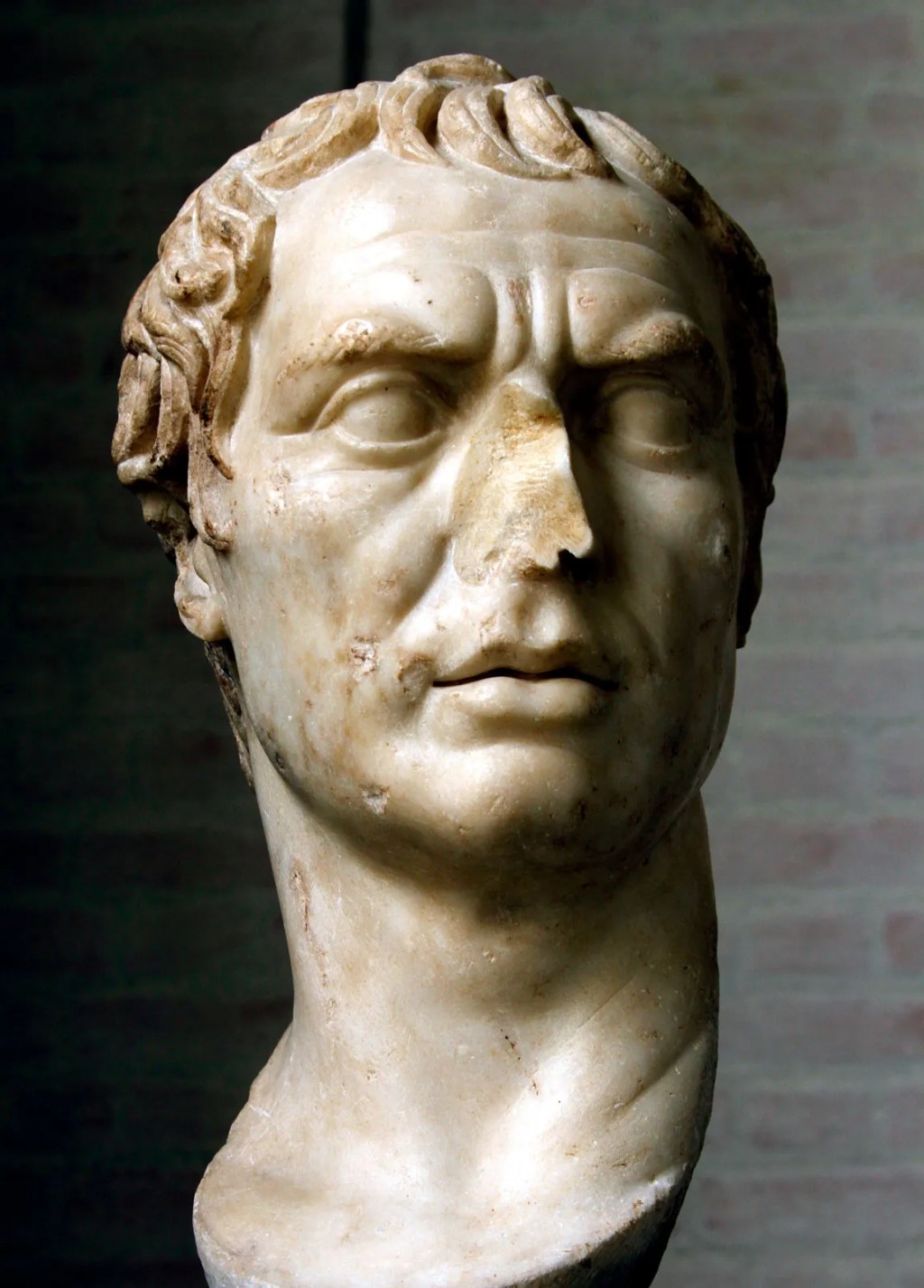
Written By: Ben Clarke
Sulla’s dictatorship (82–79 BC), which came about after his famous march on Rome in 82 BC, established a precedent which, despite his supposed policy of restoring the primacy of the senate and Rome’s magistracies to their former status, ultimately led to the demise of the Republic as is witnessed in the political careers of Lepidus, Pompey, and, most famously, Caesar. Indeed, although he sought to prevent the excessive growth of power of individuals, his march on Rome was widely influential in paradoxically stressing, as Shotter puts it, that “laws have little effect when faced with an armed force”.
Sulla’s rise to power demonstrated to the Roman Republic that, with an army’s allegiance to the commander as opposed to the state, one could achieve political power within Rome; something which was replicated throughout the breakdown of the Late Republic. A key example of this is Sulla’s supposed second letter to the Senate, which bears a great resemblance to Pompey’s of a later date. Appian states that Sulla, with the support of his legions, bitterly protested his being made an outlaw and stated he would march on Rome to restore his rights (Appian 1.77). Similarly, Pompey, on command for the Mithridatic War, was cut of his provisions as the Senate grew wary of his power. To this Pompey sent a letter to the Senate demanding money with the threat of coming back to Italy with his army should they not send it (Plut. Pomp. 1.20). Furthermore, Sulla also supposedly used military intimidation to pressure the senate into granting him the dictatorship (Valerius Maximus, Deeds and Sayings, 3.8.5), something which was again replicated by the First Triumvirate where Caesar used the two triumvirs to threaten the Senate into passing his land bill (Plut. Caes. 1.14; Plut. Pomp. 1.17). Clearly, therefore, exhibited here is just one example of the influence that Sulla’s use of military intimidation, as well as his march on Rome, had within the Roman Republic; a precedent was established which would eventually amount to its demise with Caesar.
Sulla’s use of military intimidation was key to his rise to power, but also in his consolidation of the dictatorship through his use of proscriptions, something that would later be used under the Second Triumvirate in order to consolidate their authority. Sulla exercised proscriptions as a way in which he could provide land for his veterans and eradicate his enemies from political office (Suet. Iul. 11.2; Vell. 2.28.3; App. Bell. Civ. 1.11.95). Plutarch states that the reward for anyone who slew a proscribed person would be as much as two talents (Plut. Sull. 31.4) and although this, as evidence, could have been slightly exaggerated given it was written in the 1–2 century AD, after the Second Triumvirate’s vicious proscriptions, which could have resulted in a crueller retrospective depiction of Sulla, to some extent this highlights the influence of Sulla’s military intimidation upon Republican politics.
Despite the reputation of later ancient sources, which view the period of Sullan dictatorship as a ‘tyranny’ (Plut. Sull. 30-; App. Bell. Civ. 1.98-99), Sulla’s justification for his holding of this exceptional power was the restoration of constitution within the Roman state. Even Cicero, contemporary to the period, admits that while Sulla’s dictatorship was tyrannical in nature, it was established by law (Cic. Leg. Agr. 3.2.5). Furthermore, despite the aforementioned use of military intimidation to receive the position (Valerius Maximus, Deeds and Sayings, 3.8.5), Sullan legislation passed during this period does demonstrate an attempt to prevent future civil conflict and restore stability to the Republic. In terms of the causes for civil war, Sulla himself foresaw that the excessive military authority of individuals was an issue, albeit one that he utilised himself. To prevent future occurrences Sulla introduced the lex cornelia de maiestae, which asserted that leading one’s army out of a province without explicit permission from the Senate was a treasonable offence. Furthermore, the extension of imperium of pro-magistrates was mitigated by Sulla’s growth of the number of praetors per year from six to eight, thereby ensuring that there were sufficient magistrates to oversee the provinces. Finally, Sulla’s introduction of minimum age requirements for each office, as well as the introduction of a ten-year period between holding the same office, highlights his agenda of preventing the excessive power of individuals. However, as is exhibited effectively by the following decades, Sulla’s policies proved ineffective in the face of the precedent he had already set. Lepidus’ consulship and march on Rome, opposing calls for the restoration of the tribunate, before being defeated by Pompey (who himself held pro-praetorian imperium at just the age of twenty-eight) highlights that even by 78 BC Sulla’s legislation had very little impact on the restoration of the Republic. Shotter’s argument that “laws have little effect when faced with an armed force” holds true and highlights the extent to which Sulla’s march on Rome exposed a fatal flaw within the Republic and led to its demise.
Furthermore, Sulla sought to restore the senate to its primacy and diminish the powers of the tribunate given the recent civil strife that figures such as the Gracchi and, in Sulla’s experience, Sulpicius, who deposed him of his command in Greece, had caused within Rome. Thereby, Sulla passed the Lex Cornelia de Tribunicia Potestatis which significantly reduced the power of the tribunate; the law prohibited their ability to summon the senate, their power to propose legislation, their right to veto, and left it a cul-de-sac career choice via his prohibiting tribunes to take up further positions within the cursus honorum (App. Bell. Civ. 1.100). As is expressed by Lepidus’ consulship in 78 BC, there were already calls within a year of Sulla’s abdication for the restoration of the tribunate, and by 70 BC the powers of the tribune had been restored. Clearly, therefore, regardless of how far Sulla sought to restore the Republic, the way in which he rose to the position of dictator set a precedent that his legislation could not resolve.
In understanding the legacy of Sulla and therefore the extent to which his actions led to the demise of the Republic we are forced to rely on sources which often present Sulla as a somewhat legendary figure who brought about the inevitable fall of the Republic, which can cloud the extent of his influence. Indeed, this legendary theme shines through in the various accounts, from a variety of authors, of Sulla’s supposed prescience. This is exhibited in Suetonius where, after the pardoning of Caesar, Sulla supposedly states that he was a second Marius (Suet. Iul. 1.1-3). Nonetheless, throughout the ancient sources there is a consensus, even within the contemporary source base, that Sulla’s dictatorship had a significant impact within the Republic. For example, the contemporary Sallust essentially argues that the moral decline of Rome “begun after the fall of Carthage, quickening after Sulla’s dictatorship, and spreading from the dissolute nobility to infect all of Roman politics”. In his account of the conspiracy of Catiline he states that Catiline was driven to take government since the time of Sulla’s dictatorship (Sallust, The Conspiracy of Catiline, 1.5). While as evidence this is questionable given Sallust’s ties with Caesar (a well-known foe of Sulla given Sulla’s placement of Caesar on his proscription lists), it does imply that the audience of the time would have also understood the importance of Sulla’s dictatorship in inspiring “moral degradation”. Furthermore, another contemporary, Cicero, records a supposed Pompey quote “If Sulla could, why can’t I” (Cicero, Ad Atticum, 9.10.2), bearing testimony to the precedent that Sulla’s march set in Rome. As evidence, Cicero here is relatively reliable given he is writing to his close friend Atticus with a tone of sincerity, writing “as uneasiness of mind […] deprives me from sleep […] I have begun this letter to you”. Clearly, therefore, Sulla had a profound impact upon the Roman world.
In conclusion, Sulla’s dictatorship sought to restore the offices of the Republic to their former state. Indeed, his laws sought to restore the primacy of the senate, diminish the authority of the tribunate, and, overall, sought to limit the excessive power of individuals via his legislation regarding pro-magistrates. His legislation was relatively short-lived and ineffectual, however, with the excessive use of military authority being exercised again as early as 78 BC, and his legislation regarding the tribunate being overturned by 70 BC. However, despite his apparent awareness that the excessive military authority of individuals, exposed by himself in 88 BC, would lead to the Republic’s demise, his attempts to prevent a future Sulla, or a ‘second Marius’ (Suet. Iul. 1.1-3), were unsuccessful. Therefore, Sulla’s dictatorship was not the demise of the Republic, rather his rise to power was.
Bibliography
Badian, E. (1962). Waiting for Sulla. JRS 52, 47-61.
Badian, E. (1970). Lucius Sulla, the Deadly Reformer. A.J. Dunston, Essays on Roman Culture, 35-74.
Bail, D. R. (1999). Cicero: Letters to Atticus. Loeb; New edition.
De Wilde, M. (2013). The dictatorship and the fall of the Roman Republic. ZRG 130, 1-39.
Flower, H. (2007). Roman Republics. Princeton.
Frier, B. (1971). Sulla’s propaganda: The collapse of the Cinnan Republic. AJPh 92, 585-604.
Gruen, S. (1995). The Last Generation of Roman Republic. Berkeley.
Keaveney, A. (1982). Sulla, the Last Republican. London.
Pelling, C. (2012). Sallust (Gaius Sallustius Crispus.
Santangelo, F. (2006). Sulla and the Senate: a reconsideration. Cahiers du Centre Gustave Glotz, 7-22.
Shotter, D. (1994). The Fall of the Roman Republic . Routledge.
Steel, C. (2014). Rethinking Sulla: the case of the Roman senate. CQ 64, 657-68.
Steel, C. (2014). The Roman senate and the post-Sullan res publica. Historia 63, 323-39.
Thein, G. (2014). Reflecting on Sulla’s clemency. Historia 63, 166-186.
Thein., G. (2006). Sulla the weak tyrant. Lewis, S. (ed.)Ancient Tyranny, Edinburgh, 238-249.
Featured Image Credit: “Sulla | Biography, Civil War, Roman Dictator, & Facts.” Encyclopaedia Britannica. https://www.britannica.com/biography/Sulla
 Retrospect Journal