
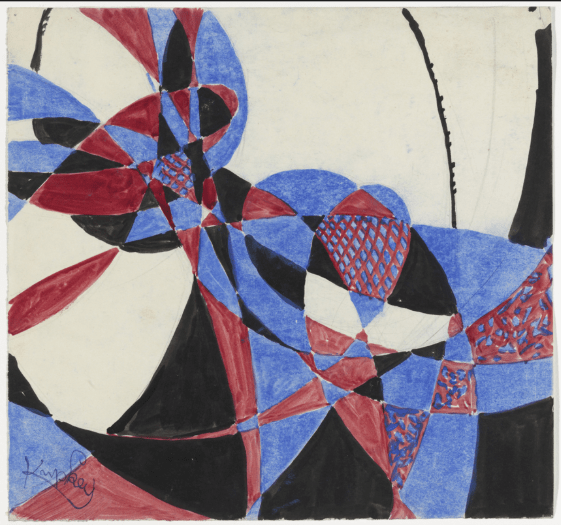
FIG 1: Amorpha: Fugue in Two Colors (1912)
written by Helene Chaligne
02/11/2025
The question of who made the first Western abstract work is among the many art history questions that scholars cannot agree on an answer to. In 1935, Wassily Kandinsky wrote a letter to his New York gallerist insisting he should have that title. He qualified his work as a “historic painting.” As Abigail Cain points out, other artists such as Robert Delaunay, Mikhail Larionov, Natalia Goncharova, and Kazimir Malevich backdated their work, presumably being concerned with their legacies.
While Kandinsky can be credited with jumpstarting public interest in public art with Komposition V, the lines of tracing back who “was first” in terms of manifesto and execution are more complicated.
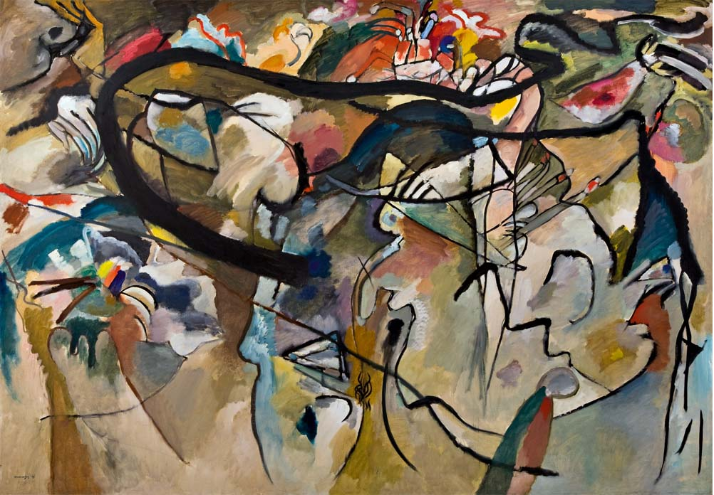
FIG 2: Komposition V (1911)
Other scholars, and my high school art teacher, point to František Kupka as the first display of works that were a total break from conventionality with Amorpha, Chromatique chaude and Amorpha, Fugue à deux couleurs, shown first in 1912. Francis Picabia is also sometimes credited with his work Caoutchouc, completed in 1909. Some scholars have pushed back against the latter due to their view that it still too strongly resembles flowers. Augusto Giacometti created abstract works derived from a study of butterfly wings as early as 1898.
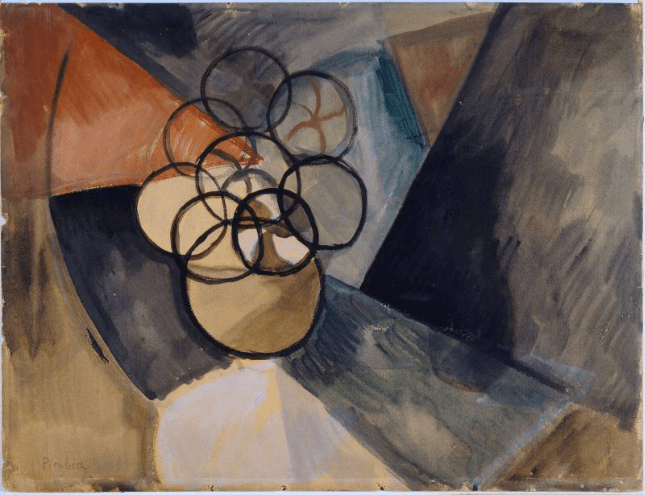
FIG 3: Caoutchouc (1909)
Julia Voss underlines how Kandinsky’s letter to his gallerist shows that this was a contest in the art world and having produced the first abstract painting would allow a highly coveted prize.
This seems to be the usual delimitation of the debate on the origins of abstract art in the Western canon. As was signalled in the MoMA’s 2012 exhibit Inventing Abstraction, 1910-1925: How a Radical Idea Changed Modern Art, abstraction is often associated with the early 20th century and the dawn of a new modern and connected culture. When approaching this exhibition, its curators laid out that their “main criterion was the artist’s own position and their statements that they’re doing something abstract.” They then added, “The terminology is a slightly different question because the word ‘abstract’ would not necessarily be used. But there was a very clear awareness from the artists that were sensitive to what was happening.” For this reason, Swedish artist Hilma Af Klint was not featured.
Af Klint’s work did not come with a manifesto for abstraction and instead sprung from her interest in the occult. She was born in 1862, much earlier than any of the aforementioned artists. She painted her first abstract series in 1906. This was after, in 1905, she notes having heard a voice giving her the message that she was to proclaim a new philosophy of life and become a part of a new kingdom. This expressive series was apparently done when Af Klint was unconscious during a scéance. Surrealists later called this method “automatic drawing” or automatism, which is characterised by creating art without conscious thought.
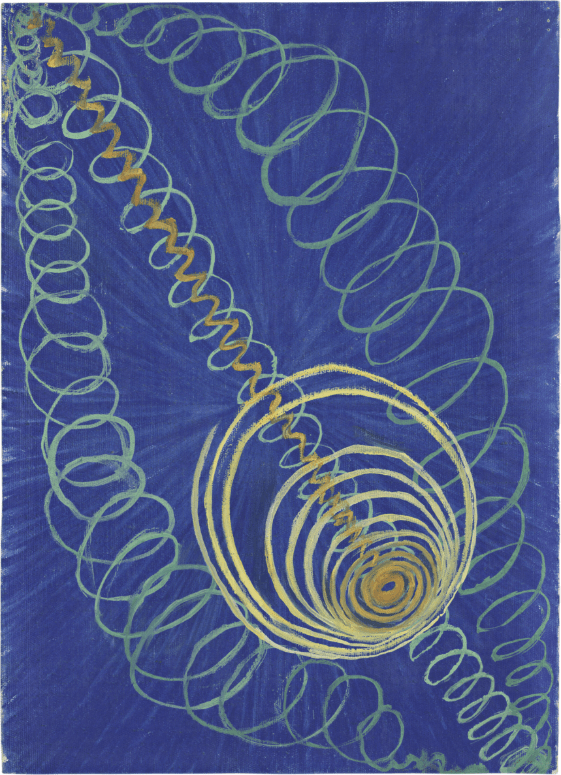
FIG 4: Primordial Chaos (1906)
Af Klint’s lack of representation among the likes of Kandinsky and Kupka is also due to how her work was kept after her death. Af Klint left her work to her nephew, who, despite having sympathies for her, struggled to understand her interests. On top of this, she left a note in her will that stipulated that her works, including 1,200 paintings and 26,000 pages of notes, should not be shown until 20 years after her death. She had no intention of winning the abstract art race, even before it had even started. It was not until 1986, in Los Angeles, that her work was shown publicly. Her international recognition would come with Moderna Museet’s 2013 exhibition, over a hundred years after Primordial Chaos was painted. This was the museum’s most popular exhibition, coming with a bit of irony, as they had rejected her grand nephew’s offer of her work in the 1970s.
There is another layer to the gradual recognition of Af Klint. The director of the Moderna Museet rejected it due to her being a medium, he did not even look at the pictures. This was the criticism some made when Hilma’s work was not displayed in the MoMA’s Creating Abstraction exhibit. As curator Maurice Tuchman underlines, “spiritual” is a very dirty word in the art world. Hence, the creation of such a debate on intention and terminology labours on.
While we may never reach a total agreement on if Af Klint pioneered abstract art or if the credit is due to be given to the once-eager-to-receive-it Kandinsky, developing scholarship on Af Klint’s work and life has left many grateful for her recent recognition.
We now know that Af Klint was influenced by botany and mathematics in her youth. She painted landscapes in a naturalistic style to earn money. Her spiritualism strengthened after the death of her sister and the visit of the Austrian polymath to her studio in 1908. Steiner told Af Klint to give up otherworldliness and to continue following her own intuition. She then stopped painting for four years, and once she resumed, some would argue she lost her initial intensity. Peter Schjeldahl insisted that this was because she lost the autonomy of her beliefs. Speculation on Af Klint’s sexuality has also been widespread, largely since she never married, left no trace of her personal life, and lived most of her life surrounded by women whom she had strong bonds with. Her only autobiographical film, made by the same director as A Dog’s Purpose (2017), Hilma (2022) portrays her as a queer woman. Theresa Dintino points to the absolute control of the Protestant Swedish church as one of the reasons Hilma could not express her visions or sexuality freely. Her philosophy of the duality of life included a duality of genders, believing that a man could be born into a female body and that genders and roles could be fluid. Furthermore, her spiritualism has been interpreted as being a part of a “long and often-repressed lineage of women mystics,” Aliya Say argues, drawing comparisons with the mediaeval abbess Hildegard of Bingen. She states they both worked with herbs and learnt from the flora around them. She underlines that both their art comes from mystical visions and upholding an interconnectivity seen in the natural world.
Other interesting developments come from Britt Lundgren of the University of Northern Carolina, who noticed similarities with scientific diagrams from the 19th century physicist Thomas Young, created a hundred years earlier. Lundgren notes Af Klint’s interest in science, spanning from botany to colour theory and physics. Lundgren also pushes the analysis to argue that some of Young’s figures help decode elements of the Swedish artist’s paintings. The caption for Young’s Plate XXXIX cites “oblique stripes of colour” that appear when candlelight is viewed via a prism that she interprets as being a description of Af Klint’s Group X., No. 1, Altarpiece. Her article notes many other similarities; I have included one more.
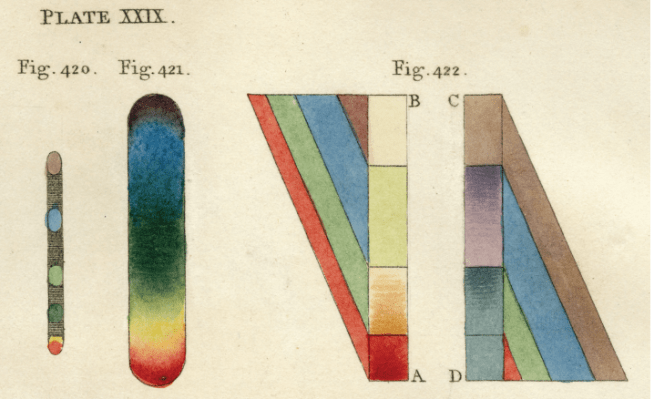
Fig 5: An excerpt from Plate XXIX of Young’s Lectures
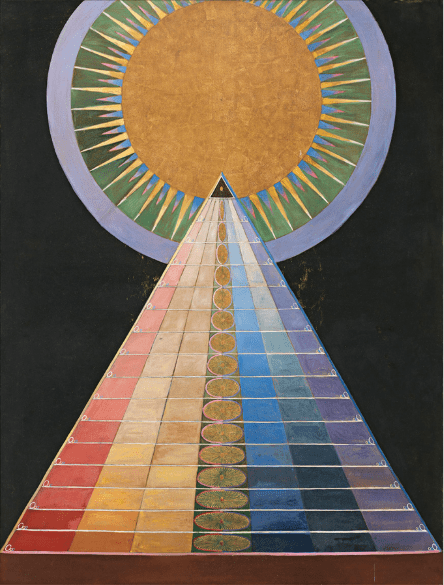
Fig 6: Group X, No. 1, Altarpiece
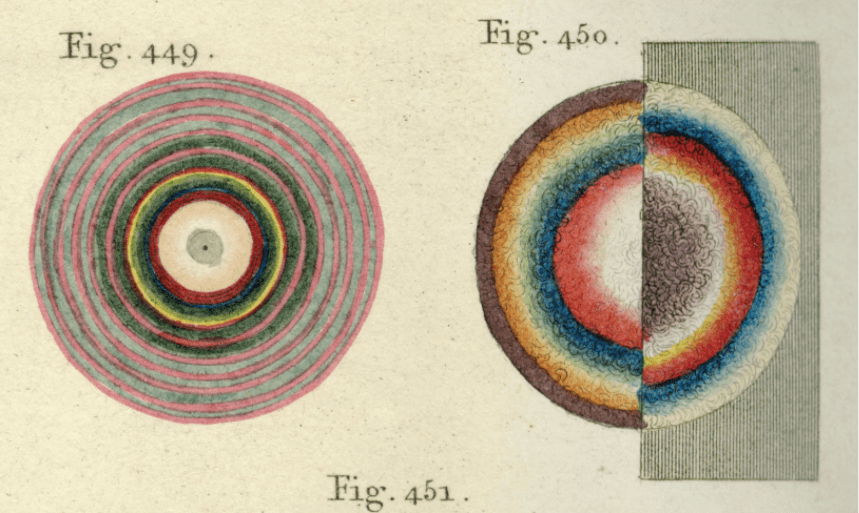
Fig 7: An excerpt from Plate XXX of Young’s Lectures
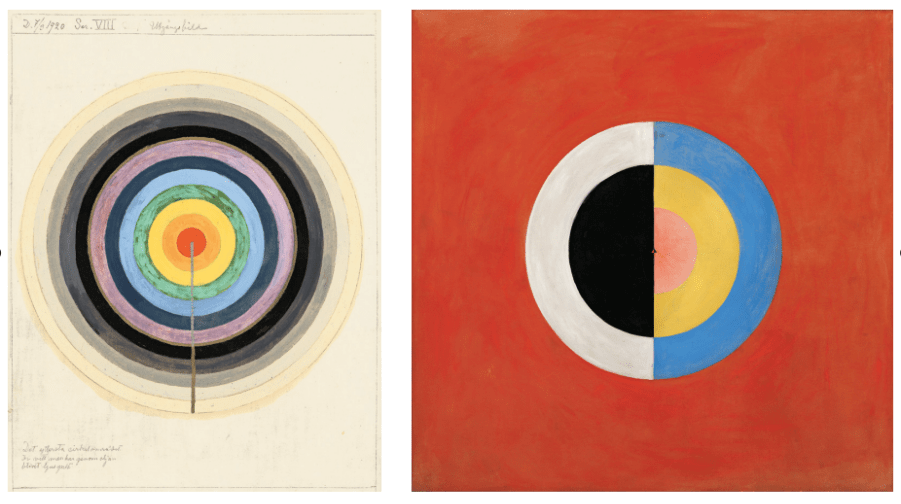
Fig 8&9: Initiating Picture, Series VIII and Group IX/SUW, The Swan.
I have included only a sample of the research being done on Af Klint’s work, historically and beyond, but it is fast increasing. As most do, I started my venture on the question of who pioneered abstract art, but, in the end, I found that that might not be the most interesting and fruitful way of approaching Af Klint’s late recognition. The research on her life, her spiritualism, her influences, and the continued debate on how to recognise artists that have seemingly been left forgotten is, in my view, a much more exciting development.
Bibliography
Aliya, Say. “Vital Signs – Tate Etc.” Tate, June 18, 2023. https://www.tate.org.uk/tate-etc/issue-58-summer-2023/vital-signs-hilma-af-klint-aliya-say.
Cain, Abigail. “What Was the First Abstract Artwork?” Artsy, March 31, 2017. https://www.artsy.net/article/artsy-editorial-first-abstract-artwork.
Dickerman, Leah, Matthew Affron, and Art New. Inventing Abstraction, 1910-1925 : How a Radical Idea Changed Modern Art. New York: Museum Of Modern Art, 2012.
Dintino, Theresa C. “Nasty Woman Artist Hilma Af Klint: How the World Works.” Nasty Women Writers, August 2, 2023. https://www.nastywomenwriters.com/nasty-woman-artist-hilma-af-klint-how-the-world-works/.
Jeffries, Stuart. “‘They Called Her a Crazy Witch’: Did Medium Hilma Af Klint Invent Abstract Art?” the Guardian, October 6, 2020. https://www.theguardian.com/artanddesign/2020/oct/06/hilma-af-klint-abstract-art-beyond-the-visible-film-documentary.
Kirpalov, Anastasiia. “What Are the Recurring Symbols in Hilma Af Klint’s Work?” TheCollector, January 6, 2024. https://www.thecollector.com/hilma-af-klint-work-recurring-symbols/.
Lundgren, Britt. “Action at a Distance: Did Physicist Thomas Young’s 1807 Lectures Inspire Some of the Earliest Examples of Abstract Art?” Leonardo 58, no. 2 (September 23, 2024): 1–19. https://doi.org/10.1162/leon_a_02617.
Schjeldahl, Peter. “Hilma Af Klint’s Visionary Paintings.” The New Yorker, October 15, 2018. https://www.newyorker.com/magazine/2018/10/22/hilma-af-klints-visionary-paintings.
Voss, Julia. “The First Abstract Artist? (and It’s Not Kandinsky): Focus: Hilma Af Klint – Tate Etc | Tate.” Tate, 2019. https://www.tate.org.uk/tate-etc/issue-27-spring-2013/first-abstract-artist-and-its-not-kandinsky.
Image Credits
Fig 1 (cover image): MoMa online resource
Fig 2: Private collection, courtesy CNAC/MNAM/Dist. RMN-Grand Palais/Art Resource NY.
Fig 3: Centre Pompidou
Fig 4: the Moderna Museet
Fig 5: McCormick Library
Fig 6: Guggenheim
Fig 7: McCormick Library
Fig 8&9: the Moderna Museet
 Retrospect Journal