
Written by Benjamin Freckelton
Within the history of English literature, no name bears as much weight as that of Geoffrey Chaucer’s; it is almost synonymous with the study itself. Chaucer’s The Canterbury Tales is generally considered to be the seminal text of the English ‘canon’, the origin of English Literature, and has, through this, also come to represent the pretension and prestigiousness often associated with the study of English Literature. By contrast, the genre of dialect poetry, spanning back centuries, had repeatedly been considered inferior to more traditional English poetry—a mode that, from the Medieval period, was generally associated with the concerns of the middle class and often used high register, flowery language to create sophistication for their like-minded readers, whilst alienating the working classes from the medium. Since then, it seems that little has changed in the public eye. English Literature as a whole continues to appeal largely to the middle classes, and poetry in particular remains—for the most part—out of the interest or obtainability of many working-class communities. This is largely due to the overemphasis on complex language and what I will refer to as the fetishization of eloquence. Chaucer wrote The Canterbury Tales in Middle English, the vernacular of the time, largely popularising English writing and, through it, becoming revered as the father of English Literature. With English now as the long-established language of the status quo in the United Kingdom, it can be easily forgotten that, as well as the ancestor of our current forms of literature, Chaucer also bears consideration as the ancestor of English vernacular writing and therefore also of dialect poetry.
It should be made clear that there will be no attempt to frame Chaucer himself as a champion of the working-class, or his works as those of the common people. Many scholars have at length discussed the role of class in The Canterbury Tales, with much consideration given to his depiction of characters such as the Miller and the Plowman, for ill or for better. Conclusions have even been reached regarding Chaucer’s sympathy with the hardship of the working class and his desire for their emancipation, however there is little to suggest that his work was ever written for anyone other than the middle and upper classes, with many believing him to have been composing for either a court or for private reading. However, when he was writing in the late fourteenth century, the upper echelons of society were torn between three languages: Latin, Anglo-Norman (a form of what we now would called French), and Middle English, with English being the popular language of the common people, the spoken language for many, and undeniably the working language. English had been used in the past for poetry, but following the Norman Invasion, Anglo-Norman works (along with Latin) were preferred for high culture. The Canterbury Tales were mostly written at the end of this linguistic grip, and its role as the origin of a new canon of English literature is felt deeply today.
So it is obvious then how we came to understand Chaucer and The Canterbury Tales as the father of English Literature, between the quality of its writing and its place at the very origin of the canon as we generally understand it. However, rather than considering its use of English as the dominant language of today, what if we consider its use of English as the vernacular language of Chaucer’s contemporaries? The closest we have for cultural similarity in the present day would undoubtedly be the field of dialect poetry—my definition for that genre here being any work that mirrors or utilises the sound of the spoken voice, specifically of a regional nature and generally looked at as socially subordinate to received English. In fact, I would argue that the closest we could come to Chaucer’s use of English would be to turn to various poets’ use of Scots in poetry, a tradition stemming back hundreds of years, with Robert Burns perhaps its most famous practitioner. Comparatively, we see both Scots and Chaucer’s English as languages widely spoken yet looked down on by the upper classes compared with the other languages they shared space with (namely Latin and Anglo-Norman for Middle English, and English for Scots). Similarly, we can turn to the history of English dialect poetry, from William Barnes’ work published in a Westcountry dialect in the Dorset County Chronicle in the 1830s through to DH Lawrence’s work, and the late Tony Harrison’s Yorkshire dialect poetry.
Dialect poetry, for as long as it has been considered as a genre, has frequently been perceived as subversive in its relationship to more traditional poetry, and is often contrasted with flowery higher-class poetry, the likes of which benefit from the fetishization of eloquence I have previously mentioned. Whilst many communities of poets increasingly view dialect poetry as having equal merit to other forms, it has endured a history of self-justification under the fist of middle- and upper-class forms of writing. Indeed, it has earned its reputation as a subversive form of art from this exactly: its stand against the poetic status quo. My reconsideration, then, turns to this dichotomy: that Chaucer’s work is the figurehead of this exact status quo of Literature that dialect poetry subverts, so what happens when we consider Chaucer’s role as the origin of dialect poetry?
What happens, ideally, is the dissolution of this dichotomy entirely, and the vision to see that their opposition is fuelled purely by classism and elitism within the literary world. Returning to the example of Scottish vernacular poetry, an analysis of that field shows that the gap between prestige and vernacular is almost non-existent; the most celebrated Scottish poets are vernacular ones, with Robert Burns at the head of this. In England, then, why has this pattern not followed? Why has fetishist eloquence established such a firm grip on the country’s poetry rather than allowing the spoken word and people’s voice to flourish? Largely, of course, due to the base of British elitism residing in or from London in England, and thus the need to dominate and push cultural agendas within the arts is stronger in England. It shouldn’t be ignored that the interest in specific dialects is also obviously regional, and not of national interest. A Westcountry reader will have little interest in Yorkshire dialect poetry, whilst an East Anglian is unlikely to want to read anything in the Cornish dialect. Londoners typically remain interested in none of the above. This lack of cross-dialect understanding and readership is an easy answer for the little fame and acclaim that dialect poetry receives outside its borders, however when considering the classist feeling from the middle- and upper-class readership, there is less excuse.
Reconsidering Chaucer as the ancestor of vernacular poetry gives prestige and legitimacy to the tradition, due to the poet’s immense stature in today’s literary scene, and perhaps this may be a useful angle to consider in the future, looking at how we can challenge the derogatory mindset that looms over the world of dialect poetry.
Bibliography
Hall, Alaric, and Matti Kilpiö. Interfaces between Language and Culture in Medieval England : A Festschrift for Matti Kilpiö. Brill, 2010.
Hélie, Claire, Élise Brault-Dreux, and Emilie Loriaux, eds, No Dialect Please, You’re a Poet : English Dialect in Poetry in the 20th and 21st Centuries. Routledge, 2019.
Mann, Jill. Chaucer and Medieval Estates Satire : The Literature of Social Classes and the General Prologue to the Canterbury Tales. 1973.
McKitterick, Rosamond, ed. The Uses of Literacy in Early Mediaeval Europe. Cambridge University Press, 1990.
Patch, Howard R. ‘Chaucer and the Common People.’ In Journal of English and Germanic philology 29.3. 1930, pp. 376–384.
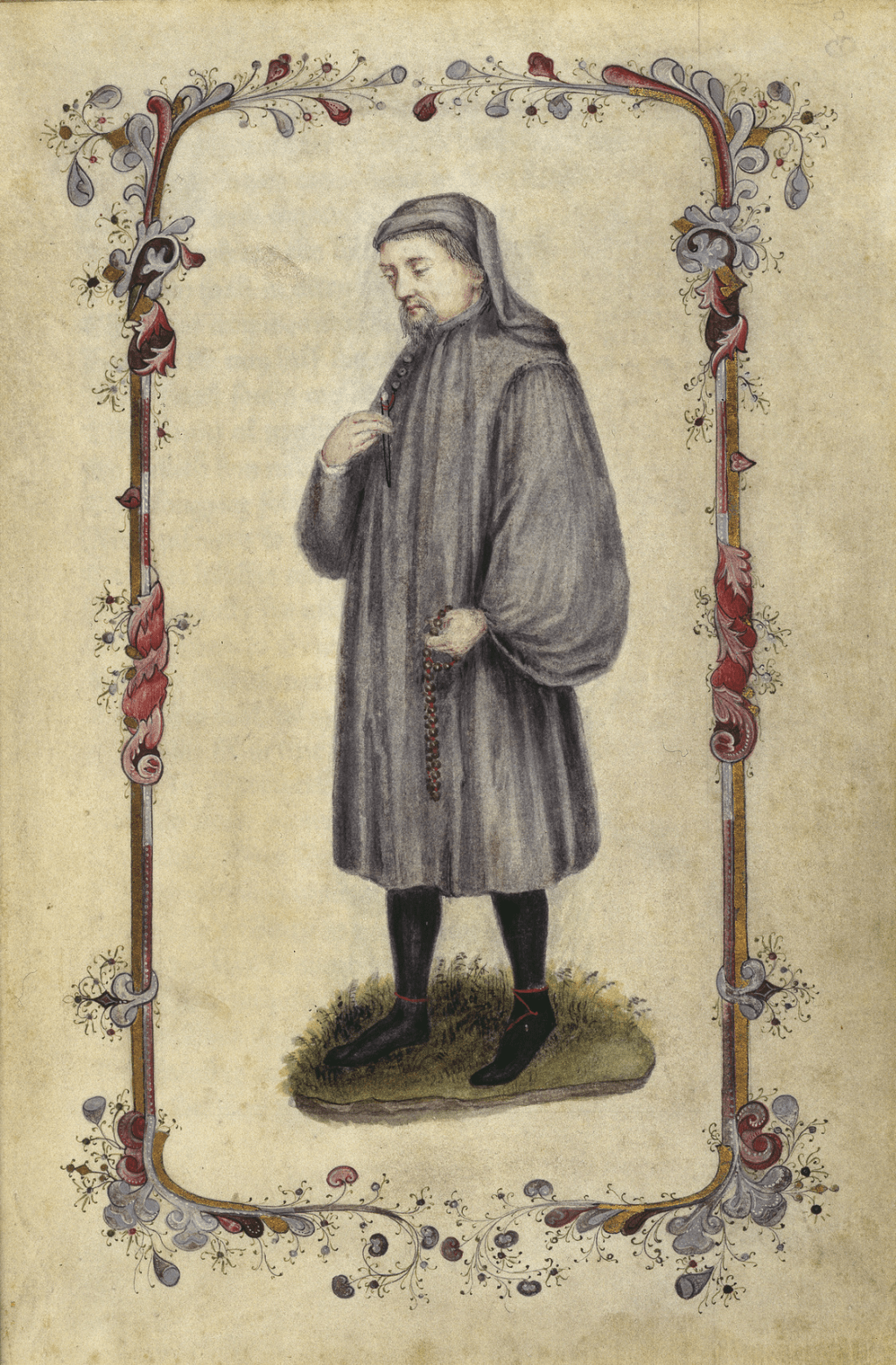
Featured image credit: “Geoffrey Chaucer – Canterbury Tales (1478), frontispiece – BL” is marked with CC0 1.0.
 Retrospect Journal