
Written By: George Purdy
During the twilight years of the waning Ottoman Empire and the early years of Greek independence, the movement of people and ideas across borders influenced the development of Greek nationalism, determining its intellectual expression and political direction in the newly independent state. Transnational intellectual currents, primarily the European Enlightenment and the subsequent rise of neohellenism, forged a strong association between the modern Greek state and its classical past, giving the nationalist movement much of its political legitimacy and momentum. Following the spread of Greek nationalism among leading intellectuals and the political elite, the process of homogenisation caused by the forced movement of people to and from Greece ensured popular support for nationalist politics while also reaffirming its ethno-religious foundations.
Towards the end of the nineteenth century, the circulation of Enlightenment ideas from Western Europe catalysed the intellectual rise of neohellenism, a movement which emphasised the connection between the newly independent Greek state and its classical past. Identifying Ancient Greece as one of the founding sites of Western European civilisation, neohellenists in Greece seized upon the popular sentiment among the Greek population to distance themselves from the “oriental barbarism” of the Ottoman Empire, from which they had recently achieved independence. An influential proponent of this view was Adamantios Korais, who claimed that the Greek nation could only attain the glory of Ancient Greek antiquity through the creation of a Hellenic Republic, privileging its classical heritage over more recent Byzantine and Ottoman influences. He referred to this state as Hellas. The desire to endow independent Greece with the credentials of the imperial Western European states was therefore highly influential among Greek nationalists, distancing Greece from its Ottoman history by emphasising the Hellenic strand of modern Greek identity.
Whilst the spread of Enlightenment thought provided much of the ideological foundation for early Greek nationalism, it was the mass movement of people to and from Greece which redefined modern Greek identity, reaffirming the ethno-religious basis of the movement. A widespread phenomenon during the early twentieth century, the migration of people in the form of several de facto or de jure population exchanges occurred as a result of the collapse of old empires and the redefining of national borders. This often constituted a process of homogenisation in a wider region previously noted for its high level of ethnic, religious, and linguistic diversity. But far the most significant population exchange during this period was the 1923 Population Exchange between Greece and Turkey, occurring as a result of the Treaty of Lausanne, which concluded the Greco-Turkish War of 1919–1922. Displacing both Turkey’s Greek Orthodox communities as well as Greece’s Muslim communities, the religious element of nationalist movements in the region were enshrined, with the Orthodox faith being confirmed as a pillar of Greek nationalism. The political composition of Greek nationalist organisations was also changed during this period of migration, with the left-wing tendencies of ethnic Greek refugees from Anatolia making left-wing nationalists more prominent in nationalist debate. This large influx of Greeks from Asia Minor also brought the native Greek population into direct contact with the military failings of the Greek state and the threat posed by neighbouring Turkey. Anti-Turkish sentiment was henceforth widely espoused among leading Greek nationalists, further aligning the movement with Western political and cultural paradigms. This political stance was further entrenched as successive Turkish governments continued the process of ethnic homogenisation within Turkey. In the aftermath of the Istanbul Pogrom of 1955, expatriated Greeks founded the newspaper O Políti, publishing articles which made their readers familiar with the experiences of persecuted groups in Turkey, such as the Kurds and Armenians. Moving the boundaries of modern Greek identity, Greek nationalism thus became the popular movement of a newly homogenous population, no longer the preserve of an intellectual elite.
As the global bipolar order between communism and capitalism solidified, nationalist movements were greatly influenced by this new socio-political pressure. The ideological rift already developing in Greek nationalism deepened, with communist sympathisers seeking greater autonomy from the mainstream movement. Following the Seventh Congress of the Communist International in 1935, members of the Greek Communist Party (KKE) working in the National Liberation Front against occupation by Axis powers emphasised collectivism in the national community, which they termed laocratia (‘rule by the people’). As communism occupied an increasingly large part of the Greek nationalist movement, the belief that the people’s kratos (‘power’) could forge a new Greece set it apart from more mainstream right-wing nationalists who espoused their belief in a monarchical system of government. This ideological rift deepened in the early years of the Cold War, resulting in the Greek Civil War of 1946–1949, a conflict identified by Odd Arne Westad as an “event that was in origin local… metamorphosing into a manifestation of a global struggle.” Following the victory of the Kingdom of Greece in the Greek Civil War, Communist elements in Greece were purged, reorienting Greek nationalism firmly toward the Western bloc. A product of this change in nationalist trajectory was the ideology of ethnikofrosini (‘national-mindedness’) which targeted left-wing elements in Greece in the same manner employed by anti-communists in the USA and Western Europe. Moreover, to delineate their ideological and cultural separation from the Soviet sphere, Greek nationalists once again drew upon Enlightenment thought, using Greco-Roman tradition to align Greece with the West and juxtapose it with the Communist Bloc. Suppressing the left-wing of Greek nationalism, the Cold War world order narrowed the political scope of the movement, firmly placing it within the Western sphere of influence.
Nationalism is, according to Partha Chatterjee, a problem in the history of political ideas, being both a cultural and political phenomenon. Viewed through this lens, early Greek nationalism, as shaped by Enlightenment values, constituted a cultural phase in the development of the movement, centred on the revival of a Hellenic state. It was the movement of displaced peoples which made Greek nationalism an overtly populist political movement, and the subsequent involvement of this movement in the globalised ideology of the Cold War which entrenched it as the dominant political framework in Greek politics.
Bibliography
Çelebi, Bahadur. Review of Instilling Religion in Greek and Turkish Nationalsim: A Sacred Synthesis, by Ioannis N. Grigoriadis. Southern Eastern Europe 40, 2016.
Chatterjee, Partha. Nationalist Thought and the Colonial World: A Derivative Discourse. Tokyo: United Nations University, 1986.
Grigoriadis, Ioannis N. “Redefining the Nation: Shifting Boundaries of the ‘Other’ in Greece and Turkey.” Middle Eastern Studies 47, no.1 (2011): 167-182.
Halstead, Huw. “Ask the Assyrians, Armenians, Kurds: Transcultural Memory and Nationalism in Greek Historical Discourse on Turkey.” History and Memory 30, no.2 (2018): 3-39.
Kasaba, Resat. Greek and Turkish Nationalism in Formation: Western Anatolia 1919-1922. Florence: European University Institute, 2002.
Katsambekis, Giorgos and Yannis Stavrakakis. “Revisiting the Nationalism/Populism Nexus: Lessons from the Greek Case.” Javnost – The Public 24, no.4, (2017): 39-408.
Papadimitriou, Despina. “Naționalism and communism go global: the ideology of ‘nationally minded’ Greeks in the early Cold War, 1947-1955.” National Identities 24, no.2 (2021): 145-164.
Sofos, Spyros A. and Umut Özkırılı. “Nationalism in Greece and Turkey: Modernity, Enlightenment, Westernisation.” In The Troubled Triangle: Cyprus, Greece and Turkey, edited by A. Aktar et al., 76-97. London: Palgrave Macmillan UK, 2010.
Westad, Odd Arne. The Cold War: A World History. London: Hachette Uk, 2017.
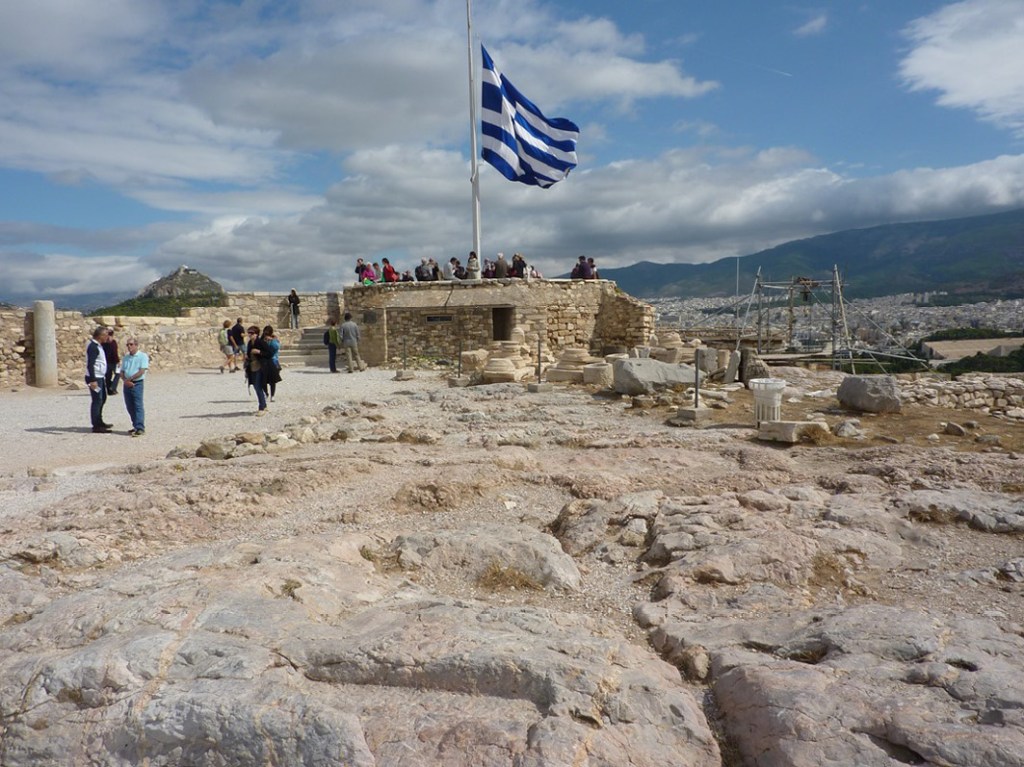
Featured Image Credit: https://www.123rf.com/photo_72082671_parthenon-on-the-acropolis-in-athens-with-greece-flag.html
 Retrospect Journal