
Written By: Harry Fry
South Korea’s Parasite (2019), the first Academy Award winner for Best Picture not in the English language, is conceptualised as a fatal stab into a disciplined, high-class household by the strategic uprising of an impecunious family. While the latter’s project is the darkly comedic crux of the film, dominating the storyline with sensory and violent themes, I argue, against the norm, that the comparative class dynamic is not the cause. Rather, the Kim’s lower-class immorality towards the upper-class Parks is (re)produced in these wealthy characters, invoking all as mutually involved subjects of corruption.
When Kim Ki-woo / “Kevin” fraudulently starts tutoring the Park family’s daughter, he takes advantage of his role as her teacher and eventually forms a romantic relationship with his student. While Kevin initiates physical contact with Park Da-hye under an educative context, telling her to calm her nerves, Da-hye reciprocates this by touching him with no context, resulting in the two kissing. The well-known split screen of the film, where poor and rich are visually divided is broken by Da-hye, a member of the upper class, as she looks directly at Kevin and makes contact while he looks away. This illicit behaviour starts with Kevin and Da-hye, the opening dynamic between rich and poor in the home. It is magnified when all of Kevin’s family have snuck into the home and the seemingly prudent Park parents, Dong-ik and Yeon-gyo, have sex and eroticise drug usage unbeknownst to the Kim family hiding under the dining table. These scenes dismantle the symmetrical segregation of rich and poor on screen, and the inter-corruption of both classes is made possible by the Kim’s entrance into the home but is observable from the Park’s own performances.
The Park’s youngest son, Da-song, notices that the helpers in his home, which is secretly the entire Kim family, have a distinctive scent. Yet, given Da-song moves closer to the helpers and almost touches them, he defines the smell as not explicitly negative but intriguing. On the other hand, the Park parents cannot resist squeezing their noses to dismiss it, meaning their prejudice is conceptualised only by the presence of the Kim family in their lives. The Park’s home is epitomised as a place of shelter and stability, not only allowing the Kim family to avoid their basement home’s flooding, but causing the hysterical, former housekeeper to be ignominiously soaked by the rain and thus destitute from the Park’s dismissal. Her disposition and the Kims’ subsequent homelessness when returning home prescribes their trickery of the Parks’ at once as a comic pursuit and as a higher necessity. In this way, the corrupted decision of the Kims’ is not severed from the Park’s but resulting from the latter’s late capitalist excess.
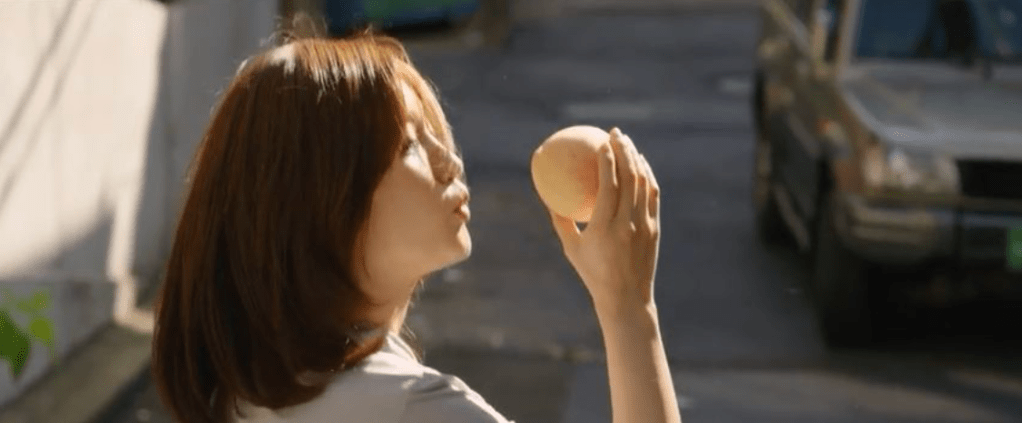
The Park’s high-class home is geometrically immaculate and minimalist, a spatial order that is intruded upon by the colour red. In the contemporary context of Hell Joseon, a grieving expostulation of wealth inequality, the redness which ripens like a parasite emblematises the Hell of modern Joseon. In his first art lesson from the Kim’s daughter, Ki-jung / “Jessica”, Da-song paints his quintessential figure, which visually matches the film’s conclusive killer living under the Park’s basement. This signalling to the final horror in Parasite is developed through the hot sauce packet, which Kim Ki-taek, the Kim patriarch, pretends is blood, and the red-tinged peach which sets off the former housekeeper’s allergies. These moments are a dark play on seemingly uninvolved goods but are only reacted to with shock by the elite family’s mother, Yeon-gyo. The impeding violence, spotted by the Park family, is therefore legitimised by elite affective responses. When the basement is discovered and the former housewife opens it by mobilising her body sideways, the Park’s home similarly becomes a viable site for the impeding hell to commence. Accordingly, the red iconography is mobilised up the inaccessible, steep hill of the Park’s home and by their satirically melodramatic emotions; this Hell Joseon subtext, from the vantage point of the wealthy, is made corrupt.
While these subtexts of colours, scents, and space do not deny the imbalance between the wealthy Park’s and the struggling Kim’s, they redistribute these breakdowns of order as a paradoxical class struggle which instead becomes symptomatic of a more implicit form of corruption. Orchestrating a spectacle of excess, the parasite is not elite hegemony nor the Kim’s intrusion, but their repeated coaction.
Bibliography
Bean, T., 2020. “Capitalism Gone Wild: The Ending of ‘Parasite’ Explained”, Forbes.
Bong J., 2019. Parasite, CJ Entertainment.
Brzeski, Patrick., 2019. “Making of ‘Parasite’: How Bong Joon Ho’s Real Life Inspired a Plot-Twisty Tale of Rich vs. Poor”, The Hollywood Reporter.
Kim, Y., 2017. Hell Joseon: “Polarization and contention in a neo-liberal age”, in Korea’s Quest for Economic Democratization: Globalization, Polarization and Contention. Palgrave: Basingstoke.
Tjahja, L., 2023. “Parasite: Spatial Dynamics created through Architecture and Film”, Cicada Creative Magazine, < https://cicadacreativemag.com/blog/parasite/>.
Featured Image Credit: https://asianwiki.com/Parasite_%28Korean_Movie%29
 Retrospect Journal