
Written By: Emiley Beasley
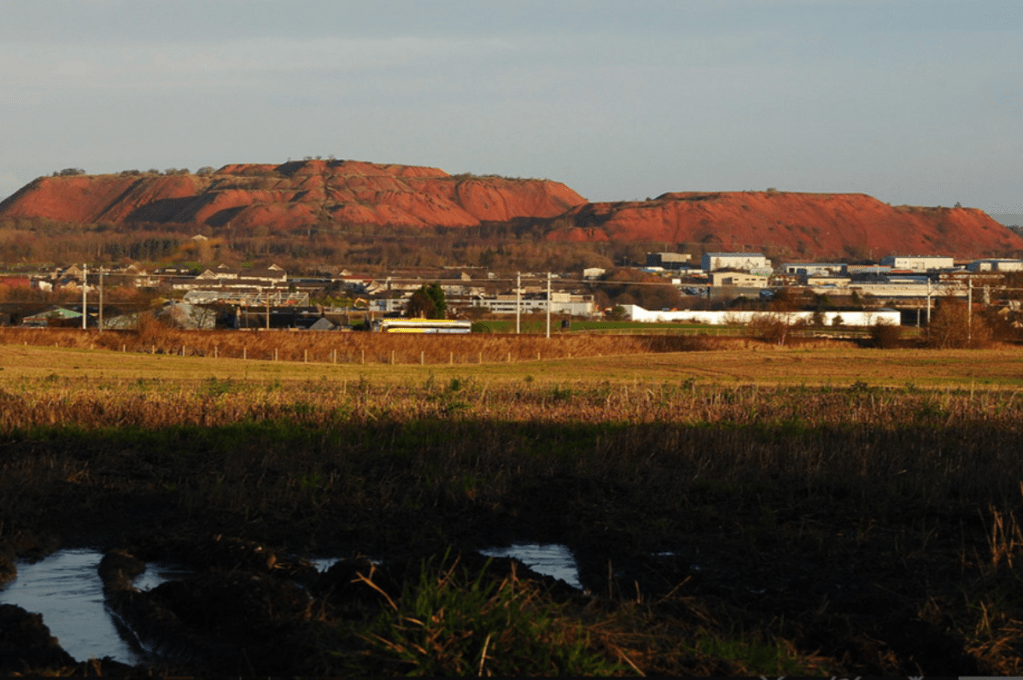
If you have ever been on the train from Edinburgh through to Glasgow, you may have looked out of the window and noticed a massive red hill dominating the landscape to the north of the town of Broxburn. You would be forgiven for thinking this red hill is a mesa with its enormous scale, flat top, and curious red colour. However, this red hill is not a mesa, but rather the Greendykes Shale Bing.
Greendykes is the largest shale bing in West Lothian and is a prominent reminder of the area’s industrial past. James ‘Paraffin’ Young developed the process of extracting oil from shale and thus began the world’s first oil boom a short distance away from Greendykes in the town of Bathgate.
Shale is a naturally occurring rock, and mines were set up all over West Lothian and beyond to extract shale from the earth, and it would then undergo a process of heating to extract the natural oils from the shale. This oil was then refined and use for purposes such as paraffin oil for lamps (hence the James ‘Paraffin’ Young!) and making soap and candles.
Oil is used throughout our everyday lives from our cars to our phones and plastics. Traces of the oil industry can be found everywhere, and enormous shale bings like Greendykes are a monumental testament to the industry that brought us the modern world.
The shale bings themselves are entirely made of the waste product from the extraction process of the shale oil. The Broxburn Oil Company responsible for the Greendykes bing was active from the 1860s–1940s. The Greendykes bing is an incredibly dominating feature in the landscape and its size rivals many of the nearby hills. This magnitude of shale waste in this time period is witness to the importance of the shale mining industry, the quick explosion in the need for oil, and the revolutionary changes that it brought with it.
Although shale bings are often seen as something unsightly, piles of waste scarring the landscape, they are also historic monuments that reflect a time of rapid change. They are the remaining monuments of the shale mining industry, standing long after the shale works have disappeared and the mines shut down, long after the miners and their descendants have moved on to new paths. These industrial mountains of waste are the remnants of an industry that changed the world.
Bibliography
‘Greendykes Bing complex between Broxburn and Winchburgh’, West Lothian Council: https://www.westlothian.gov.uk/article/39598/7-Greendykes-Bing-complex-between-Broxburn-and-Winchburgh (accessed 17/10/2025)
‘Greendykes shale bing Broxburn’, Historic Environment Scotland: https://portal.historicenvironment.scot/apex/f?p=1505:300:::::VIEWTYPE,VIEWREF:designation,SM6186 (accessed 17/10/2025)
Scottish shale: https://www.scottishshale.co.uk/ (accessed 17/10/2025)
‘The Bing’s the thing’, Shale Trail: https://shaletrail.co.uk/kids-shale-trail/bings-thing/ (accessed 17/10/2025)
Featured Image Credit: https://www.flickr.com/photos/8899981@N05/12272821076/
 Retrospect Journal