
Written by Tara Laize
The reign of Constantine, from 306 to 337, marked a fundamental rupture in the history of the Roman Empire and the Mediterranean world. As the first emperor to convert to Christianity, he transformed a persecuted religion into an institutional force at the heart of the imperial apparatus. His religious choices, often interpreted as a blend of personal faith and political pragmatism, had a significant impact on the structure of the state, the relationship between power and religion, and Roman culture. By institutionalising Christian privileges while navigating a gradual decline of pagan traditions, Constantine set the stage for the Roman Empire’s transformation into a Christian state. However, the motivations behind his religious choices and their implications are the centre of complex debates among historians.
This essay explores how Constantine’s religious choices influenced his policies and had profound and lasting consequences for the Roman Empire. First, it examines the salient elements of his conversion and his dual religious identity, combining pagan tradition and Christian faith. Second, it analyses the political innovations he implemented, such as the Edict of Milan, the integration of the Church into state structures, and legislative reforms inspired by Christian values. Finally, it considers the long-term transformations he engendered, including the Christianization of the Empire, cultural and institutional changes, and the criticisms and tensions that his legacy aroused. This essay aims to demonstrate that Constantine, while reconciling faith and pragmatism, shaped not only a Christian Empire but also the foundations of the complex relationships between religious and political power that would mark medieval Europe.
The Battle of the Milvian Bridge in 312, an event Eusebius presented as a decisive divine manifestation, is traditionally associated with Constantine’s conversion. According to his Vita Constantini (4th century AD), Constantine had a vision of the Chi-Rho symbol accompanied by the words, “By this sign you will conquer” (“In hoc signo vinces”). This revelation led him to embrace Christianity. Lactantius, in his De Mortibus Persecutorum (c. AD 316), reports that this symbol was later painted on his soldiers’ shields, illustrating the immediate influence of this vision on his military and political strategy.
However, the interpretation of this event remains controversial. Harold Allen Drake argues that this conversion should not be seen solely as a spiritual act but also as a pragmatic move to strengthen the Empire’s unity amid internal divisions. Drake claims that Constantine, in integrating Christianity, sought to build a “viable coalition around a policy of broad inclusion”. This pragmatic approach is reinforced by the fact that Constantine did not immediately abandon pagan practices, choosing to preserve a balance between Roman traditions and the rise of Christianity.
Despite his conversion, Constantine continued to claim the title of Pontifex Maximus, head of the pagan cults, a crucial symbolic role in ensuring imperial continuity. This duality reflects a complex political strategy: on the one hand, he sought to integrate Christianity into the Empire’s structures, and on the other, he avoided a sudden break with the pagan elites who constituted a large part of his administration. In his Vita Constantini, Eusebius presents Constantine as a divinely chosen ruler — a “servant of God” — charged with uniting the empire around the Christian faith. However, Singh qualifies this view by arguing that Constantine used Christianity to redefine his imperial authority without abandoning the symbolic practices that bound the emperor to the traditional Roman order. While sometimes seen as a contradiction, this dual identity was essential in managing the empire’s transition to a new religious era.
Constantine’s religious choices translated into political and legislative reforms that reorganised the relationships between state, religion, and society. The Edict of Milan, promulgated jointly by Constantine and Licinius in 313, constitutes one of the significant milestones in Constantine’s religious policy. This historic text officially legalised Christianity, guaranteeing freedom of worship to all religions in the Empire and ordering the restitution of property confiscated from Christians during the persecution under Diocletian; however, it aimed to promote Christianity and pacify an empire marked by religious divisions. Harold Allen Drake points out that the Edict of Milan testifies to Constantine’s inclusive approach, which sought to establish religious harmony through official toleration. This toleration, however, did not preclude a more favourable policy for Christianity, as evidenced by the imperial funds allocated to reconstruct destroyed churches. Mark Humphries also highlights the ambiguity of this mandate, which combined a rhetoric of religious pluralism with an implicit preference for Christianity.
Constantine transformed the Church into an extension of imperial authority by financially supporting the clergy and granting bishops an administrative role. The episcopal audience, a tribunal for civil disputes, illustrates this rapprochement. Kate Cooper explains that this institution reinforced the place of bishops as mediating figures, consolidating their authority in spheres previously reserved for magistrates. The Council of Nicaea (AD 325) marks another decisive turning point in this relationship. Convinced of the importance of doctrinal unity for the stability of the Empire, Constantine convened this council to resolve the Arian controversy and establish the foundations of Christian orthodoxy. Eusebius describes this event as a manifestation of Constantine’s divine mission. However, Singh considers this view by emphasising that Constantine was “not merely as a Christian convert but as a chosen instrument of God, shaping both Church and Empire.” The influence of Christianity on Constantine’s legislative reforms was particularly marked in law and public morality. He decreed Sunday rest, strengthened laws prohibiting pagan sacrifices, and promoted charity, such as aid to the poor and orphans. These reforms, although gradual, reflected a clear desire to shape society in accordance with Christian principles.
Constantine’s religious and political reforms had lasting repercussions, redefining the structure and identity of the Roman Empire. By establishing a close relationship between Christianity and imperial power, Constantine initiated a profound transformation that marked the history of Late Antiquity and beyond. One of the most significant consequences of Constantine’s policies was the rise of Christianity as the dominant religion. Although his reign did not result in the immediate eradication of pagan cults, it created an institutional framework that allowed Christianity to flourish. The Edict of Milan (AD 313) legitimised this transition, while policies favouring the Church gradually marginalised paganism. Daniel Paradis argues that the process of Christianisation was not simply an imperial imposition but a cultural hybridisation, in which Christian and Roman traditions blended to form a new imperial identity. By strengthening the role of bishops and subsidising the construction of places of worship, such as St. Peter’s Basilica in Rome, Constantine institutionalised Christianity and facilitated its spread throughout the empire. However, as Barnes points out, this process varied considerably by region: more stringent policies were implemented in the East after he consolidated power in AD 324.
Constantine’s reforms also changed the empire’s cultural and social norms. Christian values gradually influenced laws, education, and artistic practices. Drake emphasises that these changes aimed to reshape society in accordance with the principles of Christianity while maintaining continuity with Roman heritage. In addition, the Church established itself as a key player in social affairs. Bishops played a central role in redistributing wealth and caring for the poor, thereby reinforcing their moral and political legitimacy. Cooper explains that this development transformed traditional social hierarchies, giving rise to a new Christian elite. This social transformation is a testament to Christianity’s long-term redefinition of power structures.
Constantine’s reforms redefined the relationship between state and religion, creating a model in which temporal and spiritual power were closely linked. Constantine consolidated its role as a pillar of imperial authority by granting the Church economic and legal privileges. However, this increased centralisation also created new tensions. Singh analyses this development by emphasising that the fusion of the political and religious spheres under Constantine laid the foundations for a model of imperial authority that would influence medieval monarchies. However, this integration was not without conflict. Theological controversies, such as Arianism and repression, were exacerbated by imperial involvement in doctrinal matters.
Praised by some as a visionary ruler who led the Roman Empire into a new Christian era, he is criticised by others for his pragmatic and sometimes authoritarian management of religious affairs.
Interpretations of Constantine vary considerably across sources. In his Vita Constantini, Eusebius portrays him as a divinely chosen ruler, an “instrument of God” destined to guide the empire toward religious unity. This hagiographic representation has long dominated accounts of his reign. Eusebius presents him as a “new apostle,” a model of a Christian emperor.
However, modern historians, such as Harold Allen Drake and Timothy Barnes, take a more critical approach. Drake emphasises Constantine’s pragmatism, which he used as a political tool to consolidate his authority. On the other hand, Barnes notes that regional and strategic considerations often dictated Constantine’s decisions. Other critics, such as Singh, highlight Constantine’s ambiguities, including his retention of pagan titles and practices despite his open support for Christianity. This duality, far from discrediting his reign, reflects a strategy aimed at avoiding a sudden break with the pagan elite of the Empire.
Despite Constantine’s stated intentions, his reforms had complex side effects, some of which were contrary to his initial goals. The Council of Nicaea (AD 325) exacerbated doctrinal tensions within the Church. Singh points out that imperial involvement in theological debates often reinforced divisions. Furthermore, granting economic and social privileges to the Church transformed it into a rival institution to the state. Kate Cooper explains that the growing role of bishops in judicial and administrative affairs sometimes led to conflicts with imperial authorities. Finally, the gradual repression of paganism, begun under Constantine and continued by his successors, marked the end of the religious plurality that had long characterised the empire. While this transition allowed Christianity to become dominant, it also provoked resistance.
In conclusion, Constantine’s reign marked a significant rupture in the history of the Roman Empire, initiating a profound transition to a Christian empire. His religious choices, combining personal faith with political pragmatism, not only transformed Christianity into an institutional force but also redefined the relationship between religion and power. Through policies such as the Edict of Milan and the Council of Nicaea, Constantine integrated Christianity into the structures of the state while maintaining a degree of continuity with pagan traditions, illustrating a balancing strategy amid complex transition. The long-term consequences of his reforms were considerable: the Christianization of the empire, social and cultural transformations, and the emergence of a new relationship between spiritual and temporal power had a lasting influence on medieval Europe. However, these changes also generated tensions, including doctrinal divisions and conflicts between church and state, revealing the limits and ambiguities of his legacy. Constantine thus embodies both a figure of rupture and continuity. In this respect, his reign cannot be reduced to a dichotomy between faith and pragmatism. Still, it must be understood as a complex interplay between personal vision, political strategy, and historical transformation.
Bibliography
Barnes, T.D. Constantine and Eusebius. Cambridge, MA: Harvard University Press, 1981.
Barnes, T.D. The New Empire of Diocletian and Constantine. Cambridge, MA: Harvard University Press, 1982.
Barnes, T.D. “From Toleration to Repression: The Evolution of Constantine’s Religious Policies.” Journal of Late Antiquity 1, no. 1 (2001): 22–33.
Barnes, T.D. “Monotheists All?” Phoenix 55 (2001): 142–162.
Cooper, K. “Christianity, Private Power, and the Law from Decius to Constantine: The Minimalist View.” Journal of Early Christian Studies 19 (2011): 327–343.
Cooper, K. “The Long Shadow of Constantine.” Journal of Roman Studies 104 (2014): 226–238.
Drake, H.A. Constantine and the Bishops: The Politics of Intolerance. Baltimore: Johns Hopkins University Press, 2000.
Drake, H.A. The Impact of Constantine on Christianity. Cambridge: Cambridge University Press, 2013.
Elliott, T.G. The Christianity of Constantine the Great. Scranton, PA: University of Scranton Press, 1996.
Flower, R. “Visions of Constantine.” Journal of Roman Studies 102 (2012): 287–305.
Humphries, Mark. Constantine, Christianity, and Rome. Oxford: Oxford University Press, 2012.
Leadbetter, W. “From Constantine to Theodosius (and Beyond).” In The Early Christian World, edited by P.F. Esler, 258–292. London: Routledge, 2004.
Liebeschuetz, J.H.W.G. Continuity and Change in Roman Religion. Oxford: Oxford University Press, 1979.
MacMullen, R. Christianizing the Roman Empire. New Haven: Yale University Press, 1984.
Paradis, Daniel. The Christianization of the Roman Empire Under Constantine. PhD diss., University of Toronto, 2018.
Singh, Devin. “Eusebius as Political Theologian: The Legend Continues.” Harvard Theological Review 108 (2015): 129–154.
Singh, Devin. Eusebius as Political Theologian: The Legend Continues. In Rulers and Religion in Ancient Rome, edited by Barbara Volker. New York: Routledge, 2009.
T.D. Barnes. “Monotheists All?” Journal of Late Antiquity 2, no. 2 (2009): 223–42.
Peter Brown. The World of Late Antiquity: AD 150-750. London: Thames & Hudson, 1971.
Alan Cameron. The Last Pagans of Rome. Oxford: Oxford University Press, 2011.
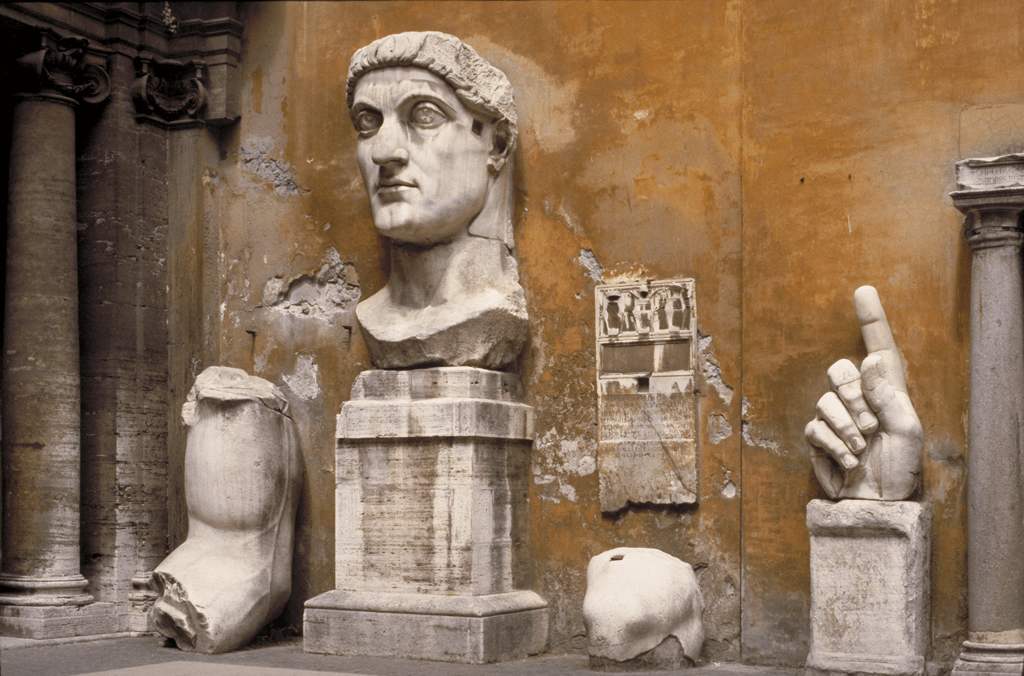
Featured image credit: “Emperor Constantine, head and fragments from a colossal statue” by MCAD Library is licensed under CC BY 2.0.
 Retrospect Journal